
The JPMorgan Chase headquarters at 270 Park takes the city skyline into new territory with dynamic LED lights.
By Nicholas Mancall-Bitel
Visuals by Karsten Moran
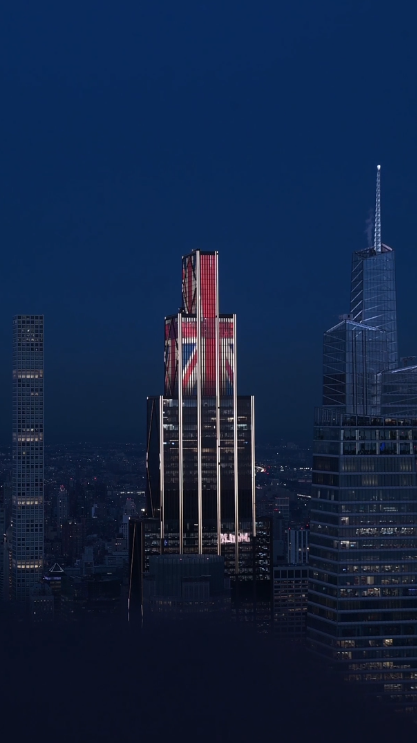
New York City’s skyline has changed once again. In October, JPMorgan Chase opened the city’s latest supertall skyscraper at 270 Park Avenue, which joined a handful of buildings looming above 300 meters (984 feet). The new construction stands out, even among its lofty peers: The top of the 1,388-foot building is cloaked in LED lights, visible from across the boroughs like a gargantuan lighthouse.
“If you’re looking at the New York City skyline, it looks totally out of place,” said Lucas Salgado, who can see 270 Park from his apartment in Long Island City, Queens. “I wouldn’t call it an eyesore. It just looks very different.”
Sometimes the lights are static, but usually they move, introducing motion into a largely still skyline. On July 4, Sept. 11 and Veterans Day, they showed a gently rippling American flag. For a party in November honoring King Charles III (who did not attend), the building displayed the Union Jack. The company says it has not finalized the concepts and schedule for these special “vignettes.”

Most of the time, the lights show “Celestial Passage,” a display of sparkling geometric patterns that resembles a screen saver seen through a glass of champagne. The artist Leo Villareal, responsible for large-scale pieces like the lights on the Bay Bridge connecting San Francisco and Oakland, programmed the work in collaboration with Tillotson Design Associates, a lighting design consultancy, and Foster + Partners, the architecture firm that designed the building.
Over the last 30 years, LEDs have become more complex, efficient and affordable, making them much easier to use on building exteriors. Light shows play on the sides of the Sphere in Las Vegas, the Eiffel Tower in Paris, the Burj Khalifa in Dubai and the Oriental Pearl Tower in Shanghai. New York had remained a holdout to grand outdoor light shows — until now.
“Our goal is to tastefully enhance the skyline with public art,” JPMorgan Chase said in a statement. “The lighting is part of the building’s design from the start, not an afterthought. It is not a jumbotron.”
In 2017, the City Council passed a Midtown East rezoning plan, which incentivized companies and developers to construct new office space by lowering barriers to replacing old buildings and expanding limits on floor space.
JPMorgan Chase took it as an opportunity to replace its old headquarters, the Union Carbide building, which was designed by Natalie de Blois of Skidmore, Owings and Merrill; the elegant midcentury glass box, praised in 1960 by The New York Times architecture critic Ada Louise Huxtable, was never designated a landmark, much to admirers’ chagrin. JPMorgan Chase purchased air rights above Grand Central Terminal to make the new 270 Park much larger.
Norman Foster, the architect responsible for constructing the imposing HSBC headquarters in Hong Kong in 1986, designed the new skyscraper, which reportedly cost $3 billion. (JPMorgan Chase declined to confirm the building’s total cost.) The company hopes to relocate 10,000 employees into the 60-story building by the end of the year, making the structure the linchpin of its back-to-office campaign.
According to the company, anyone inside the building’s upper tiers, a mixture of event spaces and mechanical floors, cannot see the facade lights, which are shielded from shining inside. But they’re quite clear across the East River to residents of Brooklyn and Queens.
“It’s beautiful obviously,” said Ruben Vaidya, who was out for a walk in Queens’ Gantry Plaza State Park on a recent evening. “It stands out. There’s more lights on that building than any other.”
“I love the classic New York skyline. Sometimes I’m saddened by some of the new, skinny, tall additions,” said Allison Holt, who can see the building when she walks in the park with her dog. “It is pretty when it’s lit up. I don’t notice it during the day. It’s just another tall building.”
New Yorkers have aired their opinions on the building on Reddit, where some celebrate it as “the most iconic supertall skyscraper of this decade,” while others say it “defaced the skyline,” complain about the brightness of the lights and bemoan the digital lights.
From the vantage point of Times Square, the building is just one of a sea of lights.
“We have a saying: One man’s glare is another man’s glitter,” said Charles G. Stone II, a founder at Fisher Marantz Stone, a lighting design firm known for the Sept. 11 “Tribute in Light” memorial.
Some of New York’s most recognizable buildings shine, from classics like the Chrysler Building to recent additions like One Vanderbilt. In 2012, the Empire State Building upgraded to LEDs from floodlights to project more effects on its spire honoring holidays and sports teams.
Still, 270 Park represents a significant technical advancement. “This is somewhat new for New York to have this level of intensity, changes in pattern, changes in color,” said Linnaea Tillett, the owner and principal of Tillett Lighting Associates, a lighting design firm that has worked on outdoor projects across the city.
According to JPMorgan Chase, 270 Park’s crown has lights that face both outward, toward residents, and inward, toward the facade, to create a unique, double-layer optical effect. Mr. Villareal creates the animations for “Celestial Passage” with proprietary software, according to the company, producing an “ever-changing and ever-evolving illumination.”
JPMorgan Chase said it has no plans to use the lights to display company branding or product advertising, which municipal codes prohibit. But, like the flashing, ever-changing ads of Times Square billboards, the elements of random movement in “Celestial Passage” are captivating to the eye.
“It’s an artwork,” Ms. Tillett said. But compared with the lights atop the Empire State Building, she said, “it relates more to how we use our phones and see constantly shifting images.”
The building also enters the city at a moment of debate over access to dark skies. Satellite imagery shows that Midtown East is one of the few Manhattan neighborhoods where light pollution is increasing. Studies have shown light pollution at night negatively affects migrating birds, pollinators and other species, including humans, stressing people’s circadian rhythms and mental health.
“Lighting our built environment at night is a joyful expression of our humanity,” Mr. Stone said. “However, darkness is critical to human health. We can find the balance.”
Per regulations under the city’s Department of Buildings, 270 Park must shut off its exterior lights at midnight, and JPMorgan Chase said it had worked with sustainability and lighting experts to minimize the lights’ effect. But even before 270 Park, advocates at organizations like DarkSky International were pushing for stricter legislation to limit light pollution.
“For DarkSky International, our definition of light pollution is human-made alteration of outdoor light levels from those occurring naturally, so any outdoor light basically is light pollution,” said Ruoyu Li, an organizer with DarkSky’s New York chapter. He said the organization doesn’t oppose all lights at night, but instead lobbies for responsible use. “We just want to make sure all the lights are necessary,” he said, adding that the lights on 270 Park “are just not necessary at all.”
Park Avenue may welcome more supertall skyscrapers in the next decade: 175 Park, designed by Skidmore, Owings and Merrill, and 350 Park Avenue, designed by Foster + Partners, would both dwarf 270 Park if they’re completed to their proposed specifications. The completion of 270 Park also marks the start of JPMorgan Chase’s renovation at its old, temporary home at 383 Madison Avenue across the street. The company declined to comment on whether facade lighting would be involved in that project.
“The thing about New York is the tips of the buildings are lit,” Ms. Tillett said. “That’s what we’re known for. Whether one considers it beautiful or vulgar, it’s part of New York’s identity.”