
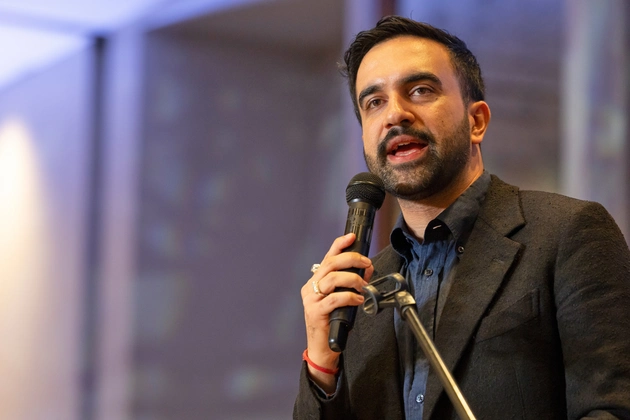
The mayor-elect was unsuccessful in slowing down the race to pick his governing counterpart in the NYC Council.
By Joe Anuta
NEW YORK — Days after his November win, mayor-elect Zohran Mamdani made a quiet attempt to slow the internal race for New York City Council speaker. It set into motion one of the first tests of his political muscle — and it did not end well.
Mamdani and his team, fresh off his landslide victory over former Gov. Andrew Cuomo, asked unions, county party organizations and several Council members to hold off on backing a candidate for the chamber’s top leadership role while he assessed the field, according to half a dozen people familiar with the conversations.
The mayor-elect’s team then doubled down on that message weeks later as they began to explore options for potentially influencing the race. Those efforts — muddled and late — were ultimately unsuccessful.
Months of behind-the-scenes dealmaking among the city’s lawmakers and power brokers ended abruptly when Council Member Julie Menin declared victory with a supermajority of support.
The episode has prompted political insiders to question how Mamdani will navigate the relationships that will shape his agenda at City Hall and in the state Capitol — where his most ambitious and expensive proposals will require cooperation he has not yet nailed down.
Allies of the former state lawmaker say the moment reflected timing, triage and prudence after a hard-fought general election; critics say it showed an incoming administration still adjusting from movement politics to the transactional, often unforgiving negotiations that define governing in New York.
“Zohran’s team is obviously gifted and sharp but not when it comes to political maneuvering and backroom scheming,” said one Democratic consultant who followed the race closely and was granted anonymity to discuss the soon-to-be mayor. “His team comes from the outsider advocacy world, and these are two wholly different animal breeds.”
Mamdani’s team and some political experts brushed off the speaker’s race saga, saying the lax involvement was a function of several realities: The democratic socialist had to run a more competitive general election than most Democratic nominees, allowing less time to worry about the Council. His affordability agenda is also far more dependent on the state government, requiring less focus on City lawmakers, they said. And exerting any palpable influence would have required a tremendous amount of political capital for an uncertain and nebulous payoff — because even speakers initially aligned with the mayor eventually go rogue.
“Getting involved in the race is a trap. It does not work,” said Chris Coffey, a longtime political consultant and chief executive of Tusk Strategies. “This to me is a show of strength.”
The 51-member City Council and its speaker are two of the biggest checks on a mayor — and they have bedeviled past denizens of Gracie Mansion.
The annual budget and major rezonings must be approved by a majority of the body. Lawmakers can drag agency heads into oversight hearings that can expose operational shortcomings and generate cycles of damaging headlines. And the Council can subpoena the administration, force agencies to enact policies, override mayoral vetoes and file lawsuits against the city’s executive branch. Speakers themselves also enjoy a prominent bully pulpit.
Previous mayors felt that acutely. Eric Adams and Bill de Blasio, recognizing how a Council speaker can make life difficult for the city’s executive, both sought to intervene on behalf of their favored candidate — with vastly different results.
Mamdani appeared cognizant of this dynamic days after the election at an annual political conference in San Juan where, every four years, the new mayor and the race for Council speaker dominate poolside conversations and chatter in hotel bars.
At the time, two leading competitors had emerged: Menin, a Democrat representing the Upper East Side who was perceived as more of a check on the Mamdani administration and who had been assiduously laying the groundwork for her campaign; and Council Member Crystal Hudson, a Brooklyn lawmaker whose backing was concentrated in the body’s progressive wing, where members tended to be more supportive of Mamdani’s candidacy.
During the SOMOS Conference in Puerto Rico, Mamdani met with power brokers including leaders from borough Democratic parties and labor unions including service workers union 32BJ and the Hotel and Gaming Trades Council to ask for a favor, according to five people familiar with the interactions who were granted anonymity because they were not authorized to discuss private conversations.
While some of the organizations had already expressed support for Menin, Mamdani asked them to hold off on making any final decisions, giving him and his team time to fully absorb the contours of the race and what, if anything, they might want to do before members voted to pick their next leader on Jan. 7.
Over the course of the next several weeks, as Menin and Hudson attempted to shore up a winning coalition, Mamdani’s team reached out to members with a similar message, according to the five people. And in some cases, Mamdani’s team urged them to hold off on expressing official support for Menin, according to a sixth person with direct knowledge of the overtures.
As the outreach began to ramp up ahead of the Thanksgiving holiday, Mamdani’s team also began mulling potential avenues to influence the race, such as talking to some of the power brokers with sway over members, according to one of the people who spoke with POLITICO, along with another who confirmed the explorations.
Yet while Mamdani was widely assumed to support Hudson, neither he nor his team ever clearly articulated their desired outcome. And eventually, the labor unions, Democratic poobahs and Council members supporting Menin made their move without him.
On the Tuesday before Thanksgiving, Menin’s coalition gathered in the office of Rep. Greg Meeks, a Queens Democrat, to draft a press release listing members supportive of her candidacy — an effort that lasted well past midnight, according to one person involved.
By the following day, Menin went public with a supermajority of members pledging to vote for her along with support from organized labor organizations 32BJ, HTC, the NYC District Council of Carpenters and the United Federation of Teachers.
The impact on Mamdani’s mayoralty remains to be seen.
Following her win, Menin struck a collaborative tone in an interview with POLITICO, indicating she and Mamdani were largely aligned on priorities to make the city more affordable.
Mamdani’s team did the same in response to questions about the mayor-elect’s role in the speaker’s race.
“We are looking forward to working with incoming Speaker Menin to get the affordability agenda done,” spokesperson Dora Pekec said in a statement. “That’s the most important thing, and we know we have alignment on that issue.”
During the campaign, Menin had pledged to use the Council’s subpoena power — a tactic that could be deployed against Mamdani’s administration — though she has said publicly she wants to target corporations. And Menin reportedly told members she would take a close look at Mamdani’s plans to create a Department of Community Safety before supporting it.
Regardless of how the dynamic plays out, political observers said Mamdani will need to step up his intergovernmental affairs game if he wants to have a successful working relationship with the Council and the state Senate and Assembly in Albany, which requires flexing many of the same muscles used in the speaker’s race.
Backchanneling with elected officials — striking deals with allies and enemies and building coalitions — is an essential but far less visible part of governing, which is why City Hall maintains an entire intergovernmental affairs division tasked with nurturing relationships with lawmakers at every level of government.
For de Blasio and Adams, how they handled the speaker’s race provided a preview of their performance in office: de Blasio’s team went all-in to help push Melissa Mark-Viverito to victory in 2013, and the former mayor’s IGA department became a nerve center of his subsequent government. Adams’ team bungled their push for an unsuccessful candidate in 2021 and had an acrimonious relationship with Speaker Adrienne Adams (no relation) for four years after the fact.
A person close to Mamdani’s transition argued the mayor-elect should not be compared to de Blasio or Adams for a race the mayor-elect opted against fully engaging in: At some point between SOMOS and Menin’s victory, the team decided it could work with Menin and that opposing her was not worth the required political capital. In part, the person said, that was because throughout the primary and general election Mamdani was able to elevate affordability to such prominence that it has become a shared priority for not only the incoming Council speaker, but Gov. Kathy Hochul.
Still, advisers to the mayor-elect had been split over whether to get involved in the race, according to two of the people with insight into Mamdani’s operations. These people said no such ambivalence will be present once the new administration begins to fight for its agenda in the New Year.
“Given the protracted race from the primary contest through a tough general election and then moving straight into the transition while having to figure out whether the president of the United States would send in ground forces — all of that was about 10,000 times more important than the speaker’s contest,” one person familiar with the mayor-elect’s thinking said. “If it was muddled, it was because it never rose to the level of an actual priority for Zohran for all of those reasons. And I think he actually showed remarkable maturity not to do what Adams did.”