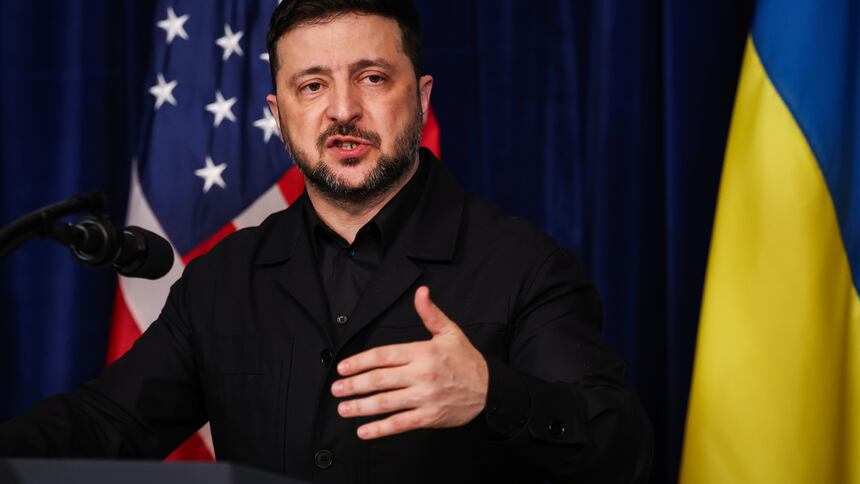
U.S. President Donald Trump and Ukrainian President Volodymyr Zelenskyy expressed optimism after meeting in Florida on Sunday for talks aimed at ending the war between Russia and Ukraine. However, both acknowledged that thorny issues, including territory disputes, remain.
Details of the security guarantees have not become public, but Zelenskyy said Monday that they include how a peace deal would be monitored, as well as the "presence" of partners. He didn't elaborate, but Russia has said it won't accept the deployment in Ukraine of troops from NATO countries.
As indications suggest, negotiations could come to a head in January, before the fourth anniversary of Russia's full-blown invasion of Ukraine on Feb. 24, 2022. Russian President Vladimir Putin on Monday claimed that Russian troops are advancing in the eastern Donetsk region of Ukraine and are also pressing their offensive in the southern Zaporizhzhia region.
Putin has sought to portray himself as negotiating from a position of strength as Ukrainian forces strain to keep back the bigger Russian army.
He also emphasized at a meeting with senior military officers the need to create military buffer zones along the Russian border.
"This is a very important task as it ensures the security of Russia's border regions," he said.
In a televised meeting with Putin and other top military officials, Gen. Valery Gerasimov, the chief of Russia's General Staff, said that Russian forces in 2025 had captured 6,460 square kilometres of territory in Ukraine, including 334 villages.
Reuters could not independently verify the battlefield reports.
Kremlin spokesperson Dmitry Peskov said Monday that Putin and Trump were expected to speak in the near future, but there was no indication the Russian leader would speak to Zelenskyy.
French President Emmanuel Macron said Kyiv's allies will meet in Paris in early January to "finalize each country's concrete contributions" to the security guarantees.
Trump said he would consider extending U.S. security guarantees for Ukraine beyond 15 years, according to Zelenskyy. The guarantees would be approved by the U.S. Congress, as well as by parliaments in other countries involved in overseeing any settlement, he said.
Zelenskyy said he wants the 20-point peace plan under discussion to be approved by Ukrainians in a national referendum.
However, holding a ballot requires a ceasefire of at least 60 days, and Moscow has shown no willingness for a truce without a full settlement.