
With his new book, “The Journal of a Prisoner,” the former French President seeks to place himself in the company of Alfred Dreyfus and Jesus Christ.
With his new book, “The Journal of a Prisoner,” the former French President seeks to place himself in the company of Alfred Dreyfus and Jesus Christ.
By Lauren CollinsYou’re reading Critic’s Notebook, our weekend column looking at the most interesting moments in the cultural Zeitgeist.
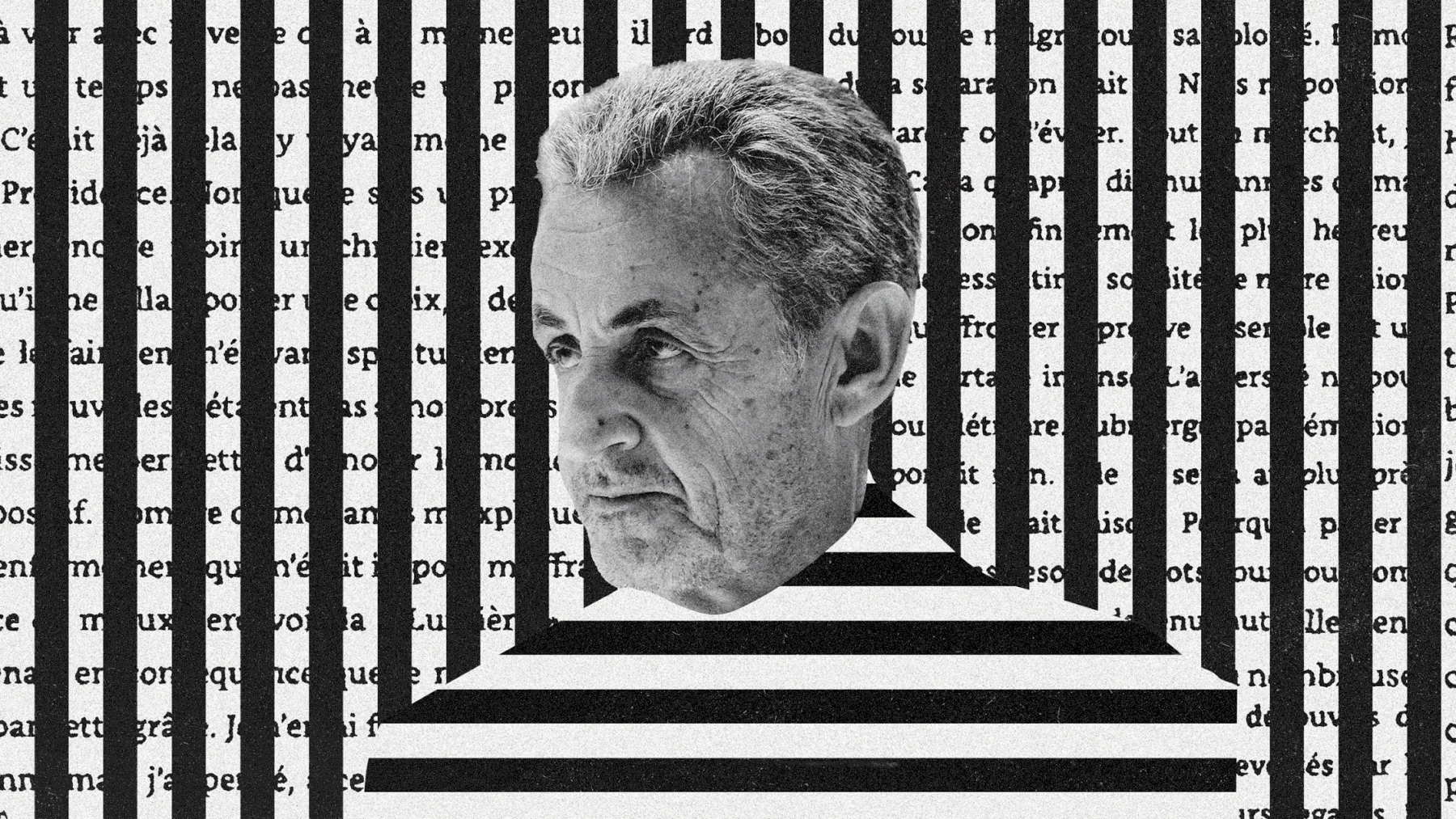
It has been called “the most anticipated book of the year’s end”—a chronicle of life behind bars by the former French President Nicolas Sarkozy. The book’s title is “Le Journal d’un Prisonnier” (“The Journal of a Prisoner”). According to the author, it was written freehand in seven-to-eight-hour spurts from an uncomfortable chair at a flimsy desk in the twelve-square-metre cell that he occupied at La Santé prison, after being convicted in a campaign-finance scandal. His sentence began October 21st and ended less than three weeks later, on November 10th, when he was granted conditional release while appealing the verdict. In France, the book is certainly the most widely mocked and memed of the year’s end. “I didn’t even get my period twice before he finished his book,” one woman wrote on social media. “Twenty days in jail and he thinks he’s Mandela,” a YouTube commentator joked, while Libération branded him a “Wish version of Solzhenitsyn.”
The prisoner prefers a comparison to Alfred Dreyfus, writing that the similarities between their cases are “stupefying.” Spoiler: they are not. Yet, like Devil’s Island, where Dreyfus spent four years, largely in solitary confinement, La Santé is a trying environment. “Prison is louder at night than during the day,” Sarkozy writes, as evening falls. “My neighbor in the cell next door passed part of his time singing ‘The Lion King’ and the rest of it banging his spoon against the bars of the cell, creating a deafening sound.” Before his prison term began, Sarkozy announced that he had chosen to bring with him two works of literature: “The Count of Monte Cristo” and Jean-Christian Petitfils’s biography of Jesus Christ. Perhaps inspired by the stoicism of the latter, he declines to specify whether the unsolicited lullaby was “Hakuna Matata” or “Can You Feel The Love Tonight.”
The prisoner had reported to La Santé that same morning, arriving twenty-five minutes early—punctuality is “a sickness chez moi,” he writes. What’s a conscientious guy like him doing in a hall of “assassins, miscreants, and crooks of all sorts”? Surely, his plight is not the consequence of, as a Paris court found, having conspired to solicit money from the Libyan government, under the dictator Colonel Muammar Qaddafi, in order to finance his 2007 Presidential run. Sarkozy maintains his “complete and total innocence” and insists that his downfall is the work of a shadowy clutch of enemies including the French magistrature, the investigative website Mediapart, whoever decided to strip him of his Legion of Honor knighthood, and la haine: pure, abstract hatred itself. As a protagonist, he is a marvel of passivity. “As I watched the heavy door slide along its track with solemn slowness, I reflected on the irony of the situation and on this strange life of mine,” he writes. “Why have I lived so many extreme situations?”
The intake process requires him to sign some paperwork, which he does in a dissociative state: “I initialed the documents mechanically, having decided to be elsewhere for my mental health.” This is the man who once promised to use an industrial power washer to cleanse the Paris suburbs of human “scum.” But he is gentler now, more vulnerable, or at least he would like readers—members of the media and judiciary presumably among them—to see him as such. After a full-body search, he ascends to the floor where he will be confined. “Guards upon guards dressed entirely in blue saturated the landscape,” he writes. “It was as if they’d all arranged to be there as I was passing by.” Enduring this gantlet of rubberneckers is a humiliation, but it’s also a flex. You half expect Sarkozy to bust some dance moves, as though he’s passing through the spirit tunnel on “The Jennifer Hudson Show.”
Sarkozy is assigned prisoner number 320535. “Four days earlier, I had been Nicolas Sarkozy, the former President of the Republic, being received by President Emmanuel Macron himself at the Élysée Palace,” he writes. “Could one ever have imagined a more striking contrast? A more ludicrous situation?” (And you thought Jean Valjean was having an identity crisis.) Sarkozy tries valiantly not to indulge in self-pity—child cancer patients have it worse, he reflects—but it is nonetheless clear that Cell No. 11 is not to his liking. In addition to the shit desk and chair, the shower is “the most incommodious” he has ever encountered, the mattress the hardest he’s ever felt, and the mirror has been hung at half height, so that he’s forced “to bend over double to fix my hair or trim my beard.” He is isolated in his cell, for safety reasons, while two bodyguards keep vigil nearby.
A longtime jogger and teetotaller, Sarkozy relies on routine to maintain his physical and mental equilibrium. He refuses to eat prison food, subsisting on yogurt, cereal bars, mineral water, apple juice, and “a few sweet treats” that he’s allowed to keep in a mini fridge. (“Neither wishing nor knowing how to cook,” he ignores the presence of a hot plate, even though a former chief of staff has been kind enough to write down instructions for boiling an egg.) Still, he has an in-room television and is allowed daily use of a treadmill; the room is “clean and rather luminous.” If it weren’t for the bars and the peephole, he writes, he might have thought he was in a “low-rent hotel.”
It's time, really, that weighs on the prisoner’s spirit. “I feared my first Sunday,” he writes. The sands running through his hourglass are missed moments with his wife, the model and singer Carla Bruni, and his four children. His third grandchild is born while he’s locked up. In nearly eighteen years of marriage, Sarkozy writes, he and Bruni had never been apart for more than a few days, and their record remains unbroken during his incarceration. (Sarkozy claims that he insisted on being treated like any other inmate, but Mediapart, the enemy website, recently reported that the French Minister of Justice intervened to give Bruni special visiting privileges.) While Sarkozy is away, a huge, mysterious bouquet of flowers is delivered daily to the couple’s home. The card invariably reads “Edmond Dantès”—the name of the dashing, unjustly imprisoned hero of “The Count of Monte Cristo.” I really hoped that our narrator was about to out himself as the perpetrator of this extravagant, kind of freaky romantic gesture. Alas, the sender was one of his friends, hoping to boost morale.
Sarkozy claims that he’s a softie, “an incurable sentimental” with a forgiving streak, but his current circumstances have forced him to reëvaluate certain things. I’m not sure where he found time to read Alexandre Dumas’s masterpiece—along with the Jesus biography, Antoine de Saint-Exupéry’s “Letter to a Hostage,” and a bit of Sartre—while also writing a book in twenty days, but the experience seems to have had a bracing effect. Dumas’s book, Sarkozy explains, “delivers a dual message. Rebirth, of course, but also vengeance.” Edmond Dantès does not forget those who’ve crossed him but, rather, “finds each of his accusers and grants them the punishment they deserve.” (Here’s hoping that works out better for Sarkozy than it did for the Count.) Let this be a warning: if you are a French magistrate and receive an invitation to a dinner party featuring mysterious liquids and exotic fish, better to decline.
“Le Journal d’un Prisonnier” is currently the No. 1 best-seller on French Amazon, edging out the forty-first volume of a series of “Astérix” comics. Hundreds of adoring supporters turned out for a signing in the Sixteenth Arrondissement, Sarkozy’s Paris fief. On purely literary merits, though, the book is, at best, a mediocris opus. Much of it reads like a padded-out term paper, replete with extraneous detail and word-count-boosting reps. We learn not once but twice, for example, that the prison guards, “many of them originating from France’s overseas territories,” never fail to address him “using the title of President.”
Other times, the book sounds like a droning Christmas-card letter, as Sarkozy endlessly tallies his friends and foes. When he writes, “I was particularly moved by the actions taken by the Bulgarian political class,” you almost wish he’d just write, “In March, Carla and I enjoyed a wonderful cruise on the Danube.” Sarkozy loves an exclamation point. He is also fond of desert metaphors, an odd choice given the particulars of the scandals marking his career. Before his alleged solicitation of Qaddafi, he enraged the families of those killed on UTA Flight 772— which Qaddafi associates bombed in 1989, sending the plane crashing into Niger’s Ténéré desert—by renewing diplomatic ties with Libya. “I lost my innocence when the man who represented France invited the dictator,” Mélanie Grisot, one of eleven relatives who testified at Sarkozy’s trial, told the court. (Sarkozy has also been convicted in two other cases, one involving campaign financing and the other illegal wiretapping.)
The book’s occasional oases of self-examination are surrounded by dusty expanses of omission and unconcern. In his political career, Sarkozy took a hard-line stance on crime, introducing mandatory-minimum sentencing and toughening rules for young offenders. “I promised myself that upon my release, I would have a more thorough and less caricatured perspective than I had in the past on all these subjects,” he writes, without offering further detail or much in the way of awakening compassion for his fellow-prisoners.
In the grand tradition of jailhouse literature, “Le Journal d’un Prisonnier” is a conversion narrative. Primed, perhaps, by Petitfils’s life of Jesus—a sort of spiritual Playboy—Sarkozy, until now an indifferent Christian, is overcome by a sudden need to “kneel down by the side of my bed.” Having discovered the power of prayer, the prisoner strikes up a relationship with a young chaplain and takes communion for the first time in years. He knows that “some will scoff at this type of sudden conversion,” but from the moment he sets foot in La Santé the evidence of divine intervention is impossible to ignore. “By a scheduling miracle, that evening there was a PSG match being broadcast on Canal+, live from Leverkusen, Germany,” he writes. He continues, “A Champions League match on my first night in prison—it was either a coincidence or another sign from Providence.” (He’s being serious.) So much for a cruise on the Danube: Sarkozy vows, “If I get out of this hell, I’ll go to Lourdes to see the sick and the desperate.”
The far more consequential conversion in “Le Journal d’un Prisonnier” is a political one. For decades, French politicians spanning from the far left to the center right have upheld a bargain known as the “republican front,” banding together in important elections, persuasions be damned, to prevent the far-right Front National, now known as the Rassemblement National, from gaining power. About midway through his account, our heretofore pliant, susceptible, and resolutely done-with-politics narrator drops a bomb: Marine Le Pen, the former president of the R.N., has been really nice about his legal troubles, and he has promised her that, come the Presidential election, in 2027, he will no longer uphold the republican front.
This defection wasn’t entirely unexpected: the billionaire businessman Vincent Bolloré, one of Sarkozy’s longtime patrons and the owner of Fayard, publisher of “Le Journal d’un Prisonnier,” has been doing his most to propel the far right to victory. But the move is unprecedented for a French President—“a crucial step in the union of the right with the far right,” as Libération put it—and Sarkozy still commands a faithful following. He hardly bothers to justify his change of heart; before you know it, he’s rattling off a compliment that Le Pen paid to Bruni, recalling the viral moment after the trial when Bruni went up to a Mediapart reporter, plucked the windscreen from his microphone, and dropped it on the floor. “She did it with remarkable class and gentleness,” Le Pen told Sarkozy. Twenty days behind bars, and not long before France may very well have a far-right head of state for the first time in nearly a century.