
The move to Schedule III marks the greatest change to U.S. drug laws since the Controlled Substances Act in 1970 and represents a new future for the $32 billion cannabis industry.
ByWill Yakowicz, Forbes Staff.
oday is a good day for potheads, and a great one for the nation’s state-regulated marijuana businesses. In a historic move, the federal government will reclassify cannabis to a more lenient category.
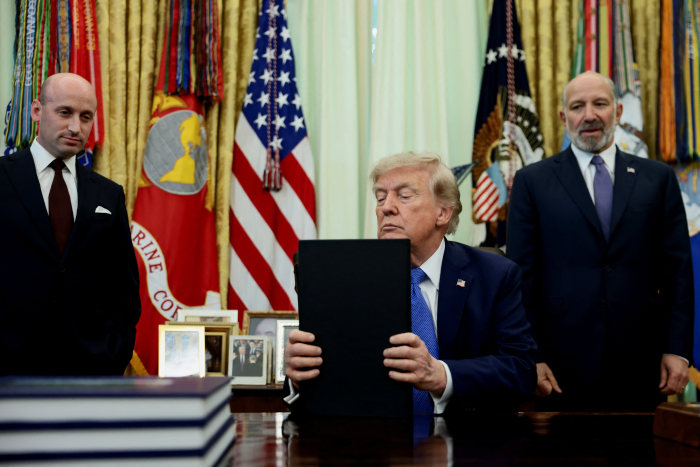
On Thursday, President Donald Trump signed an executive order directing U.S. Attorney General Pam Bondi to move marijuana from Schedule I, a category reserved for illegal drugs such as heroin and LSD, to Schedule III, which is used for drugs with accepted medical benefits that still have addiction potential, including steroids, ketamine and Tylenol with codeine.
The move is the most significant change to the nation’s drug laws since President Nixon signed the Controlled Substances Act in 1970. It also jumpstarts a bold, new future for the $32 billion state-regulated cannabis industry across 40 states.
“Today I'm pleased to announce that I will be signing an executive order to reschedule marijuana from a Schedule I to a Schedule III controlled substance with legitimate medical uses,” President Donald Trump in the Oval Office after signing the executive order. “We have people begging me to do this, people that are in great pain for decades...It’s something to do with common sense.”
While the announcement marks a major step forward for the cannabis industry, it does not mean marijuana is legal on the federal level. Because Schedule III drugs are considered controlled substances, there will still be restrictions on cannabis’ manufacture, sales and possession. The patchwork of regulated markets across 40 states that allow medical sales and 25 that permit recreational sales will still be in conflict with federal law.
The rescheduling also does not allow U.S. cannabis companies to be listed on U.S. stock exchanges such as the NYSE and NASDAQ. President Trump’s announcement did, however, give the struggling industry a much-needed boost—cannabis stocks were up 15% since last week and up 85% over the last month.
The executive order does not automatically reschedule marijuana. Instead, it directs the Attorney General to “complete the rulemaking process” around rescheduling marijuana to Schedule III “in the most expeditious manner in accordance with Federal law.” Once the Attorney General issues a rule, there will be a 30-day public comment period, and there will surely be lawsuits coming from opponents, who do not want weed to be downgraded to a less dangerous substance. The executive order also includes a pilot program that would allow senior citizens on Medicare to get reimbursed for CBD and medical cannabis products.
It is unclear how this new classification will affect the intoxicating hemp industry, which is facing a federal ban that will go into effect next fall. But the executive order does direct the administration to work with Congress to develop a regulatory framework for “hemp-derived cannabinoid products, including development of guidance on an upper limit on milligrams of THC per serving with considerations on per container limits and CBD to THC ratio requirements.”
Once marijuana is reclassified as Schedule III, there is a multibillion-dollar reason for the cannabis industry to celebrate, especially during tax season. For decades, marijuana companies have operated under the punitive 280E tax code reserved for traffickers of Schedule I and II substances, with an effective tax rate of about 60% of gross revenue. As a Schedule III substance, cannabis companies will finally be able to take the same tax deductions as other companies do, unlocking billions of dollars across the industry.
“We strongly support the Trump Administration's decision to reclassify marijuana as a Schedule III substance,” Kim Rivers, CEO of Trulieve, the Florida-based cannabis company that generated $1.2 billion in sales last year, tells Forbes. “It is a historic shift that acknowledges the medical value of cannabis and its lower abuse potential compared to Schedule I drugs like heroin and synthetic fentanyl, and aligns federal policy with decades of scientific research and real world patient outcomes. It has meaningful benefits for patients and enables scientific discovery while supporting over 425,000 Americans employed in the regulated marijuana industry. I would say it is very exciting.”
Rivers has been an integral part of lobbying President Trump to reschedule cannabis. According to two sources who asked remain anonymous because they were not authorized to speak, Rivers was one of the cannabis executives present in the Oval Office while Trump held discussions around rescheduling last week. (Howard Kessler, a credit card entrepreneur who runs The Commonwealth Project, an organization focused on integrating medical cannabis and senior care, was also there.) The two sources tell Forbes that President Trump was convinced about marijuana, even though he is a teetotaler, because it is clearly not as dangerous as heroin, he wants to see more robust research and wants to support a $32 billion homegrown American industry.
Rivers says the move to Schedule III will also make it easier for scientists to conduct research, which could help establish “the medical benefits, and the risks of cannabis” and “lead to significant breakthroughs in product development.”
During the signing, Kessler noted that the CBD pilot program will help millions of Americans. “We want to help people 65 and over,” Kessler said, “and hopefully change the world.”
Paul Armentano, deputy director of nonprofit marijuana legalization advocacy group NORML, tells Forbes the move has “significant symbolic importance” as the U.S. government now “recognizes the fact that marijuana is a medicine.”
But it does not mean the fight for de-scheduling or full-blown legalization is over.
“It's significant because I think it will hopefully shape a more rational evidence-based narrative surrounding cannabis and ultimately cannabis policy going forward,” says Armentano. “But as far as actual tangible changes in policy, I think those are going to be fairly few and far between from a move to Schedule III.”
Despite rescheduling, the state regulated cannabis industry will still be considered illegal under federal law. Schedule III drugs are medicines approved by the U.S. Drug Food and Administration that require a prescription from a doctor, which must be filled at a pharmacy. It is a crime to possess Schedule III drugs without a prescription, just as it is to manufacture and distribute these substances without being a licensed pharmaceutical company.
Jaret Seiberg, an analyst at TD Cowen, wrote in a memo last week that there will be some bumps in the road ahead for cannabis companies, but he does not expect legal action to be taken against licensed cannabis companies operating in state-regulated markets.
“We expect a period of uncertainty as the rescheduling process advances,” Seiberg wrote. “The most likely outcome is the status quo with states as the primary regulator of medical and recreational cannabis. Those operations would still be in violation of federal law and still at risk of a crackdown if a President at some point decides to act.”
Trump’s announcement is also good news for pharmaceutical companies that are racing to develop cannabis-derived medicines and get them approved by the FDA. The Stanley Brothers—who popularized CBD with Charlotte’s Web, a cannabinoid product that helps people with severe epilepsy and other conditions—are working on a marijuana-based drug to treat symptoms of autism they hope will one day become a pharmaceutical medication. And German pharma billionaire Clemens Fischer is developing a marijuana-derived tincture for pain management.
“This is an unparalleled move,” says Joel Stanley, who is now bringing his cannabis-derived pharmaceutical through the FDA clinical trial process with his new company Ajna Biosciences. “This is the largest moment since I entered the industry in 2008 and I’ve been waiting for it for a long time.”
Seiberg expects that reclassifying marijuana to Schedule III will “open the door for pharmaceutical companies.” In 1985, the FDA approved Marinol, a synthetic form of THC called dronabinol, for cancer and AIDS patients, its sales are an estimated around at around $250 million annually. The current cannabis-derived blockbuster is Epidiolex, a CBD tincture that has been FDA approved for children and adults with Lennox-Gastaut syndrome, Dravet syndrome and other rare epilepsy seizure disorders. With a small patient population hovering around 100,000 people globally, Epidiolex has managed to reach $972 million in sales last year and is tracking to surpass $1 billion in sales this year, analysts say.
Today’s decision has been hotly anticipated for years. In October 2022, President Joe Biden tasked the Department of Health and Human Services and then-Attorney General Merrick Garland to review “expeditiously” how marijuana is scheduled under federal law. By August 2023, HHS completed its review, concluding that marijuana has some legitimate medical benefits and sent its recommendation to re-classify marijuana as a Schedule III drug to the DEA. However, the DEA process was stalled and not relaunched under President Trump.
For longtime cannabis investors, such as Emily Paxhia, who cofounded the pioneering San Francisco–based hedge fund Poseidon in 2013, the news could not have come any sooner. “I’m doing better than yesterday, when I thought I was dead,” Paxhia tells Forbes.
Under the blanket of federal prohibition and a lack of movement for years, the cannabis industry has been deprived of institutional capital and robust stock prices—much of which caused company valuations to crater over the last few years. With the shift to Schedule III, Paxhia believes more investors will be willing to put money to work in the sector.
“The industry has been devoid of federal reform that has indicated any progress for years, but this is an incredibly important and positive indicator for capital to be able to start flowing back into the industry,” she says. “This is one key acknowledgement of the federal government that cannabis have a place in our society.”
Despite today’s important milestone, re-classification has little impact to the current criminal status of the cannabis industry, or the criminality of using it as a consumer. The dispensary model that has rolled out across America state by state is still considered unlawful under federal law. It also raises more questions regarding how state-regulated marijuana products may or may not be subject to FDA approval.
For now, cannabis advocates are savoring the victory. David Culver, the vice president of industry trade and lobbying organization U.S. Cannabis Council, says today is nothing short of historic. “It goes without saying that this is the most significant cannabis reform in modern history and sets us on the clear path to federal legalization,” says Culver.
Culver believes that by removing the 280E tax burden, the industry will now experience real growth. Currently, about 27% of companies in the cannabis industry are profitable, thanks in big part to being taxed as illegal drug traffickers. “We won’t be sitting next to heroin anymore,” says Culver, “so lawmakers will have an easier time working on additional cannabis reforms.”
But will President Trump imbibe?
“I’m not going to be taking it,” he said at the end of the press conference. “It’s an honor to do this.”