A team that once could seem a little bloodless has, in the absence of its best player, become scrappy and slightly unpredictable.
Aconfession: I did not know that Jordan Walsh, the Boston Celtics’ young forward, was the second coming of Moses Malone. I did not realize that he could ably step into the shoes of Jayson Tatum, the Celtics’ superstar forward, who went down with a ruptured Achilles tendon during the Eastern Conference semifinals against the New York Knicks last May. Salvation, it turns out, was already sitting at the end of the bench, averaging three minutes a game. Before this season, I did not know much about Jordan Walsh at all.
Walsh was the thirty-eighth pick of the 2023 draft, and had spent the better part of the past two seasons in Portland, Maine, with the Celtics’ G League affiliate. He spent the first month of this season at the back end of the team’s rotation. But then Joe Mazzulla, the Celtics’ intensely idiosyncratic coach, inserted Walsh into the starting lineup, and Walsh was suddenly a terror to opposing scorers everywhere—and a scoring threat himself, cutting and screening and shooting, plus crashing the glass for offensive rebounds when his or his teammates’ shots didn’t fall. The team has gone 10–3 since Walsh became a starter. “He just plays hard as crap every single possession,” the Los Angeles Lakers’ Austin Reaves said of Walsh earlier this month, after going 0 for 3 with Walsh as his primary defender.
What about Neemias Queta? Queta, a seven-footer from Portugal who’d been a member of the Celtics for a couple of fairly undistinguished years, is affecting the game so profoundly that the Celtics have one of the league’s best defenses when he’s on the court and one of the worst when he sits. Coming into the season, he was considered one of the team’s liabilities.
Not that anyone blamed him for that: everyone knew that he would have to step into a role previously occupied by All-Stars. After Tatum had surgery on his Achilles, which will keep him out for most or all of this season, the Celtics’ front office took a knife to the team’s roster, trading or otherwise saying goodbye to several key players, including the three centers who used to play ahead of Queta: Kristaps Porzingis, Al Horford, and Luke Kornet. The team also traded the former All-Star Jrue Holiday. The Celtics brought in Anfernee Simons, Josh Minott, Luka Garza, and Chris Boucher—nice-seeming guys with little to no pedigree.
All that slashing of salary and shedding of talent appeared to suggest one thing: the team, one year removed from an N.B.A. championship, and only a few weeks removed from the No. 2 seed in the Eastern Conference, was pulling the rip cord, bailing on any chance of winning this year. Kevin Pelton, an ESPN commentator known for his incisive statistical analysis, graded the Celtics’ off-season moves as a C. The team’s chances depended on Jaylen Brown, a former N.B.A. Finals M.V.P. who struggled through stretches of last season, and a couple of élite role players—Derrick White and Payton Pritchard—now tasked with much bigger jobs. Throughout the summer and fall, commentators referred to the Celtics’ season euphemistically as a “gap year.” Some fans were more blunt: they hoped that the team would finish low enough in the standings to be granted a top draft pick the following spring, and then reset with new talent when Tatum returned.
But that was never going to be the plan if the coach could help it. Mazzulla, after all, is one of the most overcompetitive men in sports, which is saying something. He embraces suffering. He starts every day with an ice bath and ends it in his chapel. He hiked through the Costa Rican jungle in bare feet. After winning the championship last year, he told reporters, “People are gonna say the target is on our back, but I hope it’s right on our forehead in between our eyes.” During training camp this past fall, at the annual media pickup game, he had the media play the coaching staff—and then instructed those coaches, which included former N.B.A. and N.C.A.A. Division I players, to run a full-court press on defense. The coaches won 57–4. (The game was just twelve minutes long.) Mazzulla fist-pumped after the final basket. That man? Tank? We all should have known.
The Celtics started the season 0–3, then muddled their way to 5–7, which was more or less where many people thought they’d be. They won some quality games, lost some games they might have won, shot a lot of threes, and couldn’t rebound to save their lives. Brown was great, but White and Pritchard, the other main holdovers from the championship team, struggled badly, and sometimes pressed and panicked as the clock ran down and the shots didn’t fall.
The turnaround was sudden: after a tough loss by two to the Philadelphia 76ers, the Celtics blew out the Memphis Grizzlies the next night, 131–95. And for two weeks after that they had the No. 1 offense in the league. What happened?
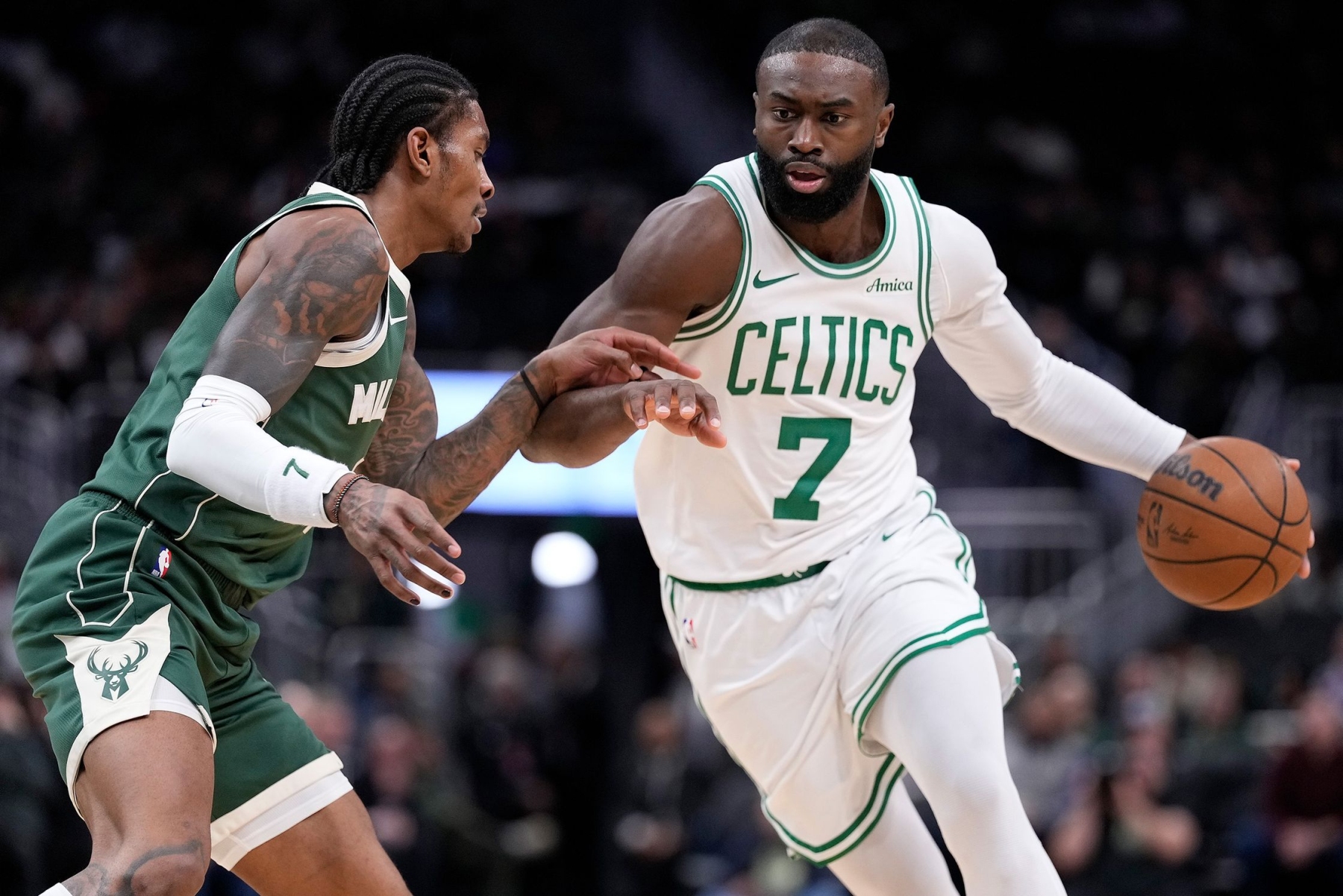
The simplest answer centers on Brown. Most of the offense centers on him, too, and he’s been spectacular. Great players can make up for a lot of team-wide weaknesses. Brown is constantly attacking and making sharp reads of the situation; he runs pick-and-rolls now with ease. His main job is to score, and he’s doing it from everywhere—including taking more deep two-point shots than anyone, shots that have fallen out of favor lately for their analytical profile (almost as hard to hit as threes, but worth fifty per cent fewer points). They’re working for him—and for the team, opening driving lanes, causing defenders to hesitate. He’s averaging nearly thirty points a night, and is not only more involved in possessions but also scoring more efficiently—a rare combination.
Another answer is that White and Pritchard are good players, and even good players have cold streaks; eventually, the cold streaks end. The Celtics’ fortunes have changed as those two have recovered their form. Yet another answer emphasizes the team’s adaptability: a lot of players are getting minutes, and all of them are treating those minutes as valuable. Talent wins in the N.B.A., but solid execution on basic fundamentals can go a long way toward upending the established order. (Then there’s the Oklahoma City Thunder, who have only one loss so far this season, and are an order all their own.) Brown has perfect footwork. Queta is a wall. Everyone sets screens and cuts hard. The team watched a lot of film to fix its rebounding problem, and upped the effort: when you’re smaller, coaches stressed, it helps to hit first and hit hard.
That could describe the team’s over-all approach. Last season, and for a while before that, the Celtics rode a kind of algorithmic process to the top, involving shooting a lot of threes—so many threes that the strategy became known as Mazzulla Ball. And the players taking those shots, particularly Tatum and the seven-foot-two-inch Porzingis, were so smooth that the style could seem a little bloodless. That’s not true anymore. The shotmaking now feels less actuarial than psychologically motivated. The Celtics still are near the top of the league in three-point attempts, but they’re not playing the kind of seamless, positionless basketball that modern teams favor. Every single player appears to have something to prove, and everybody knows their job. The basic instructions are clear enough: don’t turn the ball over, ever; hustle to collect missed shots; knock their balls loose; take open looks. Do absolutely everything you can to help the team score.
Can the team’s success last? Maybe not. On Thursday, playing the Milwaukee Bucks—who had been in freefall, and were without their star, Giannis Antetokounmpo—the Celtics coasted to an early advantage. Walsh hit all seven of his shots in the first half, for eighteen points, to go with three rebounds and three steals. Then, in the second half, the Celtics lost aim. There was an almost slapstick quality to ball after ball being heaved up, over and over, clanging against the rim or missing it altogether. Collectively, the team missed sixteen consecutive three-point attempts.
Mazzulla pulled his starters early, and talked about moving on. An absolute obsession with winning means, paradoxically, not obsessing too much over any individual result. In athletespeak, it’s “a process.” And maybe that’s what sets Mazzulla and these Celtics apart. There are stories all over the league of under-heralded players finding a purchase through maximal effort. A lot of teams are using deeper rotations; a lot of teams are emphasizing defense and looking to shoot threes. What makes these Celtics seem different is the over-all ethic, which comes back to Mazzulla.
What is it? Mazzulla might call it “love.” In a short interview with the site Andscape, in November, Mazzulla used the word “love” ten times. “It’s easy to say you love coaching when you have a chance to win a championship every year. But for the years where you’ve got to grind it out and you’ve got to really build something, that’s love,” he said. There is something a little deranged about hearing Mazzulla talk about love. This is, after all, a man who recently answered a child reporter’s question about having “fun” by calling the phrase “a cop-out” and then adding, “You just got to tap into your darkness.” If it’s love, it’s love of the Catholic wear-a-hair-shirt variety: love as sacrifice, love as suffering, love as struggle. And yet watch the Celtics. You can tell. It’s love.