
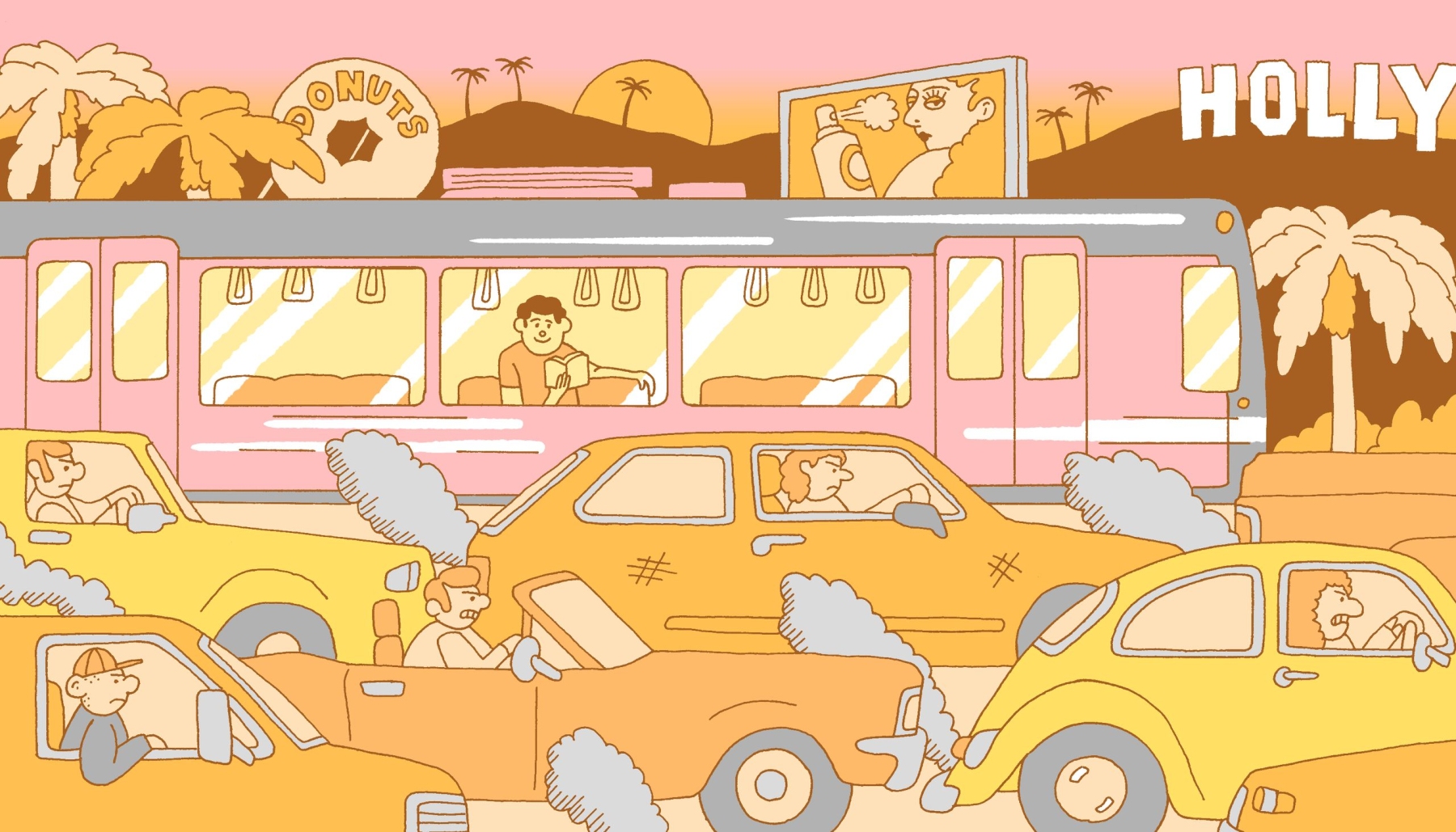
After decades of false starts, a new rail line has opened along the city’s most congested boulevard.
In 1895, an eccentric businessman named Henry Gaylord Wilshire began developing a luxury residential community on what was then the western edge of Los Angeles. In a gesture of civic pride, or perhaps shrewd self-promotion, he cut a strip of land running four blocks down the middle of the subdivision and donated it to the city for a grand boulevard. But his gift had two conditions. The first was that the road be named for him. The second was that rail lines be banned from the thoroughfare. Wilshire believed that automobiles were the future. The city agreed to his terms, wrote them into municipal code, and L.A.’s most important boulevard was born.
Today, Wilshire Boulevard runs nearly sixteen miles from downtown Los Angeles to the Pacific Ocean. It is the densest urban corridor west of the Mississippi River, and one of the most congested streets in all of Los Angeles County. Wilshire Boulevard is also the most direct route through Los Angeles’s core to various business districts, schools, and cultural institutions, making it a major artery for Angelenos who live on the city’s cheaper, denser East Side, and work in the various industries centered on the West Side.
These commuter patterns mean that every weekday, for three hours in the morning and another three hours in the evening, Los Angeles is choked by gridlock. During peak hours, it can take thirty minutes to cross a half-mile section of Wilshire Boulevard to either side of the 405 freeway. The five miles from Westwood Boulevard down Wilshire to Fairfax Avenue can easily stretch to an hour. Henry Wilshire may have correctly predicted the automobile’s dominance in Los Angeles, but he did not factor in traffic.
Los Angeles has more public transportation than people might think: the county’s Metro Rail network, which opened in the early nineteen-nineties, comprises a hundred and twenty-one miles of track, including the longest light-rail line in the world. But Henry Wilshire’s agreement with the city presaged a long struggle to build the system’s central artery, the D Line, which runs east to west underneath the city, roughly along the path of Wilshire Boulevard. For decades, the line existed as little more than a stub—just two stops past its junction with the north-to-south B Line.
This week, the wait is over: the first part of the D Line extension, which runs from Koreatown to Beverly Hills, is open. The full nine-mile extension is scheduled to be completed by fall of 2027—just in time for the 2028 Summer Olympics, when Los Angeles will need to move millions of visitors between more than forty venues across one of the most car-dependent cities on earth. The line will connect riders to many of L.A.’s busiest destinations and whisk passengers from Brentwood to downtown—nearly the entire linear core of the city—in about twenty-five minutes. It’s an almost unfathomably quick trip by today’s traffic standards.
Currently, only about four per cent of Los Angeles residents regularly use public transit—just edging out the two and a half per cent who walk. Safety concerns, a persistent stigma, and decades of underinvestment have kept ridership low even as the network has grown. The car is not just a convenience in Los Angeles; it is, for many people, a matter of identity. The D Line extension is the most significant test yet of whether any of that is changing. “We hope Angelenos begin to see that this city can be a transit-first city, and that Metro can be part of their life style,” Stephanie Wiggins, the C.E.O. of the Los Angeles County Metropolitan Transportation Authority, told me. “There’s nothing like this particular subway extension to really demonstrate that Metro has arrived.”
Historically, Angelenos didn’t need to be persuaded to ride the train. After all, it was a rail system that built modern Los Angeles: in 1876, the Southern Pacific Railroad connected the city to San Francisco and the new transcontinental network beyond it. By 1890, the population of Los Angeles had nearly quintupled, and land speculation in the city’s outlying areas, from the coast to the mountains, was rampant. But developers had a problem: to boost property values and to get people to live in these places, they needed transportation. The solution was a network of privately funded streetcars known by locals as the Red Cars. In effect, mass transit helped establish L.A.’s notorious sprawl.
At its peak, in the nineteen-twenties, the Red Car network comprised more than a thousand miles of track around greater Los Angeles, making it the largest rail-transit system in the country. It was the transportation of choice for all but the wealthiest Angelenos. Riding the Red Car down to the beach or up into the San Gabriel Mountains was a common leisure activity. But as the city’s population boomed the streetcars became crowded. “People started to get tired of the long lines, how slow it was, and then they started to get stuck in traffic by cars,” Ethan Elkind, the author of “Railtown: The Fight for the Los Angeles Metro Rail and the Future of the City,” told me. Cars were exciting, efficient, and relatively cheap.
After the Second World War, streetcar usage declined precipitously, as many white middle-class and working-class Angelenos bought automobiles and moved out of the city’s core. “They were driving—they didn’t care about public transit anymore,” Eric Avila, the author of “Popular Culture in the Age of White Flight,” told me. The fantasy of a sunny, suburban Los Angeles was explicitly an automobile-centric one—there was no room for the Red Cars. “It was apathy on the part of Angelenos,” Avila said. As a result, funding for the streetcars dwindled, and the city, county, state, and federal government stopped supporting it altogether. By 1961, the last operating Red Car line was decommissioned.
Eventually, the government built a network of freeways in Southern California, and drivers began facing the same traffic jams that had made them turn away from the Red Cars decades before. In response to the mounting issues of car culture, a movement formed to bring rail transit back. Tom Bradley, who was elected mayor of Los Angeles in the nineteen-seventies and went on to serve five terms, made reviving the streetcar (and a subway to the sea) a cornerstone of his platform. But many Angelenos remained wary of mass transit. In the seventies and eighties, a wave of East Coast transplants, fleeing the economic decline of cities like New York, brought with them an aversion to public transportation. “At that point, the New York City subway had a pretty bad reputation as being crime-ridden,” Elkind told me. For wealthier Angelenos on the West Side and in the San Fernando Valley, a Manhattan-like city of subways was antithetical to the suburban fantasy that they were building.
Still, over the next twenty years, Bradley and other civic leaders managed to push rail transit along in parts of L.A., with one major exception: a section running the length of Wilshire Boulevard. In 1985, an explosion in the basement of a Ross department store—caused by an unventilated buildup of methane gas underneath the store—razed several city blocks and injured twenty-three people. Henry Waxman, a congressman who represented the city’s West Side, used the incident as a pretext to propose a bill in Congress that banned the use of federal funds for tunnelling under a large swath of Wilshire. In reality, the incident had no bearing on subway construction—much of Los Angeles sits on or near petroleum and natural-gas deposits, and Metro engineers had already demonstrated that they were equipped to deal with the hazards—but the bill passed anyway. The B Line was rerouted to avoid Waxman’s methane zone by turning north from Wilshire Boulevard and heading up to Hollywood. In a moment of foresight, though, Metro built a small spur off the B Line down Wilshire Boulevard that ended right at Waxman’s boundary.
The spur opened in 1996. Eleven years later, with the urging of the then mayor, Antonio Villaraigosa, Waxman reconsidered his opposition to the project, and Congress lifted the tunnelling ban, paving the way for a renewed effort to complete the Wilshire subway. Still, many residents on the West Side and in Beverly Hills rallied against the project. The school board of Beverly Hills once claimed that the subway would make the local public high school a target for ISIS terrorists, and the school’s parent-teacher council released a video showing the school’s campus being hypothetically destroyed by a methane-related explosion that, the argument went, might occur should the subway pass underneath it. (Curiously, parents and administrators were unconcerned with the health or safety issues posed by the active oil wells on campus.) But the fearmongering failed. Digging for the new D Line project began in 2018; six years later, boring machines finished their dig after reaching the line’s new terminus at the Veterans Affairs campus in Brentwood.
Afew weeks ago, I talked to Uri Niv, an attorney who lives in L.A.’s Highland Park neighborhood. The opening of the full D Line extension next year will take him from his house to a stop that is half a mile from his office, in Beverly Hills. “I can’t wait to ride it,” he told me. But he has concerns, too. “I used to ride the B Line daily from North Hollywood to downtown. It was so convenient and cheap, but it felt sketchy before the pandemic, and then after it was unbearably scary and dirty.”
Safety has become the chief concern for Angelenos considering riding the bus or subway. Lea Madda, an arts educator in East Hollywood, told me that, in the past, she had used the subway to commute from Koreatown to downtown. She said that she would only take it to work during the day, never home at night. “It was just nuts. I had some episodes where large men started screaming at me,” she continued. On one occasion, she said, a man followed her around the subway-station platform and then between the subway cars. “That world feels so unsafe,” she added. “Definitely for women, but really for anyone.” She remained doubtful about taking the new D Line, and skeptical that more Angelenos would adopt it.
A study of university students from 2020 found that nearly half of the students who used the Metro Rail network, and three out of four students who rode the bus, had been sexually harassed. “You’re talking about the majority of passengers in either part of the system,” Madeline Brozen, the deputy director of the Lewis Center for Regional Policy Studies at U.C.L.A.’s Luskin School of Public Affairs, told me. Harassment tends to happen while Metro passengers wait for either the bus or train; bus stops are particularly vulnerable. Incidents are most common at night. The study found that sixty-five per cent of female students and thirty per cent of male students felt the need to take some precautions during their transit trips. Fear of getting involved in an incident led some students to avoid public transit altogether. Others who didn’t have alternatives tried to stay away from the system at night.
“What we found is that frequency of how often a bus or train arrived is the No. 1 solution that helps people feel safer,” Brozen told me. “Once riders are on the bus or train, they’re in the safest part of the system.” But frequency is partially a function of high ridership. During the pandemic, Metro’s ridership cratered, and it has yet to fully recover. The problem is essentially circular: riders won’t use a system they perceive as unsafe, and a system with few riders will struggle to become safe. In recent years, a litany of violent, seemingly unprovoked attacks across Metro led to the deaths or severe injury of several passengers—a confirmation of Angelenos’ worst fears about the system.
Around the same time, Metro launched a new safety initiative called the Ambassadors Program. Originally designed as a response to the Black Lives Matter protests and a call to keep armed police officers out of the Metro system, the agency deployed roughly three hundred ambassadors to stations and transit vehicles in the city’s core. The ambassadors wore Day-Glo-green T-shirts and usually worked in groups of two or three. They helped Metro passengers with directions, announced arriving trains and buses, and acted as an extra set of eyes around station platforms and on buses and trains. According to a survey by the agency, rider satisfaction increased, and last year Metro announced that it would be expanding the program. The agency also hires community-intervention specialists—unarmed workers recruited from the neighborhoods they serve, some of them former gang members, trained in de-escalation—to help keep stations safe.
Measures such as the ambassadors, stricter fare gates, and other safety improvements appear to be mending Metro’s public image, but it takes time for perception to catch up. With the opening of the D Line, the agency will have the opportunity to start fresh with many new riders. “I think the first few months are going to be so important for Metro to get right,” Michael Schneider, the founder of the transit policy and advocacy group Streets for All, told me. But if the stations are kept clean and there are no serious incidents, he said, then “the sheer curiosity of people to not sit in traffic—we’re drowning in traffic in L.A.—will get the best of a lot of them.” Someone who lives in Mid-City or Beverly Hills heading downtown to a Lakers game on a Friday night will now have the option of sitting on a train for fifteen minutes instead of sitting in a car for an hour.
Angelenos may not yet be riding their public-transit system en masse, but they are investing enormous amounts of money in it. County voters have overwhelmingly approved sales-tax increases to fund Metro projects. That money, along with millions of dollars from the Biden Administration, has made Los Angeles one of the largest investors in rail infrastructure in the country. Meanwhile, Metro is approving major new lines at a faster clip, and with less pushback: in January, a subway line connecting the San Fernando Valley to Wilshire Boulevard through a tunnel underneath the wealthy neighborhood of Bel Air was unanimously approved by Metro, with little opposition from wealthy residents.
A few weeks later, Metro approved another new line that would run up Fairfax Avenue, right past the site of the Ross-store explosion that galvanized rail opposition forty years ago. Some homeowners resisted, but the main point of contention was not whether the line should be built but, rather, which of three proposed routes would benefit the most people. “Once a city like Los Angeles, which is just so known for cars, all of a sudden becomes transit-friendly, it’s going to be a much nicer place to live,” Schneider said. “We were late to the party, but we are going to catch up.”