How ICE detention is forcing immigrants out of the U.S.
Source: CBC News:
May 20, 2026
Published May 20, 2026, 1:20 PM ET
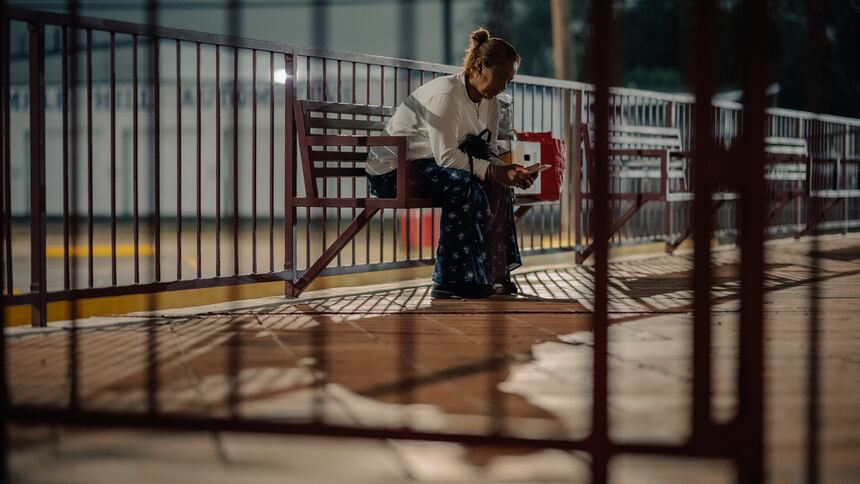
Texas resident Karla Soriano, whose husband was arrested and deported to Honduras five months ago, is considering deporting herself because she fears spending months in ICE detention. (Turgut Yeter/CBC)
U.S. Immigration and Customs and Enforcement holding about 60,000 people in detention centres
It was six o'clock in the morning and still dark in southern Texas brush country when CRB, a soft-spoken 16-year-old, was taken inside the Dilley Immigration Processing Center.
He didn't leave until 141 days later.
The centre is a collection of trailers ringed by a chain-linked fence off a desolate stretch of highway about 120 kilometres southwest of San Antonio.
This is where U.S. Immigration and Customs Enforcement (ICE) detains families, mainly mothers and children — some as young as two — it has arrested and targeted for deportation.
CRB's mother brought him to the U.S. when he was seven, fleeing violence in Mexico. (CBC News agreed to protect his identity; CRB is how he is referred to in court documents.) The family settled in San Antonio and received protection under the U.N. Convention Against Torture.
Before he was arrested by ICE, CRB was on the high school tennis team, had a circle of friends and was on track to graduate early.
"Everything was going pretty well. I had a pretty stable life," he told CBC News. "But they changed me when I got into that detention centre. My whole life did a 360."
Last week, the Trump administration announced that David Venturella, a former executive at private prison company The GEO Group, will take over the agency at the end of the month. Venturella will start his tenure while more than 60,000 people are being held in the prison-like facilities — many of them privately run — that make up the ICE detention network.
Immigration detention was once mainly reserved for non-citizens considered flight risks or security threats. But the vast majority of immigrants now in detention — more than 70 per cent, according to non-partisan researchers — don't have a criminal conviction.
The threat of extended detention in difficult conditions has become a central part of the Trump administration's mass deportation strategy.
As a woman who was detained at the Dilley facility for more than two months with her three-year-old son told CBC News, "The first thing they told us when we arrived was that if we didn't want to be there, we should send the paperwork to self-deport."
Detainees held at the South Texas Family Residential Center wave signs during a demonstration in Dilley, Texas, on Jan. 24, 2026. (Brenda Bazán/The Associated Press)
Life in family detention
In pursuing its goal of deporting one million people annually, the second Trump administration has radically expanded who can be detained and for how long. It has meant re-instituting the practice of family detention and re-opening the facility at Dilley, which the Biden administration had shut down.
CRB was detained there with his mother. As days stretched into months, he fell into a deep depression.
"I couldn't be distracting myself all day," he said. "In the night, I just started crying, because I didn't want to be there. I wanted to get out."
At one point, he had a panic attack and harmed himself. He and his mother were summarily released two days later.
U.S. courts have issued guidelines saying children should not be held in immigration detention longer than 20 days. But nearly 600 children were detained longer than that in December and January alone, according to recently filed court documents.
There was effectively no schooling available to children when CRB was at Dilley. In court filings, other detainees have reported being served spoiled food and that the water made them sick; there are also few toys in the facility and the lights are left on all night.
Some guards berate the detainees and mock their immigration status.
"I heard some racist things in there. I don't want to even say how terrible they were," CRB said.
The company that runs Dilley, CoreCivic, said in a statement to CBC News that descriptions by detainees of poor food and water are "untrue" and that their reports of racist comments by guards were "patently false."
The statement also said CoreCivic "facilitates age-appropriate educational programs" for child detainees. It said medical care at Dilley is "rigorous" and that the company provides trauma-informed mental health services to detainees.
Art work is displayed as a delegation of House Democrats hold a news conference on March 9, 2026, in San Antonio, calling on the Department of Homeland Security to release families who are being detained at the Dilley Immigration and Customs Enforcement Detention Center. (Eric Gay/The Associated Press)
ICE has also claimed media reports about the harsh conditions at Dilley are false. But the agency has also been explicit about the purpose of immigration detention.
"Being in detention is a choice," the agency said in February, offering a free flight and $2,600 US for parents to self-deport.
Under pressure
ICE has backed away in recent months from the violent enforcement tactics it used in cities like Chicago and Minneapolis, which resulted in at least three deaths and sparked widespread protests.
But the agency is still arresting on average more than 900 non-citizens per day, according to the latest figures available.
Many of these arrests occur during what had been routine interactions with government officials, such as traffic stops or immigration appointments. CRB and his mother, for example, were arrested at the San Antonio ICE field office during their annual check-in last September.
Amanda Aguilar, right, speaks with someone waiting outside the ICE field office in San Antonio. Aguilar is an attorney for a Texas non-profit that provides legal aid to immigrants. (Turgut Yeter/CBC)
Like millions who have crossed the U.S. border without inspection, they were initially detained in 2017 and then released on condition they check in regularly with ICE. The process offers migrants a work permit while their application for some kind of status in the U.S. moves through the immigration system, which can take years.
Decisions about who gets taken in appear to be based on what ethnicity is being targeted on any given day, and on available space in the detention system, said Amanda Aguilar, an attorney for American Gateways, a Texas non-profit that provides pro bono legal services for migrants.
As part of her job, Aguilar provides legal help to the people waiting outside the San Antonio field office for their check-in appointments.
"I've seen moms separated from husbands," she told CBC. "On a lot of days they'll be like, 'Make the choice: Is it gonna be you, Mom, or you, Dad? We're gonna detain one or the other.' And it's usually Dad."
The goal, she said, "is to put the financial pressure on the entire family to eventually leave."
'All human beings'
Last July, ICE adopted a policy stating any immigrant who crossed the border without authorization could be subject to mandatory detention and be held without a bond hearing, the immigration system's equivalent of bail.
ICE, in other words, gave itself the authority to detain millions of people indefinitely and without the chance to challenge the grounds of their detention.
"There's been a breakdown in constitutional norms," said Dan Gividen, a former deputy counsel at ICE who left the agency in 2019, concerned about the first Trump administration's legal moves. He now runs his own immigration law firm in Dallas.
Dan Gividen is a former deputy counsel at ICE who now works as an immigration lawyer in Dallas. (Turgut Yeter/CBC)
"I'm stunned by our society as a whole thinking that for some reason, because you're not a citizen of this country, that means that you get locked up and detained in a cage," he said.
ICE detainees end up in a network of detention facilities, many of which are for-profit enterprises that are crowded and understaffed.
There are more than 1,700 detainees at Pearsall, about halfway between Dilley and San Antonio, which generates around $45 million US in annual revenue for The GEO Group.
Yanquiel Lima spent 10 months at Pearsall. He came to the U.S. from Cuba in 2023 as part of a humanitarian visa program. Trump abruptly ended the program last year, and Lima was arrested shortly after. Under the government's new policy, he was denied a bond hearing.
Lima said he slept on a bunk bed in a room with 64 other detainees. They shared two toilets and three showers. He, too, said he was often served spoiled food and that the guards frequently made racist comments.
In the last year, 911 dispatchers have received more than a dozen calls about self-harm and suicide attempts at the facility, according to records obtained by CBC News. There have also been three calls about alleged sexual assault by staff. At least three detainees have staged hunger strikes.
Lima said he was placed in solitary confinement for six days when he complained about the conditions.
"It made me feel horrible, because we are all human beings regardless if we are American or Latinos," he said.
The GEO Group told CBC, "We are proud of the role our company has played for 40 years to support the law enforcement mission of U.S. Immigration and Customs Enforcement." The company didn't address the specific questions CBC had about the conditions at Pearsall.
An exponentially growing number of detainees are opting to simply give up on their immigration cases and leave the country instead.
In recent months, Gividen's law practice has been devoted mainly to filing habeas corpus petitions to challenge mandatory detentions in federal court. But the grim realities of detention mean many chose to forego that option.
Gividen said his clients now have to ask themselves, "'Is it worth sitting in this overcrowded ICE detention centre, where I'm being subjected to treatment like criminals?'"
Coping on the outside
The effects of ICE detention are felt not only by those locked up, but by the families and communities left coping with their absence.
"I started having trouble paying the bills," said Karla Soriano, whose husband was arrested and deported to Honduras five months ago.
Soriano was struggling to hold a box of donated food as she waited outside a church in south-side San Antonio.
WATCH | Pastor talks about impact of ICE detentions:
Pastor Diane Garcia says a growing number of families in her Texas congregation have been broken up by ICE arrests and are struggling to make ends meet.
Finding work to support her two sons has been difficult, she said. One employer threatened to call ICE when she asked to get paid. She is considering deporting herself.
"I am afraid that if I am detained, I will be in the detention centre for five or six months," Soriano said. "I'm afraid of what will happen to me in there."
The church's pastor, Diane Garcia, says a growing number of families in her congregation have been broken up by ICE arrests and are struggling to make ends meet.
Once a week, Garcia drives out to Dilley or one of the other detention centres around San Antonio where someone from her congregation is detained. The drive gives her a chance to reflect on the end game for an administration intent on expanding the detention apparatus.
"The only rationale you can come up with is to create suffering, cause trauma and to deter people from staying in the country," she said.
Diane Garcia is the pastor at Iglesia Cristiana Roca de Refugio in San Antonio and says several members of her largely Hispanic congregation have been detained by ICE.(Turgut Yeter/CBC)