Editor's note: Football is America's sport. Puerto Rico is an American territory. CNN explores the obsession with Bad Bunny's Super Bowl performance in a new CNN FlashDoc “Bad Bunny and the Halftime Show: Rhythms of Resistance.” Stream the special now on the CNN app. The hour will premiere Saturday, February 7 at 10pm ET on CNN.
History tells us that those who take the biggest stage in US sports have not shied away from using it as an opportunity to make a statement.
In some ways, Bad Bunny, this year’s Super Bowl halftime show performer, has already made his, taking the Grammys stage last Sunday and echoing a rallying cry heard at anti-ICE protests across the nation. The question now: What else will Bad Bunny have to say and will he say it during the halftime show?
“I think that regardless of what he does or doesn't do, his presence there is deeply political,” Puerto Rico historian Jorell Meléndez-Badillo told CNN, noting that Bad Bunny's show will undoubtedly put the "complex and uncomfortable realities of United States history" in relation to his homeland of Puerto Rico before a huge audience.
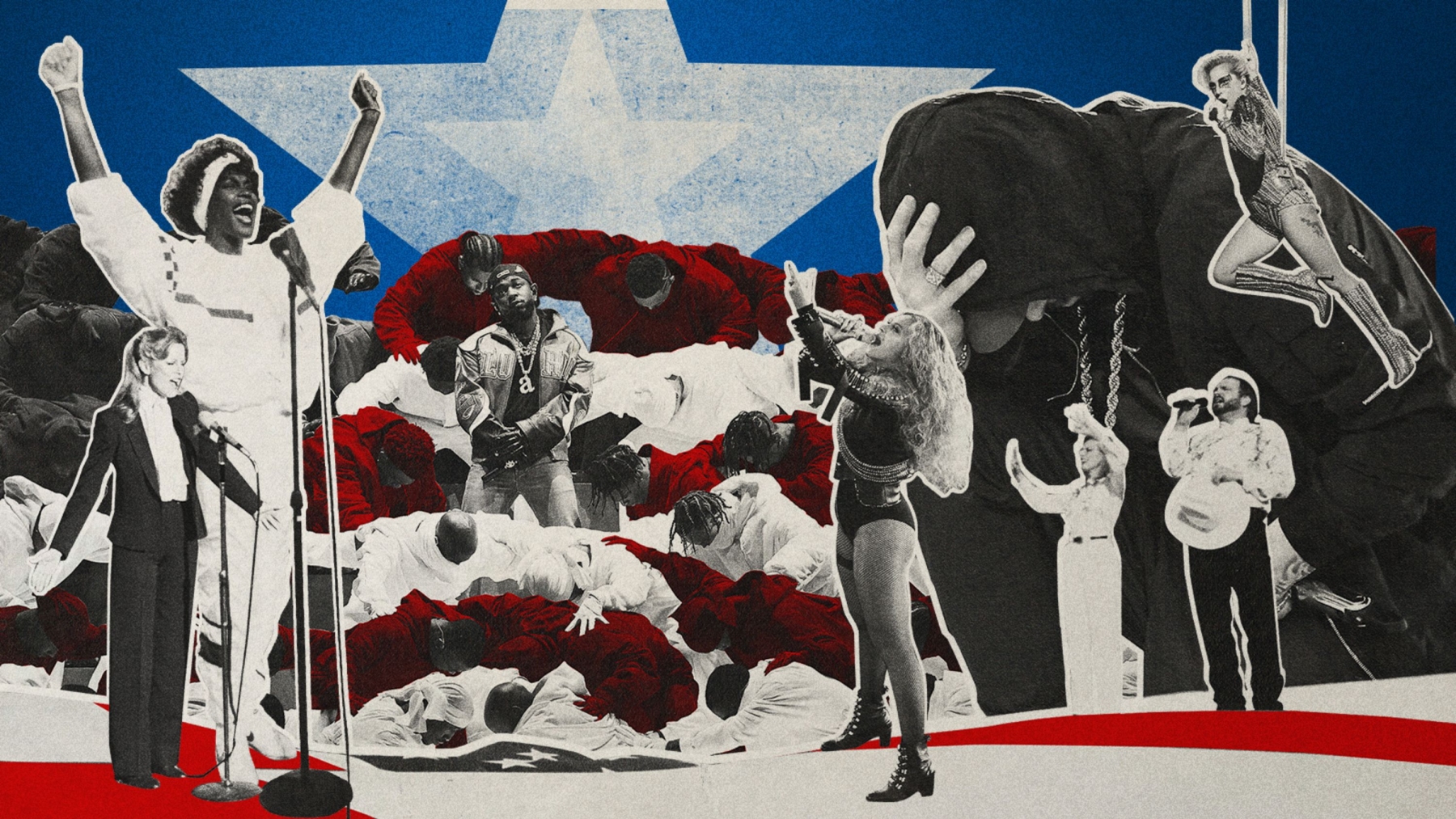
Throughout history, artists appearing on the Super Bowl stage – whether that be to sing the National Anthem or headline the Halftime Show – have time and again used their platform to make a statement about what’s going on off the field.
Here are a few examples:
Cheryl Ladd’s acknowledgement of the Iran hostage crisis (1980) Singer and actress Cheryl Ladd, who is best known for playing Kris Munroe on the 1970s TV show “Charlie’s Angels,” was tapped to sing the National Anthem at Super Bowl XIV in 1980, which saw the Los Angeles Rams take on the Pittsburgh Steelers at the Rose Bowl in Pasadena. The game came several weeks into theIran hostage crisis, in which 52 US citizens were held captive for 444 days after a group of Iranian studentsstormedthe US Embassy in Tehran. Those being held captive were mentioned during Ladd’s introduction, but she doubled down once she had the mic, dedicating her performance to “our American hostages in Iran.”Manny Rubio/USA Today Network/Imagn Images/Reuters
Whitney Houston’s healing song (1991) In 1991, the nation was just weeks into the Persian Gulf War and enhanced security measures were in place for Super Bowl XXV, with the world watching. A prerecorded, now legendary “Star-Spangled Banner” performance by Whitney Houston aired before kickoff. Arranged by composer John Clayton, it became one of the most famous covers in music history and was hailed for being the healing moment a worried and on-edge nation needed. "In the stadium, I could see the fear, the hope, the intensity, the prayers going up and I just felt like this is the moment,” Houston recalled in a 2000 interview featured in a promotional DVD for her greatest hits album. "We just needed hope to bring our babies home and that’s what it was about for me. That’s what I felt when I sang that song." Her rendition was later released as a single, the proceeds of whichbenefitedGulf War troops and their families.Michael Zagaris/Getty Images
Garth Brooks’ anthem ultimatum (1993) Garth Brooks performed the National Anthem at Super Bowl XXVII in Pasadena, with Academy Award-winning actress Marlee Matlin accompanying the famed country singer as the American Sign Language performer. His appearance, however, almost didn’t happen.According to “The Making of the Super Bowl: The Inside Story of the World’s Greatest Sporting Event,”a book by former NFL executive Don Weiss, Brooks refused to perform unless NBC aired the debut of his “We Shall Be Free" music video, which was written in response to the LA riots of 1992 and showed imagery that the network deemed inappropriate for the game’s audience. Ultimately, after the game was delayed for the first time ever in Super Bowl history, Brooks won the standoff and went on to sing the Star-Spangled Banner with his music video playing in the background.U SPresswire/USA Today Network/Imagn Images/Reuters
Madonna’s push for unity divides (2012) The pop diva’s halftime show set was a mix of classics and newer music that featured guests Nicki Minaj, M.I.A., Cee Lo Green and a choir. The latter two joined her for a rendition of her hit 1989 single “Like A Prayer,” which concluded with a cloud of smoke that eventually revealed the words “World Peace” in gold on the field. The moment divided critics, with one writer from Spin calling it “audacious to try to connect the prior 12 minutes’ entertainment to international politics.” An NPR writer, meanwhile, said “having the words ‘WORLD PEACE’ appear in lights at the end was probably the only thing she could do that would be sillier than all that had come before.” Probably not the answer to her prayer Madonna was hoping for.Andy Lyons/Getty ImagesBeyoncé’s world premiere of “Formation” (2016) Beyoncé was a mere guest of the British band Coldplay’s headlining performance at Super Bowl 50, but you wouldn’t have known it. Her profound performance of “Formation,” the video for which was released the day prior, was made complete with dozens of dancers dressed in outfits reminiscent of the Black Panthers and made reference to “Black Lives Matter.” It drew immediate backlash from conservatives like former New York City mayor Rudy Giuliani, who called it “outrageous.” Others, meanwhile, celebrated its many references to and celebration of Black culture.Harry How/Getty Images
Lady Gaga’s pledge of allegiance (2017) Taking place just days after President Donald Trump’s first inauguration, Lady Gaga took the halftime show stage aiming to speak truth to power with the world watching. She kicked off her set with a medley of “God Bless America” and “This Land is Your Land,” which contains the lyrics “this land was made for you and me.” This was, of course, amid discussions and protests over Trump’s proposed immigration bans and border wall plans. Before launching into “Poker Face” — this was still the halftime show, after all — she recited some lines from the “Pledge of Allegiance” with a red, white and blue drone show in the background.Adrees Latif/Reuters
JLo’s immigration statement (2020) Jennifer Lopez took her turn on the halftime show stage in a co-headlining spot with Shakira, where the duo performed a raucous set that celebrated Latin-American music and culture. There were a few standout moments, however, most notably during Lopez’s set, when she featured children helping her sing “Let’s Get Loud” from cage-like structures on the field in a moment that served as a statement on US immigration policy. The set — which also featured belly and pole dancing, in true Shakira and JLo fashion — was met with mixed reviews when over 1,000 Federal Communications Commission complaints were filed claiming the show was not family friendly.Anthony Behar/Sipa USA/AP
Eminem takes a knee (2022) Billed as a historic celebration of hip-hop, the rapper performed as part of a show that included his mentor, Dr. Dre, as well as Snoop Dogg, Mary J. Blige, Kendrick Lamar and 50 Cent. After getting the crowd rocking to his hit “Lose Yourself,” Eminem took a knee, which was interpreted as a tribute to former NFL quarterback Colin Kaepernick who lost his football career for taking a knee on the field during the national anthem at games in protest of police brutality and racial discrimination.Kevin C. Cox/Getty Images
Kendrick Lamar’s politically charged headlining set (2025) With the help of actor Samuel L. Jackson as Uncle Sam, Lamar gave a layered and nuanced critique of race, identity and social injustice in the type of production you’d expect from a Pulitzer Prize-winning rapper. He also managed to slide in a reference to his heralded rap beef with fellow artist Drake, which one could say was political if you’re Team Drake.Jamie Squire/Getty Images