
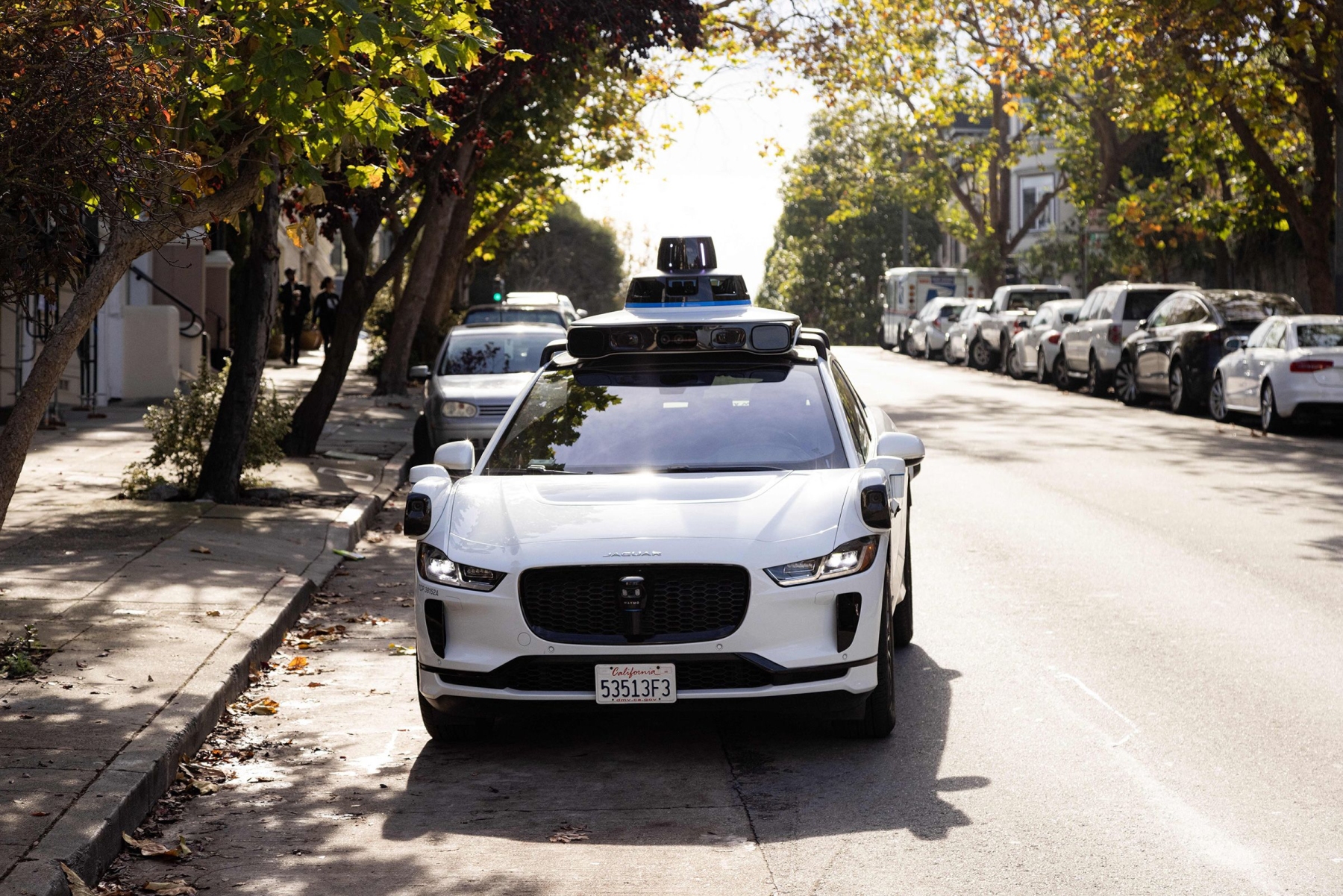
Boasting impressive statistics showing that its self-driving vehicles are far safer than human drivers, Waymo has deployed thousands of computerized robotaxis across the country that can’t drive drunk, become distracted by phones or engage in road rage.
But a CNN analysis of local and federal government records and social media videos finds that the same feature that makes Waymo robotaxis less likely to cause dangerous collisions — the lack of a human driver — also creates entirely new safety problems that are worrying government officials as the company seeks to expand beyond the 11 cities where it currently operates.
CNN identified hundreds of incidents in which robotaxis allegedly made dangerous maneuvers and struggled with obstacles that humans instinctively handle. They ran red lights, drove into oncoming traffic and active crime scenes, failed to abide by emergency road closures and came within inches of pedestrians lawfully crossing the street – missteps that the robotic vehicles are supposed to be programmed to avoid.
In just the past two months, Waymo has recalled thousands of vehicles and paused operations in multiple cities after robotaxis drove into flooded streets – including in San Antonio where an unoccupied Waymo was swept away in rushing floodwaters. And recently, the company announced it had suspended all freeway operations in cities including Los Angeles and Miami after one San Francisco rider recounted on X that his robotaxi had led police on a high-speed pursuit through an active highway construction zone.
“These are the early warning indicators that all is not well … that’s how companies need to treat them. That’s how regulators should treat them,” Bryant Walker Smith, a University of South Carolina professor who advises governments on autonomous vehicles, said about CNN’s findings. “This is the story of progress… we replace one set of problems with a new set of problems.”
At the same time, a growing number of city officials say they have been left dealing with real-world consequences of Waymos on their roads as state regulators continue to approve new expansions of the technology.
“The question is not if this is going to turn into a deadly situation for someone, but when,” Paige Ellis, a member of the Austin City Council, said at an April meeting where she and other councilmembers said Waymos were draining city resources and obstructing emergency response efforts – including the city’s response to a deadly mass shooting outside a bar in March.
Competitors, such as Tesla and Amazon’s Zoox, also have deployed self-driving taxis to select US cities, but Waymo – a subsidiary of Google’s parent company Alphabet – represents the largest commercial operation by far.
Waymo told CNN its robotaxis have already made roads safer and are better than human drivers, especially when it matters the most. They are 13 times less likely to be involved in serious injury crashes, the company said, and its own peer-reviewed research concluded that typical human drivers would have gotten in more than 500 additional injury-causing crashes over the more than 170 million miles driven by Waymo vehicles.
“No technology is perfect, but while human drivers can only learn from their individual experiences, Waymo takes community feedback and applies those safety learnings to our entire fleet,” the company said in a statement.
CNN’s review of the roughly 1,200 collisions that Waymo self-reported to the federal government from January last year through mid-April also showed that the company’s vehicles were likely not at fault in the vast majority of incidents, and that none of the collisions in which Waymo robotaxis appeared responsible, such as hitting parked cars, crashing into downed utility lines and driving into a San Francisco cable car, resulted in what was classified as a serious injury.
But this data doesn’t include any of the close calls and other potentially dangerous situations uncovered by CNN, and even Waymo’s own safety data includes examples where the self-driving technology has stumbled – such as incidents where its cars were rear-ended after unexpectedly braking for low-flying birds and mistaking business signage for a stop sign.
In one collision categorized in federal data as resulting in moderate injuries, a San Francisco cyclist alleged she suffered brain and spinal cord injuries after hitting the door of a Waymo that had parked next to a no-stopping zone next to a bike lane. She said she then flew into the side of another Waymo, also blocking the bike lane, according to a lawsuit she filed against the company. Waymo declined to comment on the case.
Other cyclists, pedestrians and motorists reported they would have been struck by Waymos if they hadn’t swerved or run out of the way.
“I had to push my son out of the way and tell him to run, or we would’ve been struck,” a parent said in a report made last fall to the city of San Francisco. “It did not slow down …This could be extremely dangerous if it was just a child or a young adult crossing the street.”
Around the same time, in Austin, a police officer reported watching a Waymo turn left towards an oncoming 18-wheeler, which braked in time to avoid a crash. “This was a very significant failure… that could have resulted in someone getting hurt. That Waymo had no business turning in front of oncoming traffic like that,” the officer said.
Police reports also detail how Waymo riders misusing the vehicles are creating additional headaches for law enforcement – from criminals using the cars as getaway vehicles to others doing drugs in the backseat or passing out drunk inside and requiring emergency help.
Waymo said it takes public feedback seriously and is actively working on improvements for some of the issues raised by CNN, but that these were largely isolated incidents. The overwhelming majority of rides are smooth and uneventful, the company said.
The company said complaints made to government agencies are unverified and social media videos often don’t show a complete picture. Waymo provided CNN its own footage from several close-call situations that depicted robotaxis making split-second maneuvers to avoid collisions.
The company also highlighted support from advocacy groups, such as those representing cyclists and the blind, as well as public health experts who have urged even quicker deployment of the vehicles to help prevent more motorist injuries and deaths.
When problems arise, Waymo has 70 remote assistance agents on call at any point in time for its fleet of nearly 4,000 vehicles, the company recently said. These operators, half of whom are based in the Philippines, have the ability to provide real-time advice to the vehicles though they do not take over driving, and Waymo would not tell CNN how often they need to intervene.
Contact us
In March, a Congressional investigation from Senator Ed Markey uncovered that a “substantial share” of Waymo’s overseas operators do not hold US drivers licenses. Markey slammed the company’s use of foreign operators, saying it “introduces an unprecedented safety risk onto public roads.”
Markey and others have called for increased transparency, but under current state and federal regulations, the company is not required to systematically track or report near collisions and other safety issues, making it difficult to assess how frequently such problems occur. While cities such as Austin and San Francisco provided reports about safety concerns flagged to city officials, most municipalities told CNN they were not tracking autonomous vehicle incidents.
Even those calling for caution say the technology will just keep getting better and has the potential to transform road safety, but only if issues that surface are taken seriously by the company and government regulators.
“Autonomous vehicles can be part of San Francisco’s transportation future but innovation must come with responsibility, safeguards and clear accountability,” San Francisco Supervisor Alan Wong said at a March meeting following a citywide blackout in December that left hundreds of robotaxis stalled in the middle of intersections, blocking roads and interfering with emergency vehicles. “The standard is not how systems perform on a normal day, the standard is how they perform when conditions are strained.”
A futuristic sight
It was a futuristic sight when Waymo began testing its automated robotaxis on the wide, flat roads of Phoenix – opening its driverless fleet to the public in the fall of 2020.
City officials in the Phoenix metro area have embraced the new technology, telling CNN that the company worked with them to ensure safety issues were minimal.
But a review of police reports from the Phoenix suburb of Chandler showed how humans have been using the cars for unlawful conduct – taking illegal drugs or using them to flee after shoplifting. Waymo said these incidents represent a tiny fraction of its operations in the area, but said the company collaborates with law enforcement as needed.
A city spokesperson acknowledged that while the new technology has clear safety benefits, it brings with it other challenges. “Two things can be true at the same time,” he said. “Autonomous vehicles, such as Waymo, have demonstrated a strong safety record compared to human drivers overall and they have introduced new operational and regulatory questions that cities and companies must work together to address.”
During a late-night trip to a McDonald’s in nearby Scottsdale, a 14-year-old exited a Waymo while it was coming to a stop and got his foot trapped underneath the wheel of the vehicle, according to local and federal records about the incident. The vehicle wouldn’t move off his foot as the teen screamed for help. Eventually, an ambulance was called, and emergency responders lifted the Waymo off the minor’s foot. He was taken to a local hospital and later discharged with his foot in a boot and on crutches. He was also issued a curfew ticket, according to the police report.

Missy Cummings, a former adviser to the National Highway Traffic Safety Administration, said the car should have stopped as soon as the door opened since Waymo vehicles have much faster reaction times than humans. She also said this is an example of why it is risky for minors to use Waymos, since the passenger started to exit the vehicle before it had fully stopped.
The Phoenix area is the only region where riders 14 to 17 years old can use the service if they have a special parent-linked Waymo account. Riders in all other locations must be 18, though the company has also been pushing to drive underage passengers in California.
“Allowing minors to have this kind of access raises serious safety and security concerns and it seems like Waymo has not thought through the hazards associated with this demographic,” said Cummings, an engineering professor at George Mason University.
Waymo said the company’s teen accounts fill an important need and that the 14-year-old passenger CNN asked about had opened the door when the robotaxi was still going 35 miles per hour and that the vehicle came to a full stop within seconds after the door opened.
Traffic violation records from Scottsdale show Waymo vehicles have been cited for ignoring traffic lights, signs or markings, driving on closed roads, failing to yield, unsafely changing lanes and driving on the wrong side of the road. In several cases, a Waymo representative failed to appear in court and a default judgment was issued against the company.
Of the 13 collision reports obtained from the Scottsdale Police Department, only one appeared to be the fault of a Waymo. The driver in the incident said the accident left him frightened and dubious of the new technology.
Jaafar Yaseen, a 37-year-old man from near Scottsdale, told CNN he was driving to meet friends in 2024 when he saw a Waymo crossing the double yellow lines on a narrow two-way street into his lane, heading towards him in the wrong direction. Yaseen said he tried to veer to the right but the Waymo never stopped and ultimately hit the driver side of his car and scraped it bumper to bumper.
“It was terrifying because I knew there was nobody behind the steering wheel,” he said. “They are driving like teenagers, like somebody just got his driving license.”
Two years later, dozens of social media posts from Waymo users and bystanders continue to document incidents that suggest the company has not perfected its driverless technology. In January, for example, a viral video showed a passenger fleeing a Waymo that had driven onto light rail tracks as a train approached. Not long after, sisters visiting Phoenix from Virginia excitedly videotaped their first Waymo ride only to have the car slowly move into the middle of a major roadway as it attempted to make a left-hand turn across four lanes of oncoming traffic.
“I thought we were gonna die,” she told a local news station, saying that if other drivers hadn’t slammed on their breaks, they could have been in “a tragic accident.” Waymo did not comment on this incident to CNN.
Legislation introduced by Arizona State Senator Shawnna Bolick in January would have required companies like Waymo to report near misses like this one to state regulators. Bolick told CNN the bill never made it out of committee due to lobbying by Waymo.
Clashes with city officials
When Waymo vehicles opened their doors to the public in San Francisco in the summer of 2024, its cars were forced to navigate a much more challenging environment of one-way streets, narrow lanes, steep hills and blind intersections. It is also home to many more cyclists and pedestrians.
In the two years since, some residents have been impressed with how conscientious Waymo vehicles have been, but others have filed hundreds of complaints about the robotaxis, according to 311 data obtained by CNN through a public records request.
Pedestrian safety complaints were among the most common, including reports detailing situations in which Waymo cars allegedly did not stop for pedestrians at all — from groups of young schoolchildren to elderly people and those in wheelchairs.

“I am in (an) electric wheel chair and it almost took me right out. It then just flew right by me almost side swiping me,” one resident reported.
“The Waymo ignored the crossing guard and did not stop until it was within a foot of hitting the student,” stated another. “The crossing guard ran and thrust her sign in front of the side camera. The Waymo sped off after the student crossed in front of it, but had not yet reached the sidewalk.”
In one complaint, a bicyclist reported seeing a child around four or five years old riding alone in the front passenger seat of a Waymo. “The child did not seem to be restrained in the seatbelt, and was very actively moving around the front seat and dashboard,” the report stated, questioning where the child’s parent was. “I was very alarmed by this… What if the car were to be in an accident, or incident? This young child would be alone in a car accident, left to face that alone. What is stopping this very young child from opening the door? WHO IS REGULATING [these] CARS?”
Waymo did not comment on any of these specific allegations.
Beyond safety concerns, dozens of residents lodged reports about the robotaxis invading their quiet neighborhoods, causing congestion, blocking driveways and keeping residents awake with loud beeping and bright lights shining in residential windows – complaints highlighted by residents of other cities in the data CNN reviewed as well. The city of Santa Monica is currently in a legal dispute with the company over the disturbances it claims Waymo vehicles have caused.
San Francisco leaders have been sounding the alarm about potential safety issues since Waymo first deployed in the city, but as is the case in many other parts of the country, the approval and regulation of autonomous vehicles is handled by the state.
City officials vented at a public meeting earlier this year that police and fire department resources were being drained because they had to respond to so many calls regarding Waymo vehicles. They expressed concerns about what would happen in the case of widescale emergencies and natural disasters, such as a major earthquake.
“Our public safety officers and responders are having to be the… default roadside assistance for these vehicles which we do not think is tenable,” said Mary Ellen Carroll, Executive Director of the San Francisco Department of Emergency Management, describing how officers often have to help move stalled Waymos.
Police reports reviewed by CNN also show how remote operators call 911 for a “welfare check” when passengers fail to exit the Waymo at the designated drop off – with police and other emergency responders often arriving to find inebriated people asleep in the back seat as opposed to a medical emergency.
“Anything that brings a high volume of calls to 911… can delay our call time for people that have true life and death situations,” Carroll said.
Waymo told CNN that the company continues to update operations, noting it has reduced the number of Waymo-initiated emergency calls by more than 50% in May.
The lack of regulatory authority over Waymo has frustrated officials in other cities as well. California only recently enacted a regulation that will allow police to issue citations against the company starting July 1– since previously, rules stated that tickets could only be given to human drivers. And 2024 legislation that would have given cities more power to regulate and even ban the robotaxis never gained traction amid heavy opposition from Waymo and competitors.
Los Angeles City Council members recently introduced a resolution in support of legislation introduced to penalize robotaxi operators for obstructing traffic and emergency operations, among of other requirements, citing “rising public safety concerns” in the city, which is preparing for major crowds and road closures at this summer’s World Cup and the 2028 Olympics.
Waymo told CNN it opposes legislative attempts such as these, saying it would be difficult to operate in states like California if every city had its own rules. Additionally, it said tracking near collisions is unnecessary because the company already closely assesses safety.
‘More and more problems’
When a gunman opened fire at a bar in downtown Austin this March, ambulances rushed to the scene – only to become stuck behind a Waymo that inexplicably froze across the path to the crime scene while attempting a U-turn. A police officer was ultimately forced to get in the vehicle and drive it out of the way, according to city records.
Obstructing and otherwise disobeying emergency responders has been a recurring problem in Austin. Law enforcement reports detail incidents in which a Waymo has parked on top of a hose being used by firefighters, squeezed through a marathon road closure, and blown past a security checkpoint at a college football game.
“I feel like whatever we say makes no difference at this point,” an officer complained in September after two Waymos drove through law enforcement checkpoints onto closed roads. “What do we need to do to make sure this does not happen again and for Waymo to understand how serious this is?”
This report was one of nearly 100 submitted by emergency responders and other city employees, painting a picture of building frustration with Waymo robotaxis ever since the company launched last spring. Waymos were accused of disregarding school-bus arms dozens of times, reckless and erratic driving and repeatedly creating dangerous traffic jams across the city, according to the city’s database of complaints, which also included incidents reported by residents.
“We had our newborn with us and this experience has convinced us that Waymos do NOT have the appropriate technology to be on the roads,” a resident wrote last summer after a Waymo “suddenly and erratically” drove into their lane and attempted to make a righthand turn from the wrong lane, almost slamming into their car.

In April, at a special meeting of the Austin Public Safety and Mobility Committee to discuss Waymo’s safety issues, the fire chief recommended that Waymo vehicles do not operate during “adverse weather conditions.” He cited an incident where a passenger had to climb out the window after a Waymo drove into a flooded street. During his presentation, he mentioned how a similar incident had recently occurred in San Antonio in April, when an unoccupied Waymo was swept away after driving straight into a flooded road. The car was recovered days later, according to local news articles, and the company quickly suspended service in San Antonio but did not provide information about what went wrong.
The company recalled nearly 4,000 vehicles this month, saying in a notice to federal regulators that a remedy is “currently under development” but that in the meantime, the company would limit operations during adverse weather conditions.
Cummings, the former NHTSA adviser, told CNN the robotaxi’s inability to estimate water depth is a “known limitation” of the technology without a known fix and that these kinds of situations illustrate “just how much AI cannot cope with uncertainty.”
“A Waymo vehicle does not know if a puddle is 1 cm or 1,000 cm deep,” she said. “That’s not very reassuring to passengers, especially if they can’t swim.”
In Atlanta, a CNN reporter witnessed a Waymo stuck in a flooded street at the end of May, the same day another Atlanta-based journalist posted a viral video showing her Waymo drive into a flooded street and stop. An Uber with a driver ended up rescuing her. Waymo temporarily suspended service in the city, telling CNN it implemented software updates to improve its performance around flooded roadways in Atlanta and other cities.
That same day, the company said it would be restricting all freeway driving across the country following the high-speed chase recounted on X. “We took the freeway and the road was closed. Waymo freaked out and sped up to highway speeds through construction trucks… Genuinely thought we were about to die,” San Francisco filmmaker Elliot Slade wrote on X about his experience in May. “The Waymo blasted through cones, swerved huge trucks and sped away from the cops…These are not ready for highways.”
Waymo told CNN the robotaxi pulled over at the nearest safe location, which in this case was the next freeway exit, and that the current pause will allow it to evaluate and improve its performance in freeway construction zones.
Safety experts said incidents such as the ones uncovered by CNN, show a need for caution and transparency, especially as Waymo looks to expand operations to more high-speed freeways and cities such as New York and Chicago which present new obstacles, ranging from crowds of pedestrians to dangerous winter weather.
“They do not have enough miles [in] all the different types of places that humans can drive,” Cummings said. “As they gain market share in more and more cities, we see more and more problems.”

METHODOLOGY