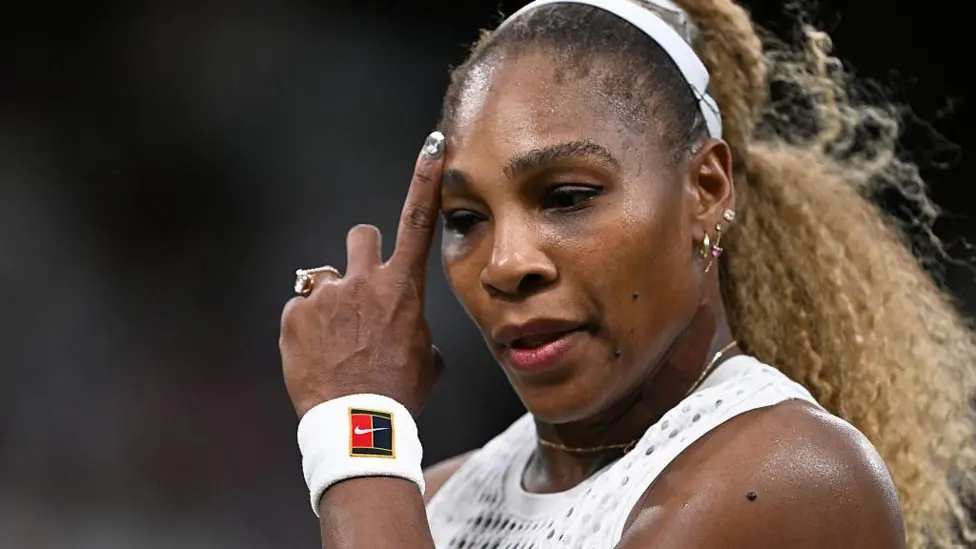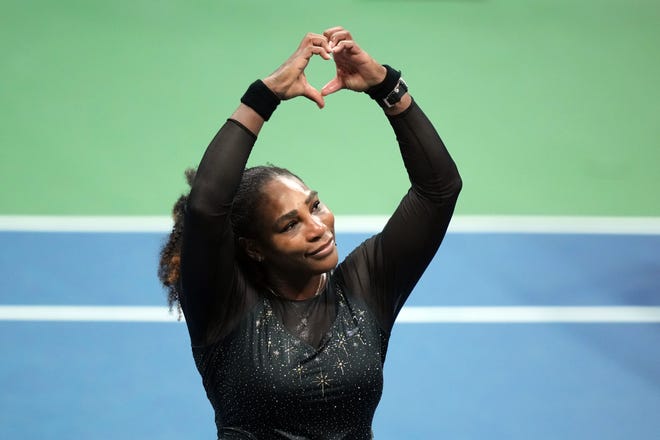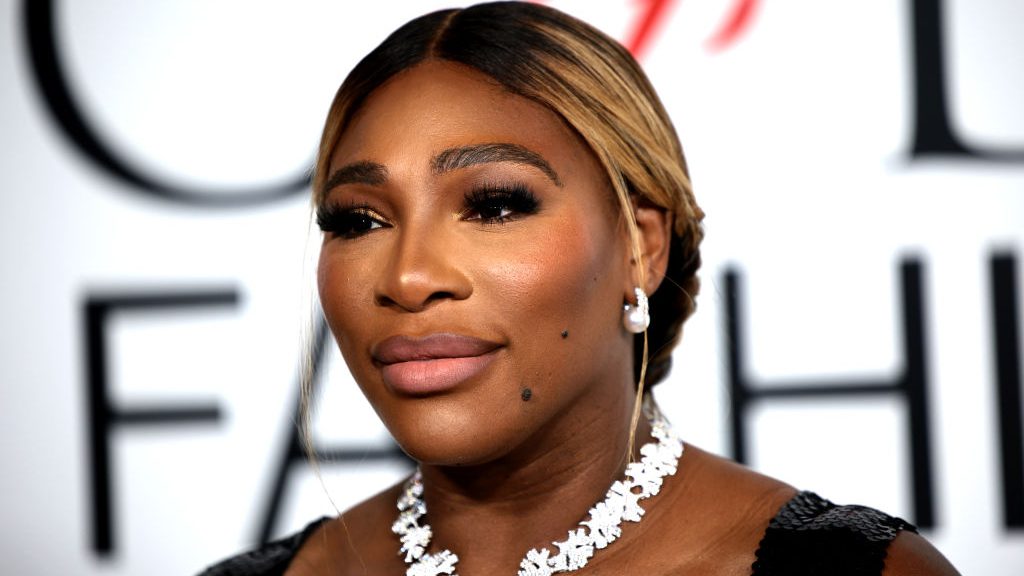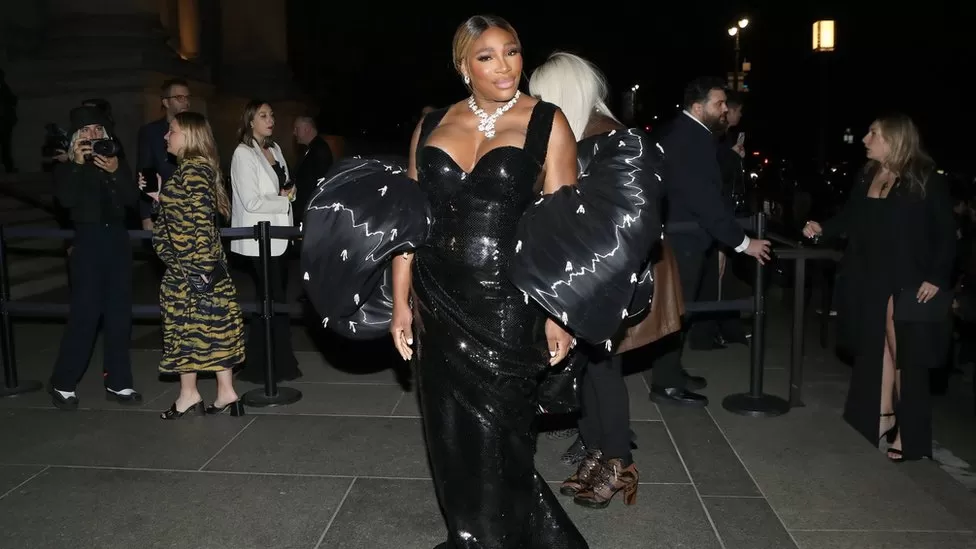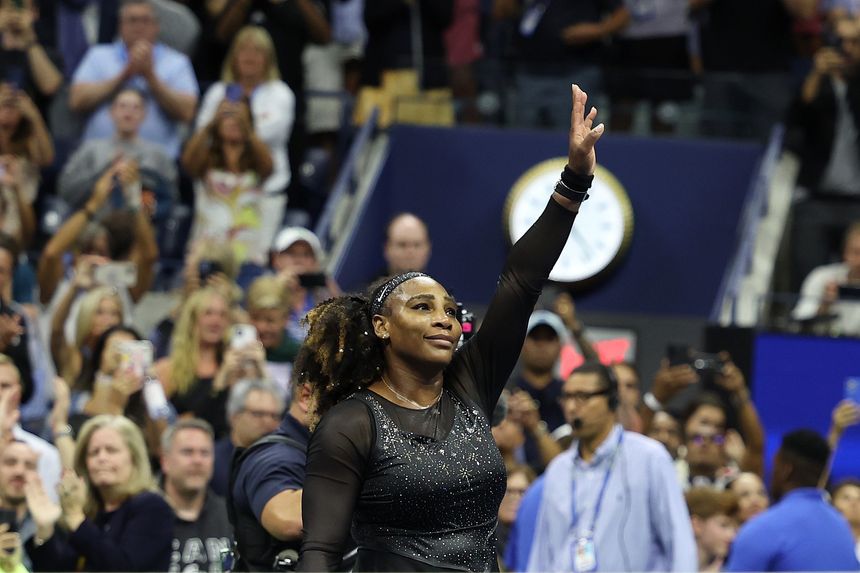


Serena Williams will return to tennis, a little under four years after announcing she was “evolving away” from the sport she dominated.
The 23-time Grand Slam singles champion will play Queen’s, the prestigious grass-court warm-up for Wimbledon, as a doubles wild card, the tournament confirmed Monday.
THE QUEEN RETURNS 👑
Serena Williams is BACK & set for doubles at the #HSBCChampionships!@WTA | @serenawilliams pic.twitter.com/lohvVo7cEy
— HSBC Championships (@QueensTennis) June 1, 2026
Whether or not Williams will use that tournament as a launchpad to play Wimbledon, the third Grand Slam of the year and one that she has won seven times, remains to be seen.
“Queen’s Club feels like the perfect place to begin this next chapter,” Williams said in a statement.
“Grass has given me some of the most meaningful moments of my career, and I’m excited to be back competing on one of the sport’s most iconic stages.”
Williams, 44, became eligible for competition Feb. 22. She had to spend six months in tennis’ anti-doping testing pool to return, and when Williams’ name was seen in that pool last December, Williams posted on X: “Omg yall I’m NOT coming back. This wildfire is crazy.”
But during an interview on the “Today” show in January, Williams was offered the chance to end speculation about her return. Instead, she laughed and responded: “If I want to put it to bed … Listen, I want to go to bed — it’s early.”
On both occasions, representatives for Williams did not respond to a request for comment. They did not respond to a request for comment about the Queen’s and Wimbledon plans.
Reentering the testing pool meant Williams had to comply with tennis’ whereabouts rules, which include random drug testing and remaining in a certain place for an hour a day. Subjecting herself to those conditions was a huge indication that Williams was, at the very least, keeping the option of a return open.
Williams will rely on wild cards for tournament entries and the expectation was that she would receive them from all over the tennis circuit. But the first came from a request. She remains one of the sport’s biggest stars nearly four years after her last match, at the 2022 U.S. Open, and any Grand Slam appearance — in New York, or elsewhere — would be a seismic moment regardless of its ultimate result.
During the first stage of her career, Williams won 73 singles titles and picked up just under $95 million, a record that made her one of the biggest icons in the history of professional sport. Now she returns to the arena.
Victoria Mboko, the Canadian player who is set to be Williams’ partner, was asked about playing with the legend of the sport on Friday, and said it was up to the American to make any announcement. Mboko added that she had an existing relationship with Williams. “Me and Serena have stayed in touch, which is really, really nice, because I really look up to her,” Mboko said in a news conference. “I mean, the fact that she even knows me is very, it’s very exciting.”
Mboko added that: “She’s my idol, so it’s really cool.”
Remembering watching her at the Canadian Open as a youngster, Mboko said: “I think she was such a great role model and such an inspiration to so many young girls out there.”
Queen’s begins June 8.
‘She’s back to duke it out with the stars of today’
Analysis from senior tennis writer Charlie Eccleshare
This may have been heavily trailed, but it’s still a huge moment for the sport. Williams transcends tennis and now she’s back to duke it out with the stars of today. It sounds like a tantalising hypothetical, but it is about to become reality.
Williams is returning largely because she can, and at 44, surely won’t be able to for much longer. She still hits regularly and will have seen how competitive her sister, Venus, now 45, initially was on her return to the sport a year ago. Why not see if she can be even more so? Especially when her Grand Slam singles tally remains one behind Novak Djokovic and Margaret Court’s record. She believes she can compete against today’s top players on the women’s tour.
That dynamic will be fascinating, especially if she ends up playing singles. Seeing how Williams might fare against Aryna Sabalenka, Iga Świątek, Coco Gauff, Elena Rybakina, Amanda Anisimova, Jessica Pegula and so many others. A WTA Tour already filled with elite players is about to get even richer.

Williams always left the door open for a return — speaking of “evolving away” from tennis rather than retiring when announcing her farewell in 2022 — and with her children a little older, at eight and two years old, she may see this as the right moment and last opportunity. Williams has proven herself the master of the comeback before — returning to the sport after various injuries to win Slams previously, and reaching four major finals after giving birth in September 2017, after which she had a pulmonary embolism.
Williams has also spoken about the benefits of taking GLP-1 weight-loss drugs, and in a series of interviews last summer said that she felt joint stress caused by her weight had prevented her from winning as many Grand Slam titles as she might have done.
Then, a year after her cameo in Kendrick Lamar’s halftime show at Super Bowl LIX, Williams appeared during Super Bowl LX in a commercial for telehealth company Ro, advertising the effectiveness of the weight-loss drugs. In the advert, Williams delivered a voiceover saying she is “moving better” and “feeling better,” at one point directly injecting a syringe into her arm. Her husband, Alexis Ohanian, is an investor in Ro and serves on its board. The World Anti-Doping Agency (WADA) says it is monitoring whether or not they will be classified as performance-enhancing.
Having Williams back on the tour will be compelling enough. If she could get close to equalling Djokovic and Court’s record, it would be one of the greatest stories in the history of sport.
‘Venus and Serena broke the door down’
Analysis from senior tennis writer Matthew Futterman
America has no shortage of candidates for its mythical sports Mount Rushmore. Williams is probably on it even if there are only two slots. Williams didn’t just win, she changed her sport: How it’s played, who plays it, who watches, and how they feel about the sport and themselves, and even the grand American experiment when they are doing so.
Serena and Venus Williams were not the first Black American tennis stars. There was Ora Washington and then Althea Gibson and Arthur Ashe, who broke the color barrier at the Grand Slams, and then another generation of quality, including two Wimbledon finalists, Zina Garrison and MaliVai Washington.
Before Serena and Venus came along, though, many Black players — including Gibson and Ashe — felt immense pressure to conform to the mores of tennis. To dress a certain way. To act a certain way. To wear their hair in a certain way. There is still some of that, but first Venus and then Serena helped to break the dam of expressing themselves and playing the sport on their terms.
At the insistence of their father, Richard, the Williams sisters largely shunned junior tennis. They took the court wearing braids and beads. They celebrated loud. They played, and still play, unapologetically.
“They came out there with the braids, wearing bright colors and all kinds of stuff,” Roxanne Aaron, the president of the American Tennis Association, said during an interview in 2024. “They acted like they were revolutionizing tennis, like they were revolutionaries.”
Resentment came out in unsubtle ways. When a chorus of boos and derogatory comments rained down on them after Venus pulled out of a BNP Paribas Open semifinal against her sister at Indian Wells in 2001, they didn’t just call out the sport; they held it to account. Serena skipped the tournament for the next 14 years, Venus for 15.
The Williams sisters ushered in what is one of the great transformations in tennis and perhaps all of American sport during the past 20 years. The top of American tennis is full of Black players, and nearly all of them — Madison Keys, Sloane Stephens, Coco Gauff, Hailey Baptiste, Frances Tiafoe, Ben Shelton and on — point to Serena and Venus as their inspirations. Not simply as players, but as people who gave them permission to be whoever they wanted to be and wear whatever they wanted to wear and act however they wanted to act on a tennis court.
“Serena and Venus said, ‘I can be myself,’” James Blake, who retired in 2013, said during an interview in 2024.
With the latest Williams comeback from Serena, many more little girls and boys can watch her. They can decide that this is how they, too, want to try to spend their lives. Few have the talent, but how many more will decide to approach their lives the way Serena does? Williams’ biggest impact has been off the court. People who have never picked up a tennis racket view her as a role model.
That’s not to say she has been perfect. There was the 2009 U.S. Open semifinal against Kim Clijsters, when she told a line judge who called her for a foot fault at a crucial moment that she wanted to shove a ball down her throat. “How many people yell at linespeople? I see it happening all the time,” Williams said afterward.
There was the 2018 final at the same tournament, when Williams was penalized for being coached during the match, back when that was prohibited — but also when it went unchecked in most cases. The match turned into something of a circus, overshadowing Naomi Osaka’s breakthrough triumph at a major.
Serena Williams on a tennis court is heat and history, power and initiative, intelligence and fight, and a good bit of glory as well, with more Grand Slam titles than almost anybody and the most for women’s singles in the Open Era. She is what every sport craves: A story bigger than tennis with a protagonist who has always had the power to change the world with her racket.
Can she still do that? There will likely be some losses in whatever shape this comeback takes. But by putting herself out there again, at 44, she will bend the sport and the world toward her a little more. The story, and the history, continue. And may it ever be thus.