
The president’s social-media posts triggered the most significant pushback from the religious right since he returned to the White House
By Philip Wegmann, Aaron Zitner, and Marianne LeVine
WASHINGTON—President Trump’s decision to post an AI-generated image depicting himself as a Christ-like figure sparked outrage on the religious right, triggering the most significant pushback from his Catholic and evangelical Christian supporters since he returned to the White House.
“We are a little bit beside ourselves,” said John Yep, CEO of Catholics for Catholics, a nonprofit that has hosted faith events at Trump’s Mar-a-Lago club and maintains close ties to the administration.
On Sunday night, Yep was eating dinner with friends after church services when his phone lighted up with messages about the now-deleted image in which Trump, wearing robes, touches the forehead of a man lying in a hospital bed.
The collective sentiment around the table, Yep said in an interview, “was one of sadness, because we were truly confused by this president after Catholics gave him such a resounding vote, and yet he is treating our faith with such disrespect at this moment.” He immediately reached out to contacts close to the administration to voice his “sadness and frustration.”
Rod Dreher, a conservative writer who attended the Catholic baptism of Vice President JD Vance before he entered politics, went further. “Not saying Trump is the Antichrist,” Dreher told The Wall Street Journal. “But he’s radiating the spirit of Antichrist, no question.” Pastor Douglas Wilson, co-founder of the conservative Calvinist denomination to which Defense Secretary Pete Hegseth belongs, called the image “blasphemous.”
Conservative Christians have rallied behind Trump in recent years, despite initial misgivings, standing with him through two impeachments and three elections. Trump, in turn, has made good on campaign promises to them, nominating Supreme Court justices who helped overturn Roe v. Wade.

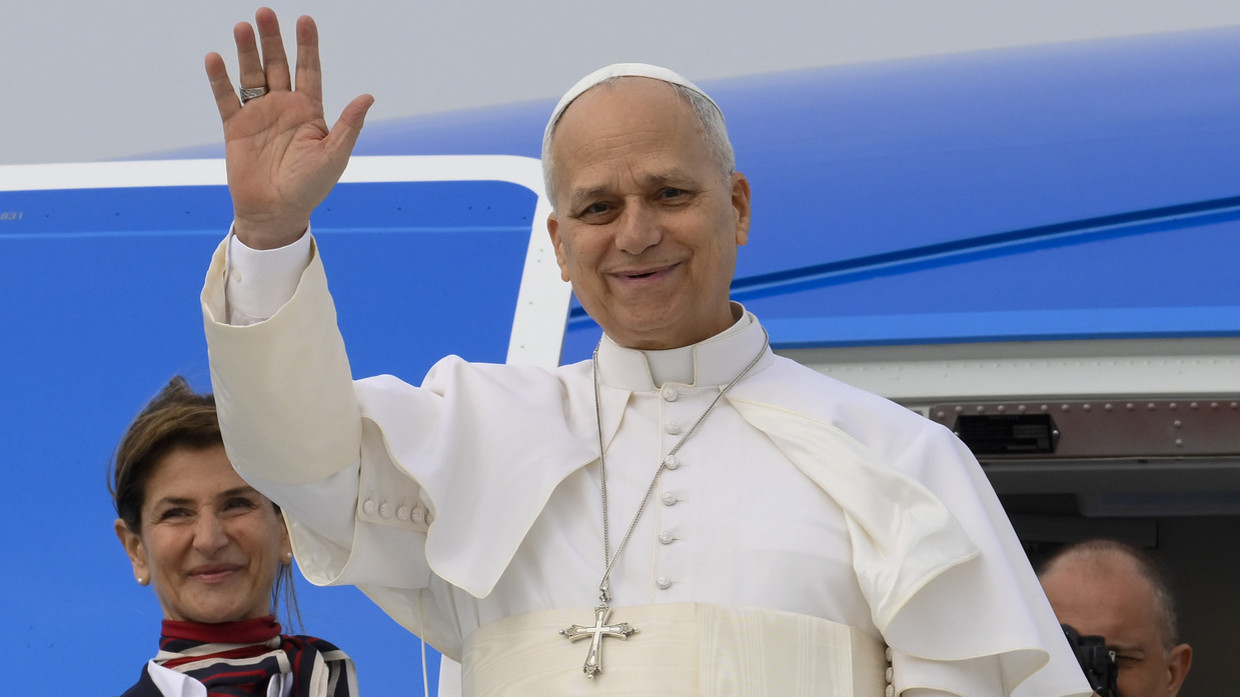
But for many Christian leaders, Trump’s Sunday night Truth Social post—along with his pointed criticism of Pope Leo XIV—went too far.
In the image, Trump is surrounded by glowing light, with a woman clasping her hands in prayer. Bald eagles and jet fighters soar through the sky, and strange figures appear in the clouds overlooking the president.
It came after Trump lashed out at the pope following the pontiff’s public condemnation of the war in Iran, accusing the leader of the Catholic Church of being weak on crime and catering to liberals
Trump confirmed that he posted the image, but said he didn’t intend to compare himself to Jesus. “It’s supposed to be me as a doctor making people better,” he told reporters at the White House on Monday afternoon. The post had earlier been deleted from Truth Social.
It wasn’t the first time Trump has blended politics with religious imagery: Last year, Trump posted on Truth Social an AI-generated image of himself dressed as the pope.
The White House didn’t explain why the post was deleted and broadly defended Trump’s record. “The President has delivered unprecedented victories for Americans of faith, and he will continue to protect and expand our sacred right to religious freedom,” White House spokeswoman Taylor Rogers said.
Megan Basham, a religious writer at the conservative Daily Wire, quipped Sunday night that if Trump was spotted on the White House lawn “munching on grass,” it would be a sign he had been laid-low like Nebuchadnezzar, the Old Testament king who was turned into a wild beast as punishment for his pride.
The consternation over Trump’s social-media posts could turn into a political liability for Republicans as the president leads the GOP into the midterms. He has won over a majority of Catholics in three consecutive elections, most recently carrying 55% of the Catholic vote in 2024 compared with former Vice President Kamala Harris’ 43%, according to Pew Research Services.
Republicans were counting on those voters as they head into the midterms, a plan made more difficult after Trump lashed out at the pope. After the pontiff condemned the war in Iran, saying that “God does not bless any conflict,” Trump shot back that the pope, an American, was “terrible for Foreign Policy” and wouldn’t be in the Vatican “if I wasn’t in the White House.”

Critics, and some Christian supporters, have taken issue with the language Trump and his allies have used to sell the war in Iran. During an event at the White House earlier this month, televangelist and Trump spiritual adviser Paula White compared the president to Jesus, saying that both had been “betrayed and arrested and falsely accused.” The remark drew widespread condemnation.
Wilson, who has attended Sunday services with Hegseth and spoke recently at a Pentagon prayer service, saw Trump’s social-media post as one of several events aimed at cloaking the president with divine authority, among them White laying hands on the president in prayer. “I am uncomfortable with the quasi-sacramental laying on of hands, as if Trump were a uniquely chosen vessel, like a civic holy man,” he said. Trump’s post, he said, “just accentuates” his discomfort.
Others saw a political motive in Trump’s post. “When spiritual advisers like Paula White publicly frame the president’s authority as divinely ordained, it’s telling the public that opposition to the president is opposition to God,” said Amanda Tyler, executive director of the Baptist Joint Commission for Religious Liberty, an organization that advocates for the separation of church and state.
Trump returned to the Oval Office vowing to end “the radical war on faith.” He has hosted faith leaders at the White House, signed executive orders favored by evangelical voters, and pledged to end “the anti-Christian weaponization of government.”
Kevin Roberts, a practicing Catholic and president of the conservative Heritage Foundation, said that he is pleased with those early results, but encouraged Trump and Leo to engage in “a more direct dialogue.” The two leaders, Roberts said in an interview, are both pursuing peace in Iran.
“While I think there are more constructive ways for President Trump to engage the Church, I fully share the president’s goal, along with most Americans, for a lasting end to the conflict in Iran,” he said.
Ralph Reed, a Trump ally and founder and chairman of the Faith & Freedom Coalition, said the president had already earned “a deep reservoir of appreciation and loyalty” from religious voters. When asked about the now-deleted image, he replied that loyalty will matter “a lot more, and in my view, will eclipse any disagreements or controversies related to a social-media post.”
The controversy comes amid a notable increase in Catholic conversions in conservative circles in the last decade. That includes Vance, who has been outspoken about his faith and is set to publish a new book, “Communion: Finding My Way Back to Faith.”

Trump’s sharp turn in rhetoric against the pope has left some outside supporters of the president puzzled. Dreher, an Eastern Orthodox Christian and past Vance acquaintance, said he has his own policy disagreements with Pope Leo but “there is no upside for a politician to beef with the pope.” He noted that heads of state and the Vatican have historically disagreed, often in more polite terms, but complained that “Trump seems to think that the pope is nothing more than Keir Starmer in a white cassock.”
Nic Rowan, managing editor of The Lamp, a Catholic literary journal that previously published Vance’s writing, said it wouldn’t be difficult to determine, ultimately, which side parishioners would come down on. “Leo’s position is a lifetime appointment, and Trump is already a lame duck,” Rowan said. “For American Catholics, one of these guys is going to be around for a long while; the other is already on his way out the door.”
Leo has vowed to continue speaking out against war. “The message of the gospel is very clear: Blessed are the peacemakers,” he told reporters on board the papal plane flying from Rome to Algeria, where he is beginning a four-nation African tour.
“I have no fear of the Trump administration,” Leo said.
Corrections & Amplifications
Megan Basham is a religious writer at the Daily Wire. An earlier version of this article incorrectly spelled her name as Meghan. (Corrected on April 13)