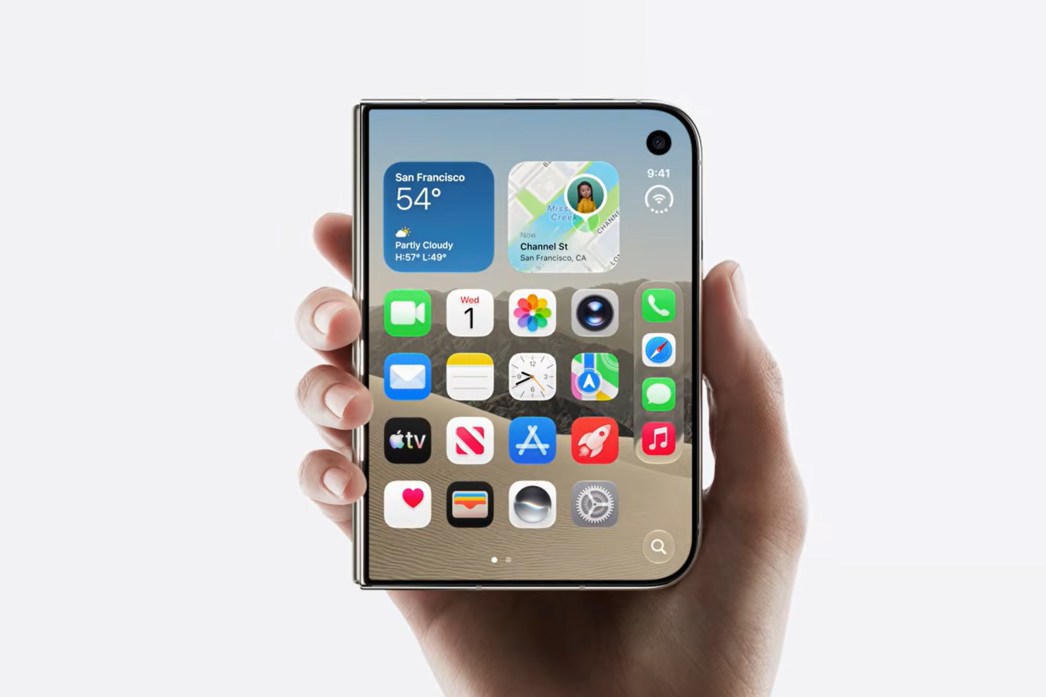

Apple’s assistant got a face-lift and a brain transplant. But if it’s a success, credit will be due to its familiarity and accessibility.
Apple’s new AI-driven Siri has a more expressive voice. Photo: Claire Hogan/WSJ
Avid AI users won’t be terribly impressed at first. In one demo, an Apple employee summoned Siri by swiping down from the center of the screen—a new gesture to access the new assistant—and asked, “What is the best national park to visit in the Western U.S. that isn’t too hot or crowded in July?” Four seconds later, it suggested North Cascades National Park.
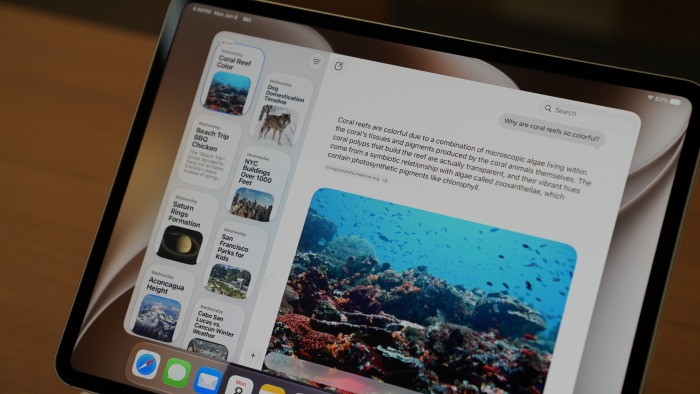
He opened the new dedicated Siri app. For a follow-up about “top family-friendly hikes,” Siri delivered a clean, bulleted list, citing several web sources.
That would be a basic query for just about any chatbot. But because it’s right there on your iPhone (or iPad or Mac), you might be inclined to use it instead of opening an app.
It’s also built into the camera: A new Siri mode, alongside Photo and Video, gives the assistant eyes. The Apple employee pointed his camera at a bookshelf: “I loved ‘Hyperion.’ Which of these two should I read next?” and Siri recommended “Blindsight” by Peter Watts.
The ‘p’ word
Besides convenience, Apple is pitching privacy.
The new Siri is powered by Apple Intelligence, which runs on Apple Foundational Models, which tap in to Google’s Gemini smarts.
All that is really to say: Siri AI uses a mix of on-device and cloud-based models to generate a response. And Apple says only the relevant information is sent to the cloud, then immediately deleted—neither Apple nor Google can view the conversations.

The privacy play makes sense. In one example, an Apple employee asked Siri, “What podcast did my sister recommend?” It scanned personal messages to find the answer. In another example, the employee asked Siri to add items to a packing list that were mentioned in an email about a camping trip.
Siri AI can look through your iPhone’s most private data. To be useful, it has to. It can even take actions based on whatever you happen to be looking at on your screen. That’s potentially a productivity marvel, but it’s not necessarily stuff you’d want training an AI company’s future models—or ending up leaked in a data breach.
Siri the conductor?
The new Siri AI can answer many more questions than its predecessor. Photo: Claire Hogan/WSJ
So much of what Apple showed off had to do with how Siri can enhance the use of the company’s native apps and features. But the potential here is for Siri to help people get more out of their other apps, too. After all, that’s why Siri AI was the centerpiece of its developer-conference keynote: to convince app makers that Siri will drive users to their apps, not away from them.
Like many people, I own an ecosystem of Apple hardware, but I spend more time in Google software such as Gmail and Google Photos. If I ask a bot to add stuff to my calendar, the calendar I’m referring to is Google’s, not Apple’s.
Even in messaging, I might use Apple’s iMessage the most, but my biggest group chats are on WhatsApp and Signal.
Siri’s capabilities will allow it to read on-screen text in any app, but that’s superficial. Until those apps allow Siri in, to look more deeply at their content or take certain actions, Apple’s digital assistant will have a pretty big blind spot.
Limited access
Siri AI is coming to Apple Intelligence-capable devices, including the iPhone 15 Pro and all iPhone 16 and iPhone 17 models. It will also work with Macs and iPads starting with the M1 chip (plus the MacBook Neo and the 7th-generation iPad Mini), and Apple Watch Series 9 and newer.

However, the most capable on-device models, which offer enhanced dictation and a voice-customization slider, are restricted to the newest silicon, including the iPhone 17 Pro, Macs with an M3 or newer chip, and iPads with an M4 or newer chip.
I see a lot of promise with Siri AI, but given the fits and starts leading up to this point, I am proceeding with caution. To understand whether it will be truly helpful, I’ll need to try it on my own. The real test is how well it performs with my real, personal data, in real life, when I just need it to work.