
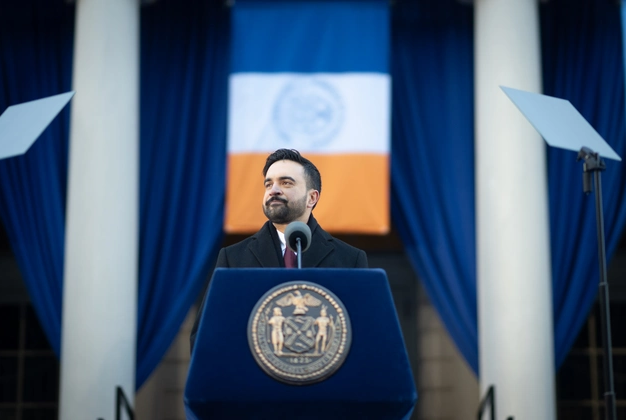
The New York City mayor has notched major wins while dropping some campaign promises as he confronts a hostile fiscal landscape.
NEW YORK — Zohran Mamdani the candidate might not recognize Zohran Mamdani the mayor.
After just 100 days in City Hall, the 34-year-old New York City mayor has largely ceded control of the police department to a moderate Democrat at odds with the left. He’s surrounded himself with several longtime government operatives untethered to the movement that birthed him.
And after finding himself marooned on a fiscal landscape inhospitable to the growth of new government programs, Mamdani has forsaken several campaign pledges while proposing a regressive tax on the middle class — part of a quixotic quest to pressure Gov. Kathy Hochul into helping cover an inherited city budget gap running into the billions.
In his evolved, more pragmatic state, the city’s first Muslim mayor and the youngest in a generation has also notched major wins.
Eight days into his term, Mamdani made a significant downpayment on his marquee campaign pledge of universal childcare. He weathered, with some caveats, a historic blizzard. And in an act of remarkable political gamesmanship, he so thoroughly beguiled President Donald Trump that the commander-in-chief seems to have mostly lost interest in retribution against the deep blue city.
“It has been a time where we have looked to show the city a glimpse into what these next four years will be like,” Mamdani said in a sitdown interview with POLITICO at City Hall, where he reflected on his first 100 days in office. “We want to be ambitious, unapologetic, unrelenting in not just our focus, but also in the speed of the work that we do.”
Every administration’s first three months tend to be a mixed bag. For Mamdani, peppered among the steady pace of policy announcements, there have been the inevitable emergencies, tragedies, scandal and communication faux pas that both set the tone and help gird for the next 1,360 days of a grueling job.
At the dawn of what Mamdani has decreed a new era in city government, he is already a more complex city executive than the one who gave a booming and lofty inaugural address in January: A democratic socialist who has retained his ideological bent while acceding to moderation and compromise. A skilled communicator nevertheless prone to tiptoeing around — and at times stumbling over — familiar trip wires that snagged his campaign. And someone who is adept at deploying his trademark social media savvy to satiate his base while endearing himself to New York City voters. On that point, recent polling offers a positive albeit fuzzy snapshot.
Mayors are rarely more powerful than the moment before they take office and begin making the myriad tough decisions that slowly erode their political capital. To that end, a March Siena poll found that Mamdani’s luster, while still bright, has taken on a slight tarnish with a job approval rating of 61 percent.
Survey results released this week by Marist reveal a more complicated view, putting his job approval at 48 percent — significantly lower than the 61 percent notched around the same time by his predecessor, former Mayor Eric Adams — but tracking high marks in other categories.
After emerging from the 100-day gauntlet, Mamdani still sees his political ideology as unchanged.
“It is very much the same in terms of being a democratic socialist and believing in government’s ability to transform working people’s lives,” he said, with one caveat: “I did not think I would think this much about the weather.”
Through all the possible prisms one can view Mamdani’s first 100 days in office, a fiscal lens most clearly illustrates the mayor’s current political predicaments and the challenges that await.
The democratic socialist campaigned on the power of bigger government to make New York City more affordable through universal childcare, free buses and a generationally large investment in affordable housing — fruits of a more competently run government that could be enjoyed by rich and poor alike. The fuel for these multibillion dollar projects, Mamdani has argued, would be higher taxes on the wealthy and major corporations.
Upon opening the municipal ledger, however, he found the city was worse than broke, with future expenses set to outpace revenue next fiscal year by billions of dollars — a yawning gap Mamdani is required by law to close.
Amid the bleak fiscal outlook, his administration backed off a promised expansion of housing vouchers for low-income New Yorkers and released a preliminary budget proposal that would cut funding for public libraries. His proposed Department of Community Safety — billed as a way to more humanely respond to mental health crises — was announced as a more modest mayoral office with few staffers and no new funding. And most troubling of all: without serious intervention, the structural budget problems left behind by Mamdani’s predecessor are likely to constrain his administration for years to come, casting long-term doubt over his agenda.
So instead of pressuring Hochul for higher taxes on the wealthy to fund democratic socialist initiatives that could prove the mettle of a movement suddenly flush with power, the Mamdani administration is seeking additional revenue just to stay solvent.
“The biggest challenge is the fiscal deficit that we face,” he told POLITICO. “It is — even after these last few months, the work that has been done, the commitments that have been made — still standing at $5.4 billion and will take an immense amount of work and negotiation and partnership to bring down to zero.”
So far, the gap hasn’t budged.
In a bid to avoid service cuts, Mamdani has pushed the city into risky fiscal territory by raiding budgetary reserves and threatening — though not very seriously — to enact a politically toxic property tax hike unless Hochul grants him his favored tax increases on the rich. Those gambits that have alarmed several bond rating agencies, even as Mamdani has been more transparent about the true cost of expenses compared to his predecessors.
The governor, meanwhile, continues to flatly refuse his entreaties. And she has few reasons to change her mind.
Her Republican reelection challenger would be eager to hit her over tax hikes. And she has no primary challenger — with the mayor helping to clear the field — to pull her leftward.
She is also the money behind an expansion of 2-Care announced in January that marked a major step toward Mamdani’s campaign pledge of universal child care for children under 5, meaning the mayor can only push his benefactor so far on taxing the rich, even as his base clamors for it.
The budget is also stoking an increasingly acrimonious relationship with Council Speaker Julie Menin, a Democrat who has begun to more fully embrace her role as a check on the mayor by refusing to back his calls for tax hikes. She released an alternative budget plan that sparked heated pushback from Mamdani and his administration.
Despite the formidable challenges, Mamdani kept the bar for himself high in his interview with POLITICO.
“As a candidate for mayor, I always made clear that we would accomplish our vision by the end of the time that I was mayor, and when it comes to the central pieces of our vision, we are very much on that timeline,” Mamdani said, referring to his promises of universal child care, freezing the rent and making buses free.
In addition to making progress on child care, Mamdani has set the stage for the ostensibly independent Rent Guidelines Board to freeze rents for rent-stabilized tenants in the fall. Free buses, however, are unlikely to happen this year. Mamdani is instead advocating for more pilot programs to be included in the state budget.
On campaign pledges fallen to the wayside — like expanding housing vouchers and a full Department of Community Safety — he says he still hopes to make good on them.
Asked to clarify if he’ll need one or two terms to achieve his top agenda items, Mamdani rapped the table in City Hall’s Committee of the Whole room and said: “Inshallah, it’s two terms.”
The first several months of a mayor’s new term are always at least partially dependent on the prior occupant of Gracie Mansion. While the budget bomb Adams left ticking as he limped out the door has hampered Mamdani, the former mayor’s agencies have also been providing ample policy fodder for Mamdani to mine as he pushes the city’s vast bureaucracy in new directions.
Bike lane fixes, a push for more public restrooms, settlements with corporations over workplace violations and more routine government functions like fixing potholes and answering 311 calls have all undergone the Mamdani treatment, appearing in a steady stream of social media videos of the type that cemented the very-online mayor’s skills as a communicator during the campaign.
“These small acts take on such an outsized meaning for New Yorkers because they are held up as examples of why government cannot be believed in,” Mamdani said. “How can you ask a New Yorker to believe in the promise of universal child care if they look out of their window every single day and see the same pothole not being addressed?”
His focus on that theme appears to be resonating, mostly.
In the recent Marist poll, more than half of New Yorkers said the city is on the right track, a 25-point-shift since late 2025, when the aftermath of Adams’ indictment plunged faith in city government to historic lows. More than 60 percent of those surveyed said Mamdani works hard, understands the problems facing New Yorkers and is a good leader for them. And more than two-thirds of respondents said he deftly managed a massive winter storm and ensuing cold snap that presented the first operational test for someone with a threadbare pre-mayoral resume.
Still, the 48 percent overall approval rating Mamdani netted in the Marist survey shows he is governing without a majority mandate. A poll from Emerson College and PIX 11 released Thursday found the mayor with an even lower job approval rating of 43 percent of registered voters.
Indeed, pockets of the city continue to harbor deep-seated animosity toward him. After being propelled by tens of millions of dollars in super PAC spending during last year’s campaign, the anti-Mamdani opposition continues to be fueled by distaste for his drive to hike corporate taxes and his criticism of Israel amid a Middle East war that is deeply personal to Jewish and Muslim New Yorkers.
And he has chosen a policing approach that could eventually alienate the left through a political triangulation of his own design.
In retaining Jessica Tisch as NYPD commissioner, Mamdani put an ideological counterweight in charge of a department he has been harshly critical of throughout his political career. And rather than aligning her messaging with his, Tisch has repeatedly — and publicly — staked out policy views that run counter to the mayor’s, putting Mamdani in an awkward bind.
In response to several instances of Tisch’s defiance, Mamdani has either softened his views or remained mum, in at least one case stoking concern from the New York Civil Liberties Union as a result.
The mayor insisted to POLITICO he remains committed to disbanding the NYPD’s Strategic Response Group — a controversial unit that responds to both counterterrorism threats and protests — and that his campaign pledge is the subject of an active conversation with Tisch.
He also praised Tisch’s job as commissioner, saying she is delivering on a key commitment to keep the city safe. The two recently announced another quarterly decrease in major felonies.
“I do not need to agree with every one of my commissioners or city workers at large about every single issue within their purview,” he said of his policy clashes with Tisch, before seeming to also claim ownership of her positions himself. “I do, however, need to agree with the decisions that they make and the outcomes that those decisions create.”
A person close to Mamdani, who was granted anonymity to speak candidly about him, said the mayor shouldn’t take support from his core leftist base for granted. The person predicted Mamdani could have a hard time keeping his Democratic Socialists of America allies in line if he inches further to the center — especially on policing strategies — since reforming the NYPD does not necessarily depend on large-scale funding infusions.
“There’s definitely a risk,” the person said of Mamdani’s pivot on public safety. “But I think generally speaking his supporters acknowledge that this budget crisis is a real problem and see their real fight at this stage as making sure Albany raises taxes on the rich.”
Mamdani still maintains strong ties with his closest outside allies, DSA’s New York City chapter. Both his chief of staff, Elle Bisgaard-Church, and the commissioner of a new department called the Mayor’s Office of Mass Engagement hail from the movement, which for now is sticking with its most prominent progeny.
“In just 100 days, Zohran and his administration have proved that democratic socialists can govern and can govern well,” Grace Mausser, co-director of the organization, said in a statement. “Childcare funding was secured, workers are already getting millions in restitution, snow was cleared with unprecedented speed, hundreds of renters have connected directly with the government in the rental rip-off hearings, and tens of thousands of potholes have been filled.”