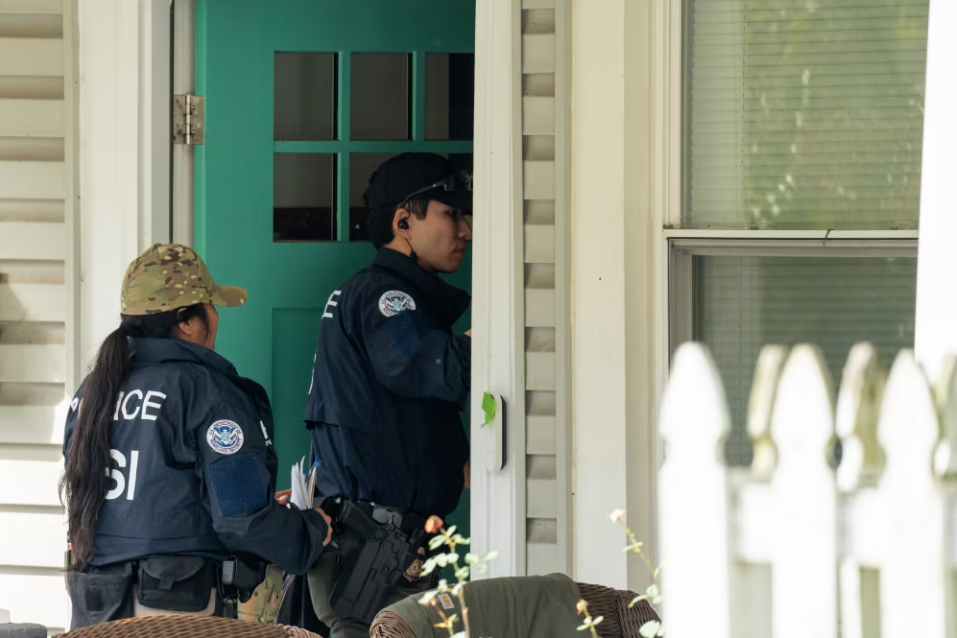


Washington’s most in-demand residences nowadays are more than a century old and extremely private — behind access-controlled gates and literally fenced off from the rest of the nation’s capital.
Intended to house generals and other top military officials, they are now home to several of President Donald Trump’s Cabinet members who say they feel safer living there than anywhere else in the city.
About half a dozen members of Trump’s administration now live in DC military housing — a historically high number considering it was rare that any senior civilian officials would live there under past presidents.
But with domestic political violence surging and new threats from foreign adversaries — CNN reported this month that Iran is developing plans to target senior Trump officials by detonating a so-called dirty bomb or a chemical weapon in Washington — experts say the trend of leadership preferring to live in secure military compounds could continue in future administrations, Republican or Democratic.
What is lost, however, is the democratic tradition of civilian leaders living among civilians.
As Trump has worked to put his stamp on Washington — deploying National Guard troops because he deemed the city unsafe; renovating the White House with a massive new ballroom; redeveloping a public golf course — the irony is that his administration is more sequestered from the city than any before.
“When they have jobs like that, they’re already living in a bubble because they have security details and they’re hustled from one event to another or to their homes,” said Thomas Kahn, director of the Center for Congressional and Presidential Studies at American University. “But now, even more dramatically, they’re not even living in the kind of neighborhood that most of us live in.”
“What it does is it contributes to or exacerbates the isolation of public officials, and it’s very sad,” Kahn added.
A White House official, touting a decline in crime in Washington, DC, said that “while many of these Cabinet officials aren’t able to live in the city themselves due to targeted security threats, they have personally contributed to the Administration’s efforts” to make the capital “safe and beautiful.”
Still, the living arrangements have invited scrutiny from some Democratic lawmakers. The Pentagon must report to the House Armed Service Committee by this spring on political appointees living in military housing, including the threats justifying their moves, legal authority for the arrangements and rental costs.
Rep. George Whitesides of California, who secured House Armed Services Committee approval for the report, said it’s necessary to investigate “politically-appointed officials living in housing designated for military members to ensure they are paying fair market rates.”

Treasury Secretary Scott Bessent was the most recent Cabinet member known to have relocated into military housing; he recently moved out of his mansion in Georgetown and onto a secure military base in Washington.
<p appearing="" on="" CNBC’s SquawkBox earlier this month, Bessent said Iranian threats on his life had forced the change. He has led an economic pressure campaign on Iran with sweeping sanctions.“F the Iranian leadership,” Bessent said. “I’m not going to be cowered. They have initiated death threats against me and other members of the Cabinet. We’re not going to be cowered.”
Attorney General Todd Blanche was also recently relocated to a military base, according to people familiar with the matter, over concerns for his safety. His predecessor, Pam Bondi, had lived on a base last year.
While some officials have moved to the protected housing because of foreign threats, others were wary of domestic political violence after the killing of conservative activist Charlie Kirk and a rise in other credible threats against them.
White House chief of staff Stephen Miller and his wife, Katie, who have four children, moved last year onto military housing from their Virginia home after a woman protested outside of it and distributed fliers with their home address. The White House official said, “The Millers relocated because there was an elaborate, well-documented stalking, doxing, and threat campaign targeting their residence.”
Defense Secretary Pete Hegseth came under fire last year when lawmakers discovered the Army was preparing to spend $137,297 on repairs and upgrades to his residence in Fort McNair.
Officials have to pay for the housing — typically upwards of $4,500 per month, depending on the residence. The rate is partially based on a precedent created by Robert Gates, the defense secretary under George W. Bush and then Barack Obama.

Gates had been the first secretary of defense to live in military housing — a historic, spacious 19th-century home on Navy Hill, next to the State Department.
Federal law at the time mandated that any civilian leasing military base housing must pay rent equal to the fair market value of equivalent off-base housing in the local area, which put Gates’ rent at more than $6,500 per month.
In 2008, the Pentagon argued for a legislative change to lower the rent by pointing out that the arrangement of living in military housing saved taxpayers money by utilizing existing military base security rather than maintaining and installing security and around-the-clock personnel at a private civilian residence.
Congress agreed, and from then on, Gates and every future defense secretary could rent military housing at a rate that was just 5% higher than what a four-star general or admiral pays.
Gates had intended for his successors to take advantage of the same arrangement, but it wasn’t until Jim Mattis, defense secretary during Trump’s first term in 2017, that another Cabinet member moved into the Naval quarters.
In 2018, Mike Pompeo, Trump’s secretary of state during his first term, inquired about living in the same Navy housing, but the Navy deemed it “problematic” because of “factual, legal, fiscal, and ethical issues,” according to an internal Navy memo previously shared with CNN.
The request raised a potential “appearance of Impropriety… relating to a civilian Secretary of State displacing a uniformed member of the military in a tight housing market,” as there was at the time “a housing waiting list of Navy Flag personnel,” according to the memo.
Pompeo ultimately lived in military housing anyway — on Fort Myer base in Virginia.
Goldendoodles and cats
What was potentially “problematic” eight years ago is now trendy as more senior Trump officials have opted for the secure residences during this White House stint.
The Millers live on the same Fort McNair base as Secretary of State Marco Rubio and Hegseth as neighbors in homes that are referred to as “Generals’ Row.” The military installation, with its homes usually reserved for high-ranking generals, sits on a peninsula where the Potomac and Anacostia rivers meet.

While appearing on Katie Miller’s podcast earlier this year, Rubio and his wife described an instance when one of their goldendoodles mistakenly burst through the Hegseths’ front door.
“The flip side of it is that one of Pete’s cats — oftentimes I’ll get home at night and the cat is just sitting on my porch and just looks at me, like, what are you doing here?” Rubio said. “The cat is on my porch acting, like, what are you doing in my house? And it’s like no, your house is two doors down.”
Kahn, who has visited the Fort McNair base, described it as “a world unto itself” with a store on the grounds and what used to be considered “the best tennis courts in Washington.”
“It’s a surreal atmosphere on them because they’re completely walled off,” Kahn said.
“There are sadly more and more threats against public officials, and it is contributing greatly to their isolation and separation from normal society,” he added. “I think we’re probably going to see more of it unfortunately.”
And there are other downsides. One defense official who has lived in Washington military housing previously said some of the accommodations might have been spacious, but “there wasn’t anything luxurious about it.”
“Let’s just say it was a century-old house,” the official said. “I mean, it was military housing. It was serviceable.”
Evan Perez contributed to this story.