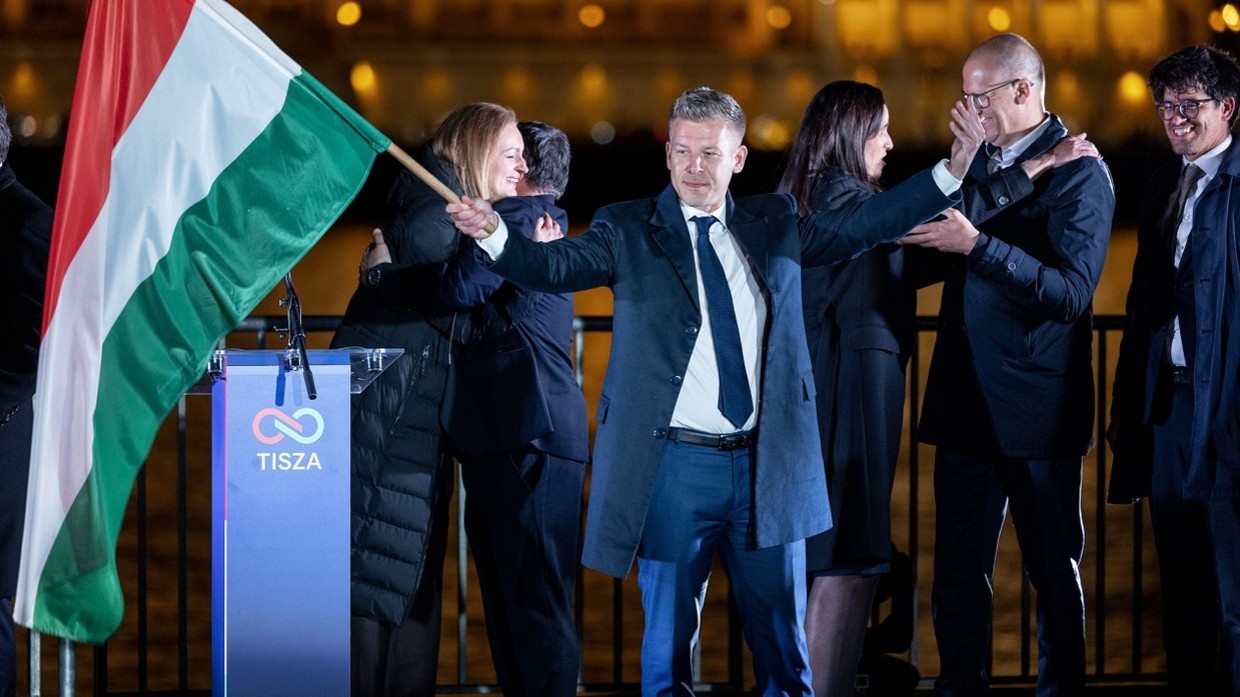
Revealing this is no spoiler, because “Spring Wind” ends before election day. Magyar granted the filmmakers, a husband-and-wife team named Tamás Yvan Topolánszky and Claudia Sümeghy, extensive access to his campaign. They shot for a year, in secret, accompanying Magyar as he rehearsed his speeches, berated his staff, walked to Transylvania, and held countless rallies before small crowds in the countryside. Then, a week before the election, they released the movie, temporarily, on YouTube. It quickly set viewership records. Some 3.3 million people watched it online—a number roughly equivalent to a third of Hungary’s population (and also, the filmmakers hasten to point out, strikingly close to the number of votes Magyar ended up getting).
A lot of the coverage of Magyar’s election, including my own, treated his victory as a hopeful harbinger, not only for Hungary but for the world. People were watching especially closely in countries, including my own, whose status as consolidated liberal democracies has been downgraded, in recent years, from “definitely” to “probably” to “it’s complicated.” There are many ways for a country to become unfree. There’s the classic military coup, the theocratic revolution, the swiftly adopted emergency decree. But these methods are blatant and outmoded, often more trouble than they’re worth, even for an aspiring tyrant who isn’t moved by human suffering. The cleaner, more contemporary path to autocracy has come to be known as competitive authoritarianism, and it was this method, as Jan-Werner Müller recently wrote in the London Review of Books, which “Orbán’s self-declared ‘illiberal’ regime had pioneered.” Orbán’s party won a super-majority in 2010, and for sixteen years he kept pressing his advantage, using the tools of the state to “staff the state bureaucracy and courts with loyalists, help wealthy allies acquire media companies and subjugate schools and universities.” As Müller notes later in his essay, “It’s hard not to think of parallels with the Trump regime.”
Of course, there are also clear differences. When Orbán lost, he didn’t put up a fight. Relatively early on election night, before all the votes were counted, he called Magyar to concede. (Some pundits argued, unconvincingly, that this proved that Orbán had been a democrat all along.) If Trumpism is modelled on Orbánism, at least in part, then anti-Trump Americans found particular promise in Orbán’s defeat, with its implication that a democratic turn could come to the U.S. next. There was an equal and opposite reaction from far-right Americans and Europeans, some of whom had flocked to Budapest in recent years, treating it as an illiberal city on a hill, and a source of government largesse. When I spoke with Rod Dreher, a right-wing writer from Louisiana, in 2022, he told me that he was about to move to Budapest. He has lived there for the past four years, working for a state-funded think tank. Last month, as Magyar was leading in most polls, Dreher wrote on Substack that he was “strongly considering moving to Vienna.” (He recently told The New Yorker that he has decided to return to the U.S., instead.)
Magyar began his career as a cog in the Orbánist machine. He represented the Hungarian government as a diplomat in Brussels during the Orbán administration, and enjoyed access to the inner circle of Fidesz, Orbán’s party. This access came mostly through Magyar’s wife, Judit Varga, who far outranked him, and who eventually became Orbán’s Minister of Justice. In early 2024, a journalist reported that, after children were abused in a state-run facility, people within Fidesz had quietly pardoned an accomplice. The scandal seemed to implicate large swaths of the regime, but only two Fidesz politicians—two of the Party’s most prominent women—suffered any immediate consequences. One of them was Varga, who resigned from parliament in disgrace. By then, she and Magyar had divorced, but Magyar claimed to be defending her honor when he wrote a screed on Facebook expressing his outrage at powerful men who resort to “hiding behind women’s skirts,” and also, by extension, at the entire system, which had become “nothing more than a political product, a layer of icing that serves two purposes: covering up the workings of the power apparatus, and acquiring immense wealth.” Magyar posted it impulsively, he later said, then retreated to his back yard in a panic. Publishing such a tirade, as everyone knew, was tantamount to political self-destruction. He rushed back inside, intending to delete it, but it had already started spreading. The following night, he gave a long interview to one of the few independent news outlets left in Hungary, repeating his complaints against the regime. This was a staggering spectacle—an insider, with receipts, confirming some of the country’s biggest open secrets in plain language—and it sparked a movement. Magyar commandeered a political party called Tisza. The Orbánists first ignored them, then smeared them. Nonetheless, the party’s popularity grew. Along the way, it acquired a staff, an ideology, and a political strategy.
After Magyar became an opposition candidate, the Orbán loyalists in the Fidesz-aligned media were characteristically aggressive, spreading lies about Magyar’s political views and his personal life without giving him any airtime to defend himself. The day after the election, the ban apparently lifted, and he appeared in the main state-controlled TV studio for an interview, which quickly turned combative. “What you did here,” he told the host, live on air, would have impressed “even Goebbels, or the North Korean dictator,” adding, “This factory of lies will shut down.” (In the archetypal hero’s journey, this is known as the victory lap.) When he left the studio and stepped into the hallway, some of the network’s employees greeted him with applause. Magyar recently claimed that several of Orbán’s top lieutenants are rushing to send their assets abroad, perhaps to avoid financial or legal sanctions, and that others have been shredding incriminating documents. The Guardian reported that “high-level figures close to Orbán have been looking into US visa options.” According to some Hungarian oligarchs, their bank accounts have already been frozen; one Fidesz-aligned media executive recently appeared on camera, in tears, offering his companies, gratis, to the incoming government. So far, Magyar does not appear to be interested.
The state-controlled media’s coverage of Magyar may have been unfair, though it is true that he has a messy personal life. He and Varga have three sons, and they continue to share custody, but their divorce was acrimonious. When Magyar emerged as an opposition figure, their disputes became a recurring story in the tabloids. He released audio, which he had recorded in secret, of her speaking unguardedly over a glass of wine in their living room, about the perfidy of the Orbán regime. She accused him, separately, of domestic abuse. Magyar began dating other people. Orbán has been known to spy on his enemies, and, during the campaign, it was rumored that someone close to Orbán had acquired a sex tape of Magyar and an ex-girlfriend, and was preparing to release it. Magyar took this rumor seriously enough to preëmptively record a speech about the sex tape, to curb the damage. (The tape, if it existed, was never released.) On the eve of the election, Varga, who had been quiet for months, wrote a Facebook post that appeared to be a tacit endorsement of Orbán.
“Spring Wind” recounts most of this. It’s not a lacerating piece of journalism; Topolánszky and Sümeghy make no secret of their fondness for their main subject, with whom they are on a first-name basis. “If you must call it propaganda, call it the propaganda of hope,” Topolánszky told me. Still, the two insisted that they had not ceded editorial control to Magyar, or to anyone else, and the film contains enough moments of tension to keep it from lapsing fully into authorized-biography territory. On camera, Magyar is asked about Varga’s allegations of abuse, and he emphatically denies them. Several talking heads mention Magyar’s temper. “What kind of person are you?” one of the filmmakers asks him, from out of frame. “Difficult,” he replies.
Given those hints of friction, it was a bit incongruous, before the film’s première in the Italian Riviera, to see four people walking the red carpet together: Topolánszky and Sümeghy, both wearing custom tuxedos, followed by Magyar and the youngest of his three sons, Miklós, who is a preteen. Magyar stopped to take selfies with some admirers who had flown in from Budapest. Then, inside the cinema, the four were seated together in the front row. (Miklós’s corn-yellow coif, which resembles his father’s, barely poked above the headrest.) During an onstage Q. & A., Magyar attempted to explain why life under Orbán had been so oppressive, even though dissidents were not beaten or jailed. When speaking Hungarian, he invariably refers to the Orbán administration using the word rendszer—a broader and harsher word than “government,” closer to “system” or “regime.” In Italy, adapting to his audience, he used the word “mafia.” His election victory was herculean, but he acknowledged that, in his hero’s journey, it was merely the end of the first act. As he put it, “The dance has just begun.”
As far as I could tell, I was the only American journalist at the première. Days earlier, before booking my flight, I had made it clear to Sümeghy that, as interested as I was in her filmmaking process, my priority was an interview with her main subject, the incoming Prime Minister. What ensued was a negotiation—or a dance, to use Magyar’s gentler euphemism—over whether I would be able to talk to him, and if so for how long, and what I would be allowed to ask. An intermediary from the documentary’s production company told me that any conversation with “Péter” would have to be a joint interview with Sümeghy and Topolánszky, as part of the film’s promotional rollout. I was urged to ask only about the movie, and to avoid political questions. I pushed back (sorry, danced back): seeing as the movie was about such things as politics and democracy, I argued, these topics should not be off limits. I couldn’t tell whether Magyar was doing a favor for Sümeghy and Topolánszky, using his star power to entice journalists into covering their movie, or whether they were doing a favor for Magyar, running interference so that he wouldn’t face tough questions, or whether this was all some sort of misunderstanding. On the night of the première, with my forty-five-minute interview scheduled for the following morning, the negotiation remained unresolved.
During Magyar’s campaign, one of his great assets was his message discipline. Once he reached a certain level of viability, he didn’t do many interviews with journalists; he preferred to speak for himself, on his Facebook page. (He did grant some access to established independent outlets, and also to a new outlet called Kontroll, which is owned by his brother.) When the Orbán administration tried to ban the Pride Parade in Budapest last year, hundreds of thousands of people showed up anyway, and it became something of a resistance rally. Yet Magyar avoided the march, defending “the people’s right to assemble” in broad terms while sidestepping the issue of queer rights, which are polarizing in Hungary. He promised to repair Hungary’s ties to the European Union, which had grown severely strained under Orbán, and to bring the country into compliance with various E.U. mandates, thus recovering billions of dollars in E.U. funds. But he also vowed to preserve Orbán’s hard-line immigration policies, which were popular domestically, including maintaining a wall that Orbán had built on Hungary’s southern border.
Magyar stitched together an exceptionally diverse coalition, and he kept it from fraying by focussing on what his supporters had in common—mostly, their opposition to Orbán’s corruption and abuse of power—while trying to avoid topics that could divide them. But now Magyar will have to govern, and any substantive decision that he makes will surely alienate some part of his base. Still, even after the election, Magyar has remained relentlessly on message—which is to say, vague and tight-lipped, leaving several inconvenient dilemmas unaddressed. Other than his feisty appearance on state TV, a long press conference the day after election day, and frequent optimistic updates on social media, he has been somewhat elusive, granting little access to the press and no major interviews to foreign outlets.
“We’ll suspend this deceitful news service,” Magyar told a state-TV anchor, during his appearance there. “We’ll create an independent, objective, and neutral public media.” But how does one go about that, exactly? Tisza’s party platform, more than two hundred pages long, promises a “peaceful regime change,” and lays out a bullet-pointed plan to “eliminate political influence in state institutions,” “recover stolen public assets,” and “restore the rule of law.” (When asked how he will accomplish all this, he has said, “We will not break the rule of law to restore the rule of law.”) This all sounds terrific, but the devil is in the dance. Many Tisza supporters hope that they will soon see the various rogues of the outgoing regime hauled off to jail—hopes that were, at times, stoked by Magyar’s campaign rhetoric. But such criminal convictions may take a long time, if they happen at all. And then there’s the separate question of whether they are a good idea.
In Hungary’s intensely gerrymandered system—originally designed to ensconce Orbán’s power, eventually a factor in his undoing—the plurality of votes that went to Magyar’s party will give it more than two-thirds of the seats in parliament. With this super-majority, it will soon be able to rewrite the constitution at will. “I didn’t hide my intentions,” Magyar said, during his post-election press conference. “Hungarians want a regime change.” This is true: if ever a candidate has come to office with a mandate for root-and-branch reform, it is Magyar. And yet, the more I heard him repeat such promises (or threats), the more they gnawed at me. At the première, watching “Spring Wind” for a second time, I remembered, with a twinge of unease, where I’d heard the same sentiment before. Throughout the film—throughout his campaign—Magyar vowed that 2026 would be a pivotal year in Hungarian history, in line with 1956, when Hungarians rose up against their Soviet occupiers, and with 1989, when pro-democracy protesters (including a young Viktor Orbán) led the transition to full independence. But there was another important year that Magyar talked about less often: 2010, when Orbán’s party took power with a two-thirds super-majority, then set about rewriting the constitution. “Hungarians want deep-seated and fundamental change in every area of life,” Orbán wrote at the time. “They have authorized us . . . to establish a new political, economic, and social system.”
Magyar has sworn repeatedly that his intentions are purer than Orbán’s, and that he has built a coalition that will hold him accountable. When his party overhauls the political system, he promises, it will do so judiciously, with ample democratic input, and only for the good of the people. It’s entirely possible, even probable, that he is being sincere. And yet, of course, this is what they all say. In person, Magyar gives every indication of being magnanimous and down-to-earth, smiling easily, thanking everyone profusely, and treating his son with what looks like authentic affection, even when the cameras aren’t rolling. But, as with any politician, it’s possible that his lawful-good pose is just that—or that he’s only a good guy for now, because he hasn’t yet been exposed to the corrupting allure of real power. (Magyar has already made at least one worrisome move—nominating his brother-in-law to be his justice minister—but recently, after considerable public pushback, the brother-in-law turned down the nomination.) During the most classic hero’s journey of them all, Odysseus prepares assiduously for his encounter with the Sirens, tying himself to the mast long before he can be tempted. Magyar—sitting in the front row, rewatching a film that had helped establish him as a global icon of anti-authoritarian resistance—was less than four days away from taking power. Was he prepared?
The morning after the première, Magyar and the two filmmakers gave a press conference to about two dozen Italian reporters. The venue was a casually magnificent stone building, constructed in the fifteenth century as a Dominican convent, on a promontory overlooking a sparkling bay. The surroundings seemed to impress no one except me. The Italians, mostly culture reporters, asked their questions about the film; the three Hungarians listened to a live translation via headsets, then gave their responses in English. I tried to pay attention while craning my neck to look up at the vaulted ceiling. (After years of frigid early-morning campaign junkets in Flint and rural New Hampshire, chasing a politician through an idyllic Mediterranean village was a welcome change; I will always give Magyar credit for this much, at least, even if he fails to revive democracy in Central Europe.) One of the Italian journalists started to sneak in a news-related question about Giorgia Meloni, the Prime Minister of Italy, with whom Magyar was about to meet, in Rome. Before the journalist could finish her question, though, Topolánszky cut in: “We are at a film festival, and this is not about the film. Next question.”
After the press conference, Magyar and the filmmakers were scheduled to sit with some Italian journalists for a series of five-minute interviews. They would be ready for me, a staffer told me, in about an hour. I went back to my hotel room to wait, but, as soon as I got there, I received a text containing one word: “Now.” Midway through the interviews, Magyar had abruptly cancelled the rest and returned to his hotel, one far more luxurious than mine, on an imposing hilltop on the other side of town. He was still willing to participate in my interview, I was told, provided I could get to his hotel right away. I speed-walked across town, trying to recast my questions about democratic renewal in the guise of film criticism.
I was escorted up to the hotel’s Ristorante Olimpo, where picture windows framed panoramic views of the bay, and seated at an empty table with four chairs. The only other people in the restaurant were two of Magyar’s aides and Miklós, his son, who sat at a nearby table eating burrata. After a while, the filmmakers joined me; a few minutes later, Magyar arrived, looking tired. “I’ll get through as much as I can in forty-five minutes,” I assured him. Magyar shook his head. “For me, it’s just three questions,” he said. “And as little about politics as possible.”
As it happened, Magyar answered more than three of my questions. Our awkward dance continued until the very end—me asking Magyar what he planned to do as Prime Minister, the documentarians interjecting with digressions about their film shoot—but what came out of it was Péter Magyar’s first substantial interview with a foreign journalist since being elected. He was cordial but cautious, and at times evasive—a big-tent politician who has come this far by hewing to his talking points—and he seemed to vacillate between an inclination to communicate directly and an instinct toward self-protection. We discussed the incipient Hungarian constitution, whether his victory represented a vindication for the center-right or the populist left, and his upcoming struggle—the still-unwritten second act of his dramatic arc—to lead his nation out of an extended period of competitive authoritarianism, into something more uncertain. Our interview has been edited and condensed for clarity.
Americans or Europeans who haven’t spent time in Hungary might be confused about how the system works—or worked, I guess, for sixteen years, until now. After your election, we even heard the argument: Orbán conceded right away, so this was never authoritarianism in the first place; he was a democrat all along. How do you explain this system to people who haven’t experienced it?
There was a clear risk during these two years [of the campaign]. To be honest, this risk goes also to nurses, policemen, teachers, doctors, public servants. Many of them have lost their jobs because they joined our movement, or supported our movement, or joined as a volunteer, or just joined the protests somewhere in the countryside.
Of course, I always said that there is an ultimate solution—to defeat [Fidesz] with an election. But to achieve this, to be able to defeat them, is not as easy as it is everywhere in Europe. This was not a government but, rather, a power machine, helped by the propaganda machine, the secret services, all the authorities used and led by Orbán puppets, like the President, the constitutional court, the public prosecutors, the media authority, and maybe the financing of the film industry, as well.
Many of the old opposition parties said that it is not possible to defeat them with an election. I was always confident that it’s possible. But it’s not easy at all. You have to risk many, many things—your personal life, your public life, your job, your dreams.
But we are finally here.
In your party platform, it says, “We are preparing for a peaceful regime change.” And that’s about to happen—or start, anyway—this weekend. So this raises the obvious question: how do you change these things? The manipulation, the abuse of institutional power, the self-censorship across the media—everything that the whole Orbán system has been built on over the past sixteen years. I mean, it’s not just going to change overnight, right? So how do you reform the system? How quickly can it happen? What are the expectations, and can those expectations be met right away?
We reached the election victory step by step, brick by brick—going around the country, visiting seven hundred cities and villages to meet personally with the people. And today, for the time being, the regime has collapsed totally. According to the latest [approval] poll, we have seventy per cent, and Fidesz has twenty-three per cent. So it collapsed—because the propaganda machine has collapsed, and more and more people are able to see the truth. Maybe it takes weeks, or days, to realize that they were not right or that they received lies about us. But I think it’s a very speedy process now. The oligarchs, the members of the regime, are now fleeing, trying to escape with their money to Asia or to South America.
Or to the U.S.
Maybe the U.S., as well. But I think now [Hungary] is a free country. The authorities are starting to work. The police, as well. The public prosecutor’s office, as well. I think this is the end of the regime, that’s for sure.
After you went on public TV and had that confrontation live on air, you left the set, you went into the hallway, and there were people applauding—employees of the network who were apparently not supportive of everything that station had become. So this shows how complex the situation is, because you can’t just fire everyone—
No, there is no intention to fire everyone.
So how will you do it?
It’s easy. Who were the political nominees? And who did any unjust, illegal things?
We have to scrutinize, we have to pay attention, we have to have a close look. It will not happen in one day. But we don’t want to fire anybody who was part [of the regime] as a civil servant, or a doctor, or a policeman. These are good guys. Our task is to rebuild and to strengthen the rule of law, the checks and balances. And to change, of course, the puppets of Orbán: the President of the country, the president of the prosecutor’s office, the constitutional court, the media authority. But not the average, normal citizen workers. That’s not our intention at all.
Last night, at the première, you said, “The dance is just beginning”—meaning, basically, that you’ve just pulled off this very difficult upset election victory, and now comes the even harder part, which is actually governing, holding your coalition together, delivering on your promises. You have supporters on the left, supporters on the right, supporters in the middle. And there will inevitably be some conflict, and some disappointment, among your supporters. How will you manage that?
You’re right—now there is a honeymoon feeling in the country, and the honeymoon could go away very, very quickly.
I think you’ll get longer than most people get.
Yes, but it’s our responsibility and task to get it longer, and to explain to the people the real situation, the exact situation of the country, of the economy, of the health-care system, the education system. It’s our huge responsibility to bring back the E.U. funds, to strengthen the checks and balances, to rebuild, to reunite the country, and to be very honest that we won’t be perfect—we are just human beings—and if we make any mistakes, to be honest and admit it, [and accept] the consequences. That will also be a huge difference from the Orbán regime, when there was no responsibility or consequences of any crime, any political mistake.
I think if you treat the people like adults, it’s not easy, but everything can be explained. And the more difficult decisions, the more sensitive decisions—we’ll see how long this honeymoon feeling will last, and, of course, I’m prepared for the change, for the [approval] numbers lowering. It’s quite normal. But, if you are honest, you will survive the more difficult times as well, I’m sure.
We will start with modifying the constitution, and we’ll write in the constitution that anybody can be a Prime Minister in Hungary only for two terms—maximum eight years. It will be a sign that we don’t want to do the same—to build a power machine—but just to govern, just to serve the country as long as possible. But maximum eight years.
So you can guarantee that you will be there only eight years?
Yeah, absolutely. Or four, we’ll see. But in the constitution it will be written that eight years is the maximum.
What are some other things that will be in the constitution that will check your power, limit your power? And is that new constitution being written right now?
[At this point, Sümeghy jumped in. “To avoid the point of the constitution at this table,” she began, steering the conversation toward a more general topic. Under Orbán, she said, Hungarians had “experienced lack of trust in our institutions—we were infantilized.” But Magyar, she felt, was starting to change this mentality, by treating his supporters as grownups.]
Well, if I can just treat all of us like grownups: I’m not trying to sneak in news-related questions, but I really think that it’s important to discuss what happens next. Everyone in the world is curious. The whole film, the whole campaign, was based on the premise that there were these key inflection-point years in Hungarian history: 1956, 1989, 2010, and now 2026. And so this moment you’re about to embark on—what you have repeatedly called a peaceful regime change—it raises some big and maybe difficult questions. Because this message—that we have won this big mandate for change, and we will rewrite the constitution—that was also Orbán’s message, after 2010, and now of course we look back on that as a disaster.
So the big question in my mind is: how do we know that this is not a moment like that, where the voters are handing you power and you will use it to lock in your own power? How can people really be sure that there won’t be an abuse of power, a betrayal?
[Smiling.] I really respect your try to reformulate the question. And I really understand that you would like to know the details. But the difference between us and the Orbán regime, one of the differences, is that it’s not Péter Magyar who will make decisions alone. So you are asking a question which will be decided by the Hungarian parliament, discussed with the Hungarian society—the professionals, the lawyers, and the political groups in the Hungarian parliament. So there is nothing to be decided at this time. So I’m not able to answer your question.
[To be a responsible leader] I think, everything starts in your mind, in your brain. It’s you who should control yourself. It’s not up to the constitutions, to be honest.
You mentioned that everything went wrong [after 2010] because of the constitution. No, it’s an average constitution. It’s because of the power, because of the Prime Minister, because of the mafia. It’s not because of the laws. I’m a lawyer—I’m ready to modify the constitution or the electoral law. But it’s up to the people, up to the political persons in power. You have to control yourself in your mind first. And to build a community that will control you as a Prime Minister, as a [leader] of the Party.
I have a sixty-three-point list on the wall of my office, written by colleagues, [about] how to control yourself. If you break these points, two or three of these points, then it’s time to reconsider whether you are still able to serve the country or not to rule the country.
Of course, it’s very important to rebuild, to strengthen the checks and balances, but at the end of the day everything depends on the people, on the political players. And I would be more than happy to transfer this power to anybody else who is better than me, who is able to serve the country, and go back to my kids and visit their football matches.
I know that everything is very personalized in politics nowadays. I think the difference between Prime Minister Orbán and myself, as well as the political players in the Tisza party and in Fidesz—what is your commitment? Why are you there? To become the richest person in Europe, or in Hungary? Or to serve the country and help the education system, the health-care system, the filmmakers—to solve problems?
That’s our intention. If I will feel in any way that it’s not my intention anymore, I will step down immediately.
How will you know if things have gone off the rails? And how will your voters know? Obviously, power corrupts. In 2010, when Orbán was elected with a large majority, people were excited for the change of regime. At some point, they knew it was going in the wrong direction, but they found out too late. So how will people know this time?
No, it’s really not possible, because our political party and movement is totally different compared to Fidesz. We have socialist-background people, right-wing people, radical greens, liberals. It’s a very heterogeneous group.
We have so many feedbacks. We have the Tisza Islands, thousands of Tisza Islands—our civic organizations. We have direct contact with the people through these groups. And we don’t have the oligarchs—we don’t have any economic power behind us. So it’s just not possible to—there is no intention [to do this] at all, but it’s just not possible to build the same system without propaganda, without a homogenous political group. We have a hundred and forty-one M.P.s in the parliament, out of a hundred and ninety-nine, so it’s a very strong mandate. But, at the same time, I can be very honest—it’s a fragile majority, as well, because we have such different people with very, very different backgrounds, coming from the countryside, coming from Budapest, coming from the left, coming from the right. So to have the necessary compromises, to be able to adopt the decisions, it’s just not possible. And, because of the direct contact with the people, we will have always the feedback, and they will have always the opportunity to just say, “Stop, we didn’t buy the ticket for this movie, or for this tour.” So I’m quite sure that the checks and balances will be working at the society level, as well, not only at the constitutional level or a political level. And maybe that’s better and more practical. I think this is the real regime change, the regime change in the minds of the people.
The story of the film is the story of building this broad coalition—left, right, and center. And everyone in the world, especially in the United States, is wondering if this is possible only in Hungary, or if this is possible elsewhere. I was in Budapest the night of the election, and the thing it reminded me of most was the 2020 election, when [Donald] Trump was defeated. I’m the one saying this, not you, but a lot of people think of Trump as an authoritarian, in more or less the same way Viktor Orbán was, and some are even feeling hopeless that there’s any real possibility of defeating him—that maybe it won’t be Trump next time, maybe it will be J. D. Vance or someone else, but still they worry that you can’t defeat this Trumpist system, this rendszer.
And then, after your election, a lot of commentators drew opposite lessons from your win. Some said that it shows that what we need to defeat Trump is to run a left-wing populist who can run to the left on economic issues, who can run against oligarchy and corruption. Others said, No, it shows that what you need is a populist who can run to the right on divisive social issues, such as immigration. Others said, No, you don’t need a populist at all; you just need someone who will promise a return to the status quo, or to the international liberal order. So which of these lessons is right? Or all they all wrong?
To be very clear and strict, I want to avoid any comparison between the U.S. and Hungary, between President Trump and Prime Minister Orbán. It’s not my task to make any comparison.
I’m not able to tell you honestly whether it can be copied or not. I know what we have made all together, the Hungarians, the fifty thousand volunteers. It was a huge amount of work, I can tell you. So there is no real secret behind the scenes—just to work, to be honest, to meet personally with the people, to look into their eyes.
So that’s it. It’s up to you, it’s up to the American people, it’s up to the European people whether they would like to make any similar political shift or something like that. Maybe it was a once-in-a-lifetime story in Hungary, but, as we mentioned already, it’s just the beginning of the story. So, O.K., we defeated the Orbán regime, but now we have to show to the public whether it was the best decision. I’m confident that it was, but the work is just starting, and the responsibility is really high. So please respect that I would like to avoid all the comparisons—I don’t know the U.S. situation in detail, and I want to avoid to intervene in any way in any foreign country’s internal politics. It was the way of Orbán to intervene into the western Balkans, or in the U.S., or in Spain, or in Slovakia. It’s not the task of a Hungarian Prime Minister or party leader to intervene in any way into other countries’ internal politics.
I respect that, but, I mean, the Americans were intervening in the Hungarian election, as you know. [Shortly before the election, J. D. Vance spent two days in Budapest campaigning for Orbán.] Why was that so important to them, do you think?
You should ask them. Or Prime Minister Orbán.