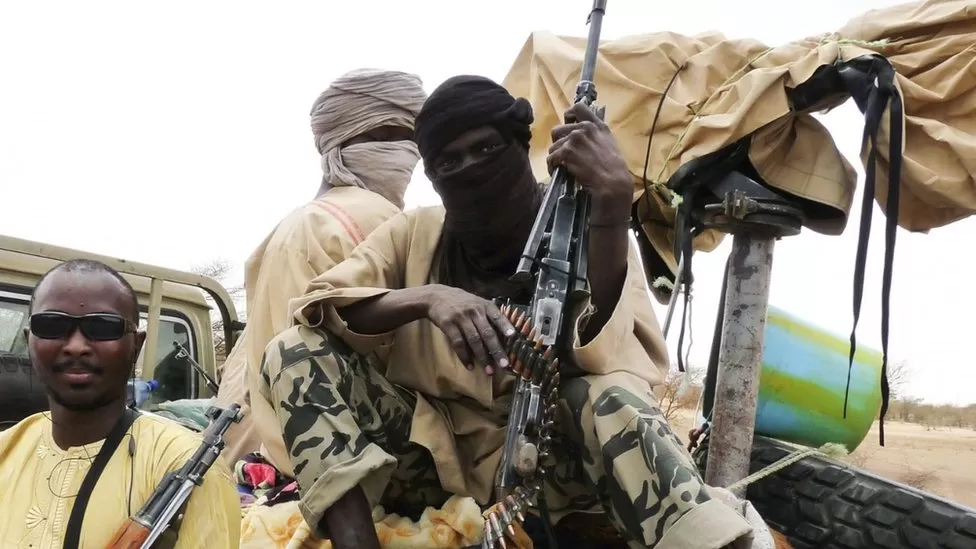

Russian Africa Corps mercenaries have suffered several setbacks since jihadists launched an offensive on April 25, including the death of pro-Russian defense minister Sadio Camara and the loss of the town of Kidal.
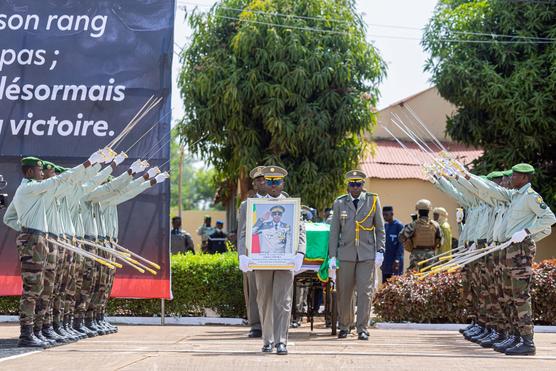
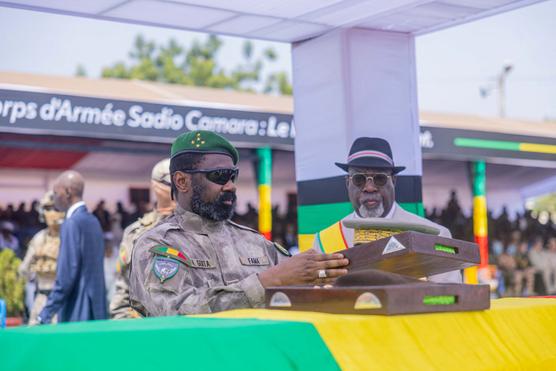
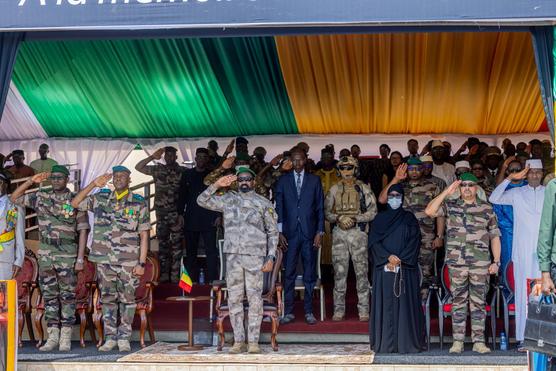
A Malian flag lay draped over a coffin. General Assimi Goïta stood at attention in front of it, with his eyes hidden behind sunglasses. On Thursday, April 30, speaking before a gathering of high-ranking officers under heavy security in Bamako, Goïta, the leader of Mali's ruling junta, paid solemn tribute to one of his key allies, alongside whom he had seized power in a 2020 coup: General Sadio Camara.
On April 25, during a large-scale joint offensive carried out by jihadists from the Jama'at Nusrat al-Islam wal-Muslimin ("Support Group for Islam and Muslims," JNIM) and Tuareg-dominated pro-independence forces from the Azawad Popular Liberation Front (APLF) in several regions, Defense Minister Camara, the junta's second-in-command, was killed in a car bomb attack at his residence in his stronghold of Kati, a garrison town located about 20 kilometers north of the capital.
Behind his calm demeanor, with his khaki beret and beige scarf, General Camara was not only a key figure in Mali's military government. He was also the architect of Mali's alliance with Russia, which he forged at the expense of France. In 2021, Camara, a Russophile who had come back from a training course in Moscow to help lead the coup in Bamako, met several times with Yevgeny Prigozhin, founder of the Wagner Group, to negotiate bringing Russian mercenaries over to Mali. Since then, he had served as Russia's primary contact in Bamako.
You have 82.54% of this article left to read. The rest is for subscribers only.