
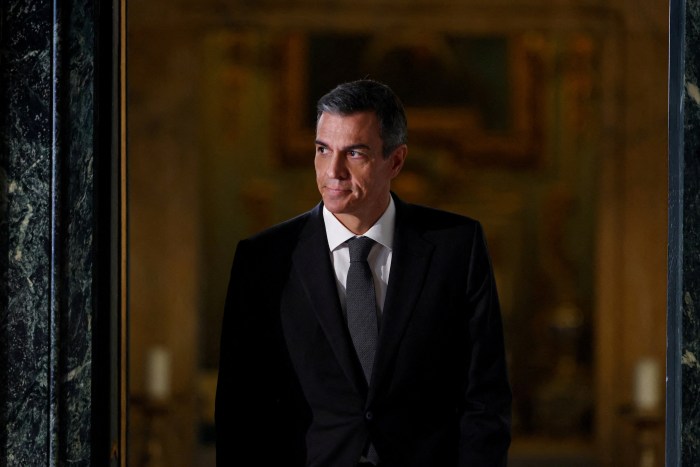
Prime minister lashes out at EU colleagues who blame his policies for Ceuta episode
By Margherita Stancati and Drew Hinshaw
As most migrants left a tiny Spanish territory in North Africa this weekend, Prime Minister Pedro Sánchez pivoted to a new crisis—one playing out in Europe’s halls of power.
His country had just experienced an extraordinary breach of sovereignty, with some 50,000 migrants illegally pouring into Ceuta from neighboring Morocco.
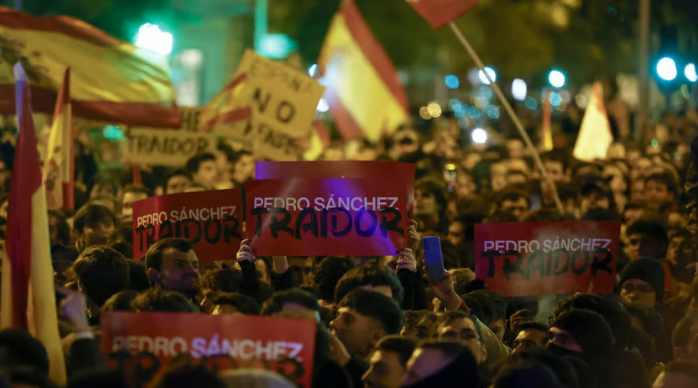
Leaders across Europe, from Italy to Finland, showed little sympathy for Spain. Some called for stricter border controls on arrivals from the country and blamed Sánchez’s government for its pro-immigration policies.
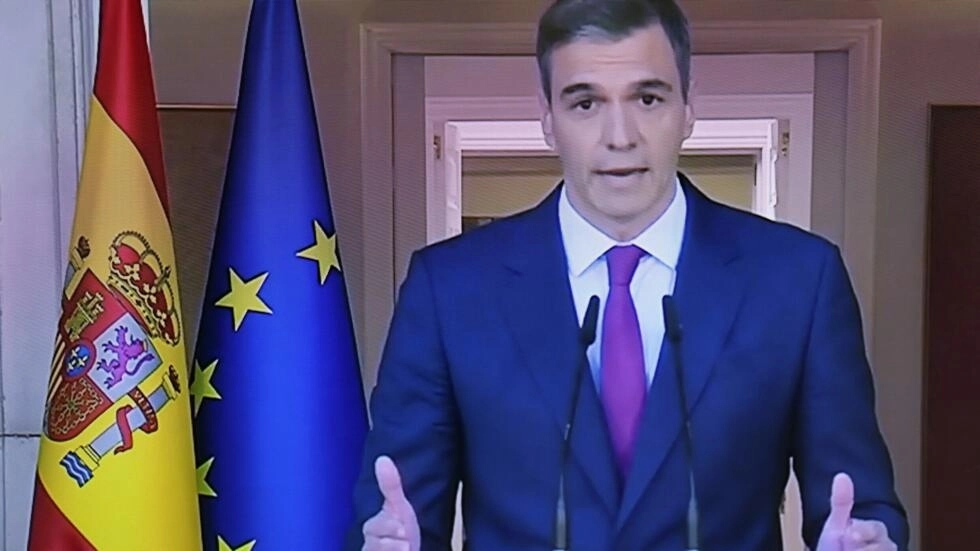
In response, the left-wing Sánchez lashed out in a letter to European Union chief Ursula von der Leyen. “The European Union cannot afford this kind of selfish, polarizing and unlawful reaction,” he wrote, accusing his colleagues of being “driven by prejudice, fake news, ignorance or political interests.”
The episode was the latest to put Sánchez at odds with other leaders on the continent, where the driving political force has been the rise of right-wing parties that have shaped their identities in opposition to immigration. Sánchez had staked his political future on a bet that he could govern and win from the left, offering amnesty to Spain’s illegal immigrants, while openly opposing the Trump administration.
The EU has sharply curbed the number of illegal migrants entering Europe in recent years—even Sánchez has erected new three-story-tall fences to check the flow into Ceuta—but the viral imagery of migrants swimming around a breakwater to get into the Spanish city shows how explosive the subject of unchecked migration remains. Sánchez’s rivals from Europe to the U.S. took the opportunity to target his policies.
“Instead of showing solidarity to Spain—and this is telling of the moment we are living—everyone is so scared of migration and its implications. So they decide to punish Spain as an outlier,” said José Ignacio Torreblanca, head of the Madrid office at the European Council on Foreign Relations.
President Trump described what happened in the exclave as a “catastrophe,” blaming the Spanish government’s “bad management” and “very liberal law.”
“When you look at Spain, they don’t know what to do,” Trump said on Friday. “They are invading the country.” He warned that similar scenes could unfold in the U.S. should Americans vote Republicans out of power at the coming midterm elections.
Prominent Republicans in Congress have questioned whether Ceuta should belong to Morocco instead of Spain. Morocco has been more supportive of the Iran war, while Sánchez was one of the most outspoken critics in Europe.
Meanwhile, EU countries that Sánchez hoped would rally around the threat to his country’s territory—as they had for Denmark in its Greenland crisis—instead accused the Spanish government of “policies that can serve as pull factors,” in a letter signed by leaders of 22 European countries. That letter, spearheaded by Italy and Denmark, singled out the amnesty granted to migrants by the Sánchez government.
Italian Prime Minister Giorgia Meloni took it further, temporarily suspending the Schengen Agreement, which allows for the free movement of people within the EU, for arrivals from Spain.
It mattered little that the crisis was over almost as fast as it had begun. The overwhelming majority of migrants left Ceuta within a day of arriving.

The few that remain face big hurdles to gaining entry to Europe. Special border checks apply to those traveling from Ceuta or its sister city, Melilla, which share Europe’s only land borders with Africa. That means migrants cannot freely cross the 9 miles of water separating them from continental Europe.
Over the weekend, Sánchez flew to Ceuta to reassure the local population, and Spaniards more broadly, that Madrid wouldn’t tolerate such violations of Spain’s territorial sovereignty.
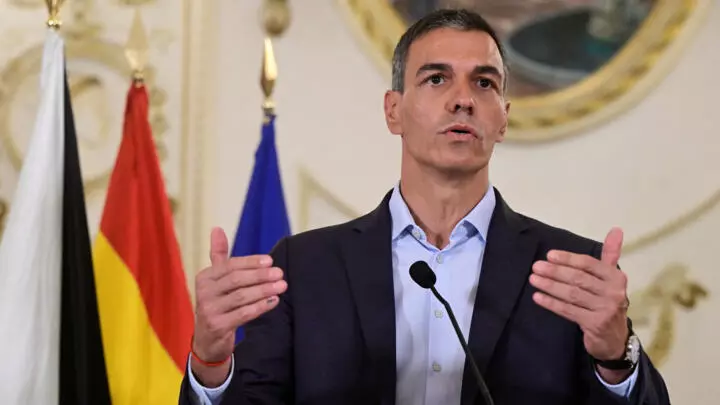
“All of Spain is with you! The government of Spain is with the city of Ceuta!” he said in a speech.
Sánchez, who became prime minister in 2018, is one of Europe’s longest-serving leaders. He has built a reputation as a political survivor, repeatedly defying expectations he would resign, including after failing to secure enough parliamentary votes to pass a national budget in recent years. His popularity has been hit by overlapping misconduct investigations into his wife, brother and Socialist party officials, who all deny wrongdoing.
The migrant crisis came as Spain’s politicians are entering election mode. Sánchez’s Spanish Socialist Workers’ Party is bracing for the possibility that it will lose next year’s election to a coalition that will probably include the fiercely anti-immigration Vox party—handing power to Spain’s most right-wing government since the transition after fascist dictator Francisco Franco’s death in 1975.
Santiago Abascal, the leader of Vox, also traveled to Ceuta, where he called Sánchez “a danger to Spaniards.”
Battles with the U.S. have given Sánchez and his party some hope that they can hold on to enough left and liberal votes to block much of what Vox and Spain’s leading conservative People’s Party would seek to achieve in office.
Sánchez has been careful not to blame Morocco for the migrant crisis. His government has instead attributed the sudden arrival of migrants in Ceuta to human smugglers. A recent ruling by Spain’s Supreme Court, which made it harder for immigrants who reach Ceuta illegally by sea to be returned to Morocco, also likely played a role, Sánchez said.
Migrants interviewed in Ceuta said that they were persuaded by social-media posts and that they found no resistance by Moroccan security forces—suggesting there could be more at play than just migration dynamics.
Ten days before the chaotic scenes in Ceuta, the Spanish premier traveled to Algeria, as he sought to secure more critical natural-gas imports from Morocco’s neighbor and rival. “Spain regards Algeria not only as a neighboring country, but also as a strategic partner and, above all, as a friend,” Sánchez said during the trip.
Morocco might have deliberately facilitated the crossings to send a political message to Spain, analysts say. Algeria and Morocco are at odds over the status of Western Sahara: Algeria has long supported a pro-independence group in the region, over which Morocco claims sovereignty.
Morocco said it had strengthened, not loosened, its security measures in response to the sudden movement of people. The spokesman of Morocco’s Ministry of Interior on Sunday blamed human-trafficking gangs and the dissemination of misleading information about easier access to Europe.

There are also diplomatic tensions between Morocco and Spain over Ceuta and Melilla, mostly Spanish-speaking cities that have belonged to Spain for centuries.
For decades, the U.S. remained neutral in the dispute between Spain, a North Atlantic Treaty Organization ally, and Morocco, which was declared a “major non-NATO ally” by the administration of President George W. Bush during the war on terror.
But as tensions with Spain have grown, the White House’s close allies in Congress have shifted toward language that treats the sovereignty issue as an open question. The change has alarmed Madrid.
In April, a House Appropriations Committee report described Ceuta and Melilla as “Spanish-administered cities…located in Moroccan territory and remain the subject of Morocco’s longstanding claim.” The appropriation committee’s vice chair, Republican Rep. Mario Díaz-Balart (R., Fla.) went further, telling reporters that the two cities lie on Moroccan rather than Spanish soil and were an open matter to be negotiated.
The American Enterprise Institute, a conservative think tank, published a call, by senior fellow and former Pentagon official Michael Rubin, for Moroccans to swarm and peacefully conquer Ceuta, expelling its Spanish residents, whom he called settlers.
“The very difficult situation of this government is that they are now trapped in an impossible situation,” said Pablo Simón, political scientist at Madrid’s Carlos III University. “There is a kind of cynicism going on here. We say we support human rights but prefer other more authoritarian countries in North Africa to do our border control. And when Morocco wants to, it can use this tool to pressure European governments.”