
By
Jason Polanco left behind nearly all of his belongings when he and his colleagues, who were just starting their work day, were told to evacuate their Midtown Manhattan office building Tuesday. They expected it to be brief.
Instead, they spent the next hours trying to get back inside to retrieve their laptops, paperwork and other essentials after the structural columns of a nearby high-rise building buckled.
Confused and frustrated, evacuated workers fled their office buildings and hotel guests hauled suitcases out of the danger zone as questions mounted over the building city officials said was “unstable” and could have a “localized collapse.”
Neither fire officials nor Polanco’s office have provided firm timelines on when they’ll be allowed back inside, with estimates ranging from a few days to two weeks, he said. A day after the incident, several nearby buildings remained evacuated and surrounding streets that are typically bustling with people were mostly vacant due to closures as teams continued stabilization work.
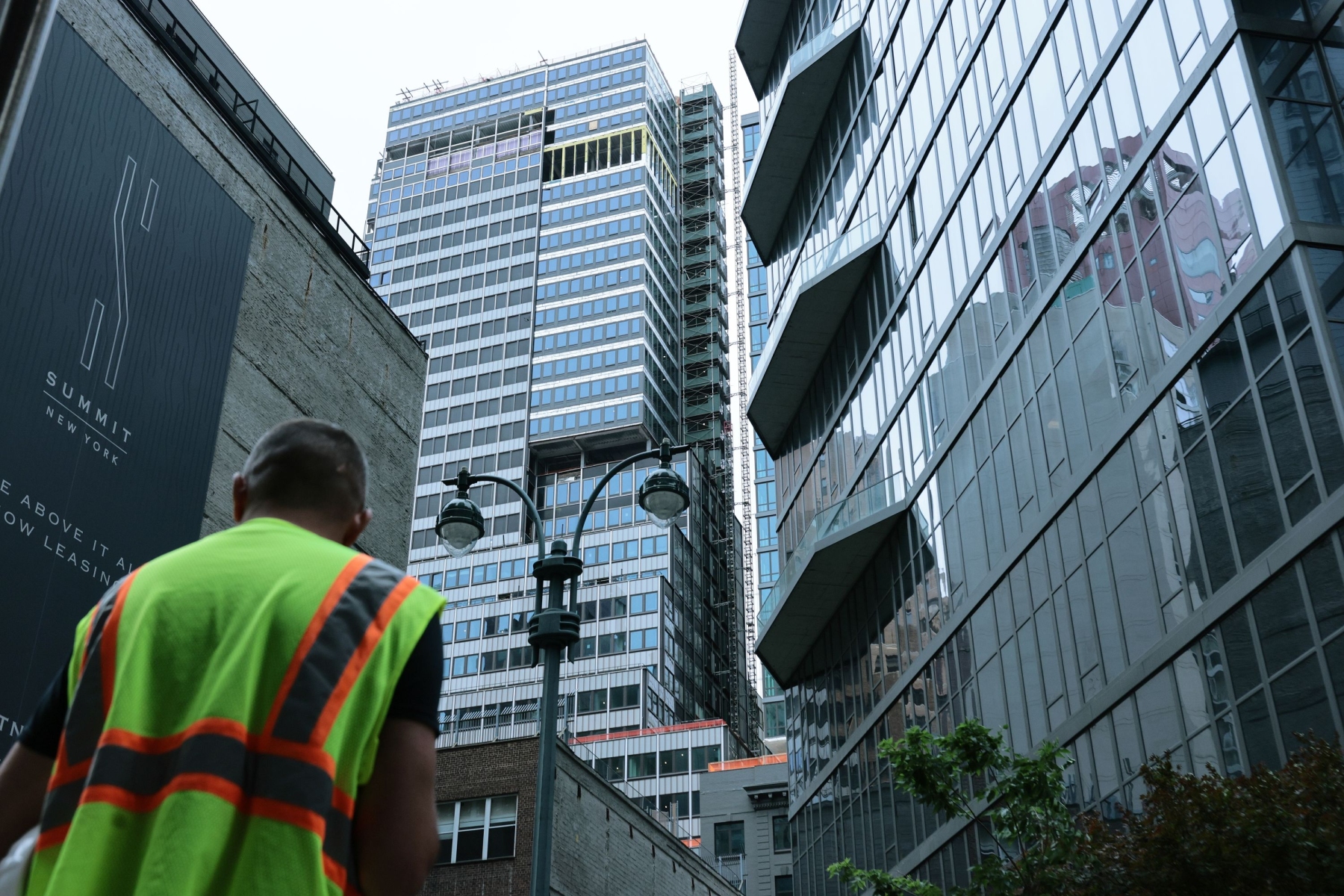
The East 42nd Street building hasn’t moved since Tuesday morning, but four nearby buildings remain evacuated, city officials said. Its developer said it has been stabilized with temporary shoring efforts and no part of it was at risk of collapse at any point, despite the city earlier establishing a formal “collapse zone” around it after warning it was not stable.
Police officers were seen walking along the barricades to keep pedestrians away. Curious passersby stopped throughout the day, gazing up at what used to be the Pfizer headquarters building. A half a block away, a local bagel shop, a nail salon and a Dunkin’ remained closed.
Here’s what we know about what will happen next:

Shoring will help stabilize building
Construction crews had worked overnight to reinforce the building’s weakest points and then began adding new steel supports to allow workers to safely begin stabilizing the building through a process called shoring, officials said.
They are expected to finish shoring up the affected floors by Thursday morning, said Nathan Berman, founder and managing principal of MetroLoft, which is the skyscraper’s developer.
The columns and beams that were impacted will be fully replaced once the Department of Buildings clears crews to do so, he said.
Workers are using emergency jacks and installing new steel supports to help stabilize the building, according to the head of the city’s Department of Buildings.
Shoring jacks are heavy-duty adjustable props used to temporarily support vertical structures such as ceilings, concrete slabs and walls. They are typically used during construction to maintain stability.
To fully stabilize the building, engineers may need to extend shoring 20 floors down to the foundation, and the sagging floors above. As of Wednesday, more than 100 additional shoring jacks had been delivered to the site and were waiting to be installed.
Crews doing the shoring work have to take precautions because their job is inherently risky, according to structural engineer Matthew Roblez. They work closely with structural engineers to find the right locations to add support or strength, he said.


Large-scale shoring operations happen regularly in New York City, as they are common in dense cities with older buildings, said Chris Cerino, past president of the National Council of Structural Engineers Associations and the Structural Engineers Association of New York.
Shoring and columns “transfer the weight in the compromised areas to the foundation,” Cerino said. “They will likely be installing shoring posts, which are small columns, for the entire height of the building at and below the failure zone.”
An unusual cause
Faulty columns supporting too much weight were to blame for the building’s structural damage, said Berman.
MetroLoft added roughly 18,000 square feet to 15 upper floors, and the additional load caused two columns to bend, Berman said. Those floors then shifted and sagged, some as much as four inches, he added.
The columns bent from either not being properly reinforced or “having been missed in the reinforcement process,” Berman said. The exact reason will be determined “in due time,” he said.
The buckled columns sit between the existing structure of the building and the new floors being constructed, which caused the floor to sag, city officials said.
It’s very unusual for beams to buckle in a building that is being remodeled and the issue presents a “unique” and “very challenging” situation, Cerino told CNN.
Union workers first spotted the buckled beams inside the 21st floor of the high-rise and helped people get out, their spokesperson said.
The Steamfitters Local 638 union workers “helped get everyone out of there” in a timely fashion, said Will Thomas, a spokesperson for the union.

Damaged portion will be rebuilt
The skyscraper is being converted into apartments, which is a more complicated process than building one from scratch and requires extensive structural, plumbing and mechanical work.
MetroLoft said it’s going to fix the issue that caused the structural damage and rebuild the affected portion alongside the ongoing construction.
Work to rebuild the buckled sections of the skyscraper won’t delay the construction project scheduled to be completed next year, MetroLoft said, adding it’s a localized situation that affects fewer than 30 apartments out of more than 1,600.
The project will add 19 floors to the existing 10-story building at 219 East 42nd Street and renovate the neighboring 33-story tower at 235 East 42nd Street, according to architectural firm Gensler.
Speaking about the city’s efforts to convert office spaces into homes as “part of our answer to the housing crisis, New York Mayor Zohran Mamdani said it has to be done safely and “in a way that is fully accountable.”
The incident shouldn’t deter future repurposing projects aimed at addressing housing shortages because it’s a “one-off,” some engineering and building experts say.

The project was “unusually ambitious” in adding 11 new floors to a 60-year-old structure, according to Kemal Celik, associate professor of civil and urban engineering at New York University in Abu Dhabi.
“The lesson is that when a project changes what a building has to carry, it needs the deepest possible level of structural review — before construction, not during it,” he said.
“The message isn’t that conversions are dangerous — it’s that old buildings deserve new questions before you ask them to carry new loads.”
Investigation into structural failure
A full investigation into the structural failure will help determine how it happened, what caused it and how similar incidents can be prevented in the future, the city’s Department of Buildings said.
Among other things, it will include reviews of construction documents, interviews with witnesses and a review of any available video or photo evidence from the site.
“Contractors and site safety professionals have a legal responsibility to ensure that they maintain a safe working environment on their construction sites, for the safety of their workers and for the general public,” the Department of Buildings said.
Any actions against those responsible for the structural failure are pending the results of the ongoing investigation, the agency said.
The agency has required the building’s owner to hire a third-party engineer to conduct a forensic evaluation — a formal investigation to determine the cause of the structural failure.


Developer already facing lawsuit
While MetroLoft continues to deal with the fallout of the skyscraper incident, it’s also facing a lawsuit filed by a construction worker who suffered a “grave injury” at the same site last year, court records show.
Wilmer Cabrera Rojas was standing on wood while working at the building when it “gave way,” causing him to fall and suffer “serious and permanent injuries,” said the November civil suit filed in New York State court.
The lawsuit was also brought against site owner 235 Fee Owner LLC, limited liability companies and others. The owner was also the subject of an anonymous complaint that the Department of Buildings investigated, accusing the company of performing construction contrary to previously approved plans.
Attorneys for the building’s defendants have denied the allegations in court filings and any liability for the accident, and have filed a third-party complaint against the construction company that employed Rojas.
An attorney representing the construction company has also denied the defendants’ allegations and could not be reached for comment Tuesday.
Lawyers for the defendants filed a motion to dismiss Roja’s case on Monday, citing the plaintiff’s failure to comply with discovery demands.
The building has also received multiple complaints alleging falling objects and unsafe conditions, but it’s unclear who filed them. The owner of the building did not immediately respond to CNN’s request for comment.
When evacuees can return
Since the incident began, the size of the frozen zone in which crews work to stabilize the building has gradually been reduced, roads have reopened and many of the vacate orders have been lifted.
While some evacuations have ended, four buildings remain under orders, the mayor said. Part of another building that includes a ground-floor restaurant also remains under an evacuation order, he said.

Evacuated workers like Jason Polanco, along with local businesses near the site, are now facing the uncertainty of when their workdays will return to normal.
For now, Polanco and his team will likely work from a nearby coffee shop until they can return to the building, he said. But businesses that rely on seeing customers in person, like a doctor’s office or a massage business, he said, are likely to be hardest hit.
CNN’s Holly Yan, Elizabeth Wolfe, Gloria Pazmino, Jeff Winter, Rebekah Riess, Sara Smart and Julianna Bragg contributed to this report.