How Argentina learnt to love Lionel Messi. He retires a god
For years, there were people in Argentina who criticised Messi, scorned him, rejected him and even booed him, but he now bows out a legend
BUENOS AIRES – What would the people of 196 countries have done if they’d been given Lionel Messi as a gift at the age of 18, at the start of his senior international career?
In all likelihood, they would have adored and supported him unconditionally. They would have made him and his football their own. They’d feel proud. What did Argentina – the country that actually received this ‘gift’ – do? It criticised him, scorned him, rejected him and even booed him. For years, many years. Not all Argentinians, of course, but a very large section of a country where many are truly mad about football.
Until one day, those Argentinians realised that the real madness lay in acting that way towards Messi.
The country that prides itself on being the birthplace of greats such as Alfredo Di Stefano and Diego Maradona took a surprisingly long time to feel the same way about a player many experts and football fans consider to be the greatest of all time.
That said, when it did happen, things swung to the other extreme, because it is almost impossible today to find anyone in Argentina who criticises him.
Those years of uncertainty will hardly be remembered this evening (Tuesday — early Wednesday in the UK) at River Plate’s Estadio Monumental in Buenos Aires, when Messi bids a final farewell to the Argentina national team with his 208th appearance in a friendly against Benin. But it is a story worth remembering, because it is highly unlikely that anything comparable will ever happen again.
At the age of 13, Messi left Rosario, the city where he was born and spent his early years, to try to earn a place at Barcelona. On that day in September 2000, he had no guarantees whatsoever. Barcelona weren’t exactly waiting for him with open arms; he had to win over the Spanish club’s coaches and leaders through his footballing ability and perseverance. And in doing so, he relied on the vital support and companionship of Jorge, his father.
Messi’s first steps in Europe coincided with one of the greatest traumas in Argentina’s history: the economic and social crisis of 2001–02. Argentinians emerged from that period with their national pride strengthened and embracing their historical heroes. Diego Maradona, without a doubt, is one of them. And for years, that posed a real problem for Messi.
In August 2005, Fabio Capello, then manager of Italy’s Juventus, approached Barcelona counterpart Frank Rijkaard and told him he wanted to sign this brilliant young player. He had been amazed by the 18-year-old Messi’s performance when the sides had met that pre-season.
“I could see he was already an extraordinary player,” Capello would recall years later in an interview with the Argentine sports newspaper Ole.
Rijkaard told him it wasn’t possible. Barcelona and the whole of European football were rapidly succumbing to the boy’s talent.
And in his own country? Many were in awe, but others insisted otherwise – that Messi was light years away from being Maradona, that he was a minor player who, if put to the ‘test’ of playing in the Copa Libertadores (South America’s equivalent of the UEFA Champions League) would be neutralised by any of its tough defenders. In the Champions League, they asserted emphatically, he had it much easier, because in Europe the defending wasn’t as physical or as ruthless as in the Libertadores.
Messi would live out his own particular tale of two cities for a long time to come – a life as a Dickensian footballer.
At home, he received praise but also criticism, along with pressure and hostility that often made his time with the national team a source of suffering. He paid the price for never having played for an Argentine club, for not having a local fanbase to idolise him. None of that mattered, however, in Europe and the rest of the world, where admiration for him was growing and unstoppable.
They were two very different lives, two Messis in one.
“For various reasons, Messi divided the Argentines. And yet he is the most brilliant player I have ever seen,” Tomas Abraham tells The Athletic.
A Romania-born Argentine writer and philosopher, Abraham, now aged 79, continues to organise his life and daily routine around Champions League matches. Among his books is one on the Holocaust (“The Denied Massacre”), which recounts how his parents escaped death at the hands of Adolf Hitler.
Abraham is a deeply cultured man, but nothing excites him or sets his heart racing quite like football, upon which he is a walking encyclopaedia. The intellectual has studied Messi’s case in great depth; he believes that, beyond the sporting aspect, there were political factors at play:
“Many Peronists (in Argentina) never liked him, because Messi never idolised the movement’s leaders. Kirchnerism (a left-wing populist strand of Peronism) chose to idolise Maradona because of their shared admiration for Fidel Castro and Hugo Chávez.”
Messi has always avoided making political statements, which is not to say he has lacked political convictions.
He showed this when, during the celebrations for Argentina’s 2022 World Cup title in Buenos Aires, he and his team-mates decided that the national team would not visit the Casa Rosada (presidential mansion), where the Peronist Alberto Fernandez was waiting for them. And he demonstrated it throughout those years in Barcelona when the club’s management and regional political powers waited in vain for him to come out in favour of Catalan independence and secession from Spain.

The Catalans, reserved and measured as they are, liked this Argentinian who spoke just enough, who stuck to short sentences and statements far removed from anything controversial. For his compatriots, who continued to view Messi through the prism of Maradona, this lack of loquacity caused bewilderment and suspicion. An Argentinian who speaks little? Is that even possible? Maradona was clear about what the Pope, Fidel Castro and George W Bush should do. The genius of Mexico ’86 had an opinion on everything and everyone. Did Messi really have nothing to say on matters outside football?
Ariel Senosiain, one of the most renowned football pundits on Argentine television, tells The Athletic that yes, Messi’s reticence was a problem for the player: “I think he was let down by the fact that idols in Argentina had a different personality, much closer to Maradona’s traits than to Messi’s. Over the years, Argentines who didn’t understand Messi came to realise that every genius has their own personality.”
Senosiain believes that Messi was treated unfairly by a section of the public back home – though he considers that this group was not particularly large: “Some Argentines felt he was aloof or distant – mistakenly so, because the truth is that Messi always maintained as much of his Argentine identity as possible, despite leaving his country whilst still a pre-teen.”
Josep Maria Minguella, the legendary agent who played a decisive role in both Maradona and Messi joining Barcelona, was very eloquent years ago when explaining why it made no sense for Argentinians to view Messi as a foreigner.
“The thing is, Messi doesn’t speak to you in Argentine Spanish… he speaks to you in the Rosario dialect! He brought Rosario to Barcelona; it’s as if he were living on the banks of the Paraná River rather than the Mediterranean.”
Marcelo Gantman, a journalist specialising in the business and technology of sport, followed Messi’s progress in person at every World Cup, and has a theory: part of the blame for the Argentinians’ disaffection lay with the media.
“I think that back then, Messi was also a reflection of the press’s frustration with the national team, which went a very long time (28 years, from 1993 to 2021) without winning any titles. They criticised Messi – a player in a class of his own – for not performing for the national team in the same way as he did for Barcelona. Without really taking into account how that Barcelona side operated and how that team was built,” Gantman tells The Athletic.
“It was a time when journalists believed they could interpret what people felt when they talked about football, because social media didn’t have the influence it does today. The press claimed to represent the fans’ voice in their football coverage.”
There was another comparison with Maradona that worked against Messi, and this one was purely footballing: while the Napoli legend displayed a style of play brimming with talent and anguish – a reflection of his eternal battle against the powerful – everything came so easily to Messi that his game became excessively cold for Argentine tastes. There was a lack of sweat, blood, drama; there was a lack of suffering. How could everything be so perfect, so simple?

It was by no means simple, however, to do what Messi did. He possessed extraordinary talent, yes, but this was underpinned by many hours of work, by countless training sessions with the team and on his own, always with the aim of approaching perfection.
Was the World Cup title in 2022 the turning point, the Rubicon where suspicion and distance gave way to love and devotion? Only partly so; the roots of Messi’s transformation into a universally adored idol must also be sought in previous tournaments and, in turn, in the difficult times he faced in his own country.
The anti-Messi sentiment reached its peak following Argentina’s elimination in the quarter-finals of the 2011 Copa America, held in Argentina, when the crowd in Santa Fe, which is in his home province, saw him off with a resounding chorus of boos – something Messi had, at that time, only ever experienced during his visits with Barcelona to the Bernabeu, Real Madrid’s stadium.
Messi, as always, responded through his play, even when he faltered, as in the 2014 World Cup final against Germany, and the 2015 and 2016 Copa America finals, both against Chile.
The political climate in Argentina began to change in 2015, although the national team remained in crisis: it would hit rock-bottom with the unclassifiable Jorge Sampaoli at the helm, before being reborn from 2018 onwards with Lionel Scaloni in charge.
The semi-final of the 2019 Copa America already sparked hopes, and the title in that tournament two years later – with a victory in the final against Brazil at the Maracana in Rio de Janeiro – signalled the start of a new era. How could anyone continue to deny Messi, or refuse to enjoy the fact that he was Argentinian?

Then came the epic run of winning the Finalissima against European champions Italy, Qatar 2022 and another Copa América title in 2024, and it all culminated in the thrilling 2026 World Cup. In five years, Messi received a hundredfold the affection that had been withheld from him over the previous 15.
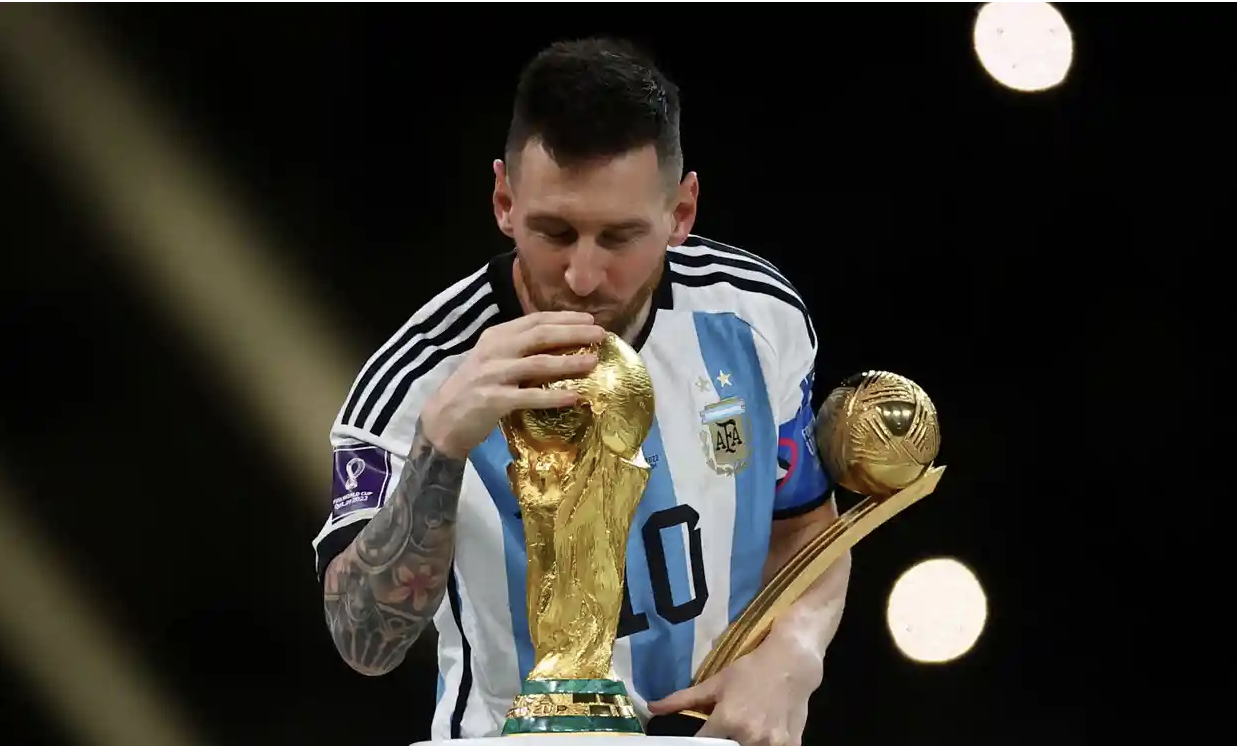
On December 20, 2022, when five or six million people took to the streets of Buenos Aires (more than ten per cent of the country’s population), the celebrations were perfect despite the anomie of Fernandez’s government. A self-organised celebration in which Messi and the Argentinians earned top honours. And nothing would ever separate them again.
This was demonstrated in the days leading up to this year’s World Cup — a distillation of Messi’s life, as the No 10 experienced every possible emotion: the intensity and euphoria that only football can generate, and the worry over his father’s health, the truth of which his family had actually been keeping from him, so as not to bring him down in the middle of the tournament.
In three months — from June to September— Messi went through far too much: a whirlwind of events in both his sporting and personal lives. A fabulous World Cup in which he was the best player, even though FIFA denied him that award; a crushing defeat in the final against Spain; the death of his father; and the announcement that he will be leaving the national team. A combination of emotions that had the effect of revealing a more human and approachable side to Messi, with social media posts marked by heart-wrenching sincerity and simplicity – a true laying bare of his soul and heart.
On August 8, Nelson Castro, one of the most renowned presenters on Argentine television, was overcome with emotion. A screen showed Messi arriving at a cemetery in Rosario, where he was bidding farewell to his father, who had died just hours earlier.
“What values Jorge instilled in Lionel!” repeated Castro, while hundreds of thousands of Argentinians couldn’t take their eyes off their screens, on which not much could be seen — though it didn’t matter to them.
What mattered was to be there for Messi from afar, to make him feel that there was nothing left to think about or debate, that it had all been a mistake, that they would never turn their backs on him again.
- Sebastian Fest is a freelance journalist based in Buenos Aires who has covered Messi’s career at club and international level. He is the co-author of the biography Messianic, alongside Alexandre Juillard.