
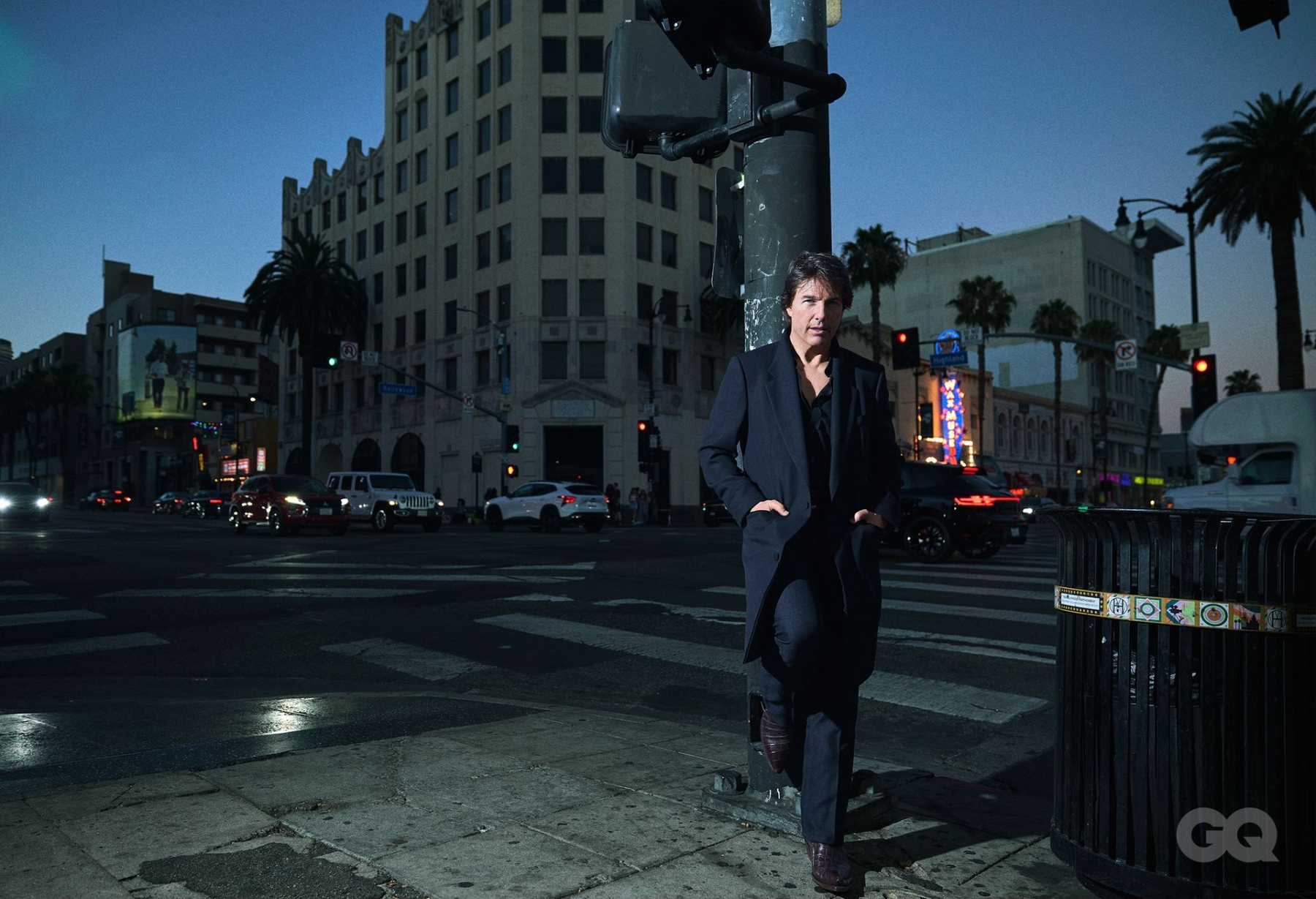
This interview is drawn from two conversations, one with Cruise and Iñárritu and another with Cruise one-on-one. The latter was filmed for a video that you can watch below. The conversations have been combined and edited here.
On the Warner Bros. lot in Burbank, California, just down from where they shoot The Pitt, is the studio’s old scenic loft—the dusty industrial space where artisans once painted backdrops. Tom Cruise is standing in the center of the room and he is happy. “When you’re making a movie,” he says, “you remember every single person that it takes to be able to make a film.” This is how he talks: grandly, universally. He looks like he’s conducting a tour of the lot. He looks like Tom Cruise. “I mean, these guys that are painting backgrounds and building the sets and moving the cameras, lighting, every area of making a movie—it’s light, architecture, the design, all of it, to entertain audiences,” he says. (The question was: Do you remember using a painted backdrop in a movie?)

Cruise, at 64, has lost none of the intensity or commitment that, at 18, signaled the arrival of an impending star with 1981’s Taps. In fact, he might be more intense. He believes in movies so much that he’s taken to saying: “Making films is not what I do. It is who I am.” Having spent some time with him, I believe that he believes this. He is a camera-lenses guy. He is a ride-the-actual-motorcycle-off-the-actual-cliff-and-deploy-the-actual-parachute guy. He’s risked his life for the movies and also seems to have winnowed away the entire rest of his life for the movies. (When I ask him what he does when he’s not working on a film, he says: “I’m preparing for the next.” This is a typical answer for Cruise, whose approach toward questions that are not about work is to make them about work.) The first trailer for his newest film, Digger, was a two-and-a-half-minute clip reel of Cruise’s past performances followed by 42 seconds of the new film. The message was: This is a person who carries all of cinema—a body of work that spans Stanley Kubrick (Eyes Wide Shut) and Steven Spielberg (Minority Report, War of the Worlds) and Paul Thomas Anderson (Magnolia) and Martin Scorsese (The Color of Money) and Michael Mann (Collateral) and Francis Ford Coppola (The Outsiders)—everywhere he goes.


Digger is directed by Alejandro G. Iñárritu and stars Cruise as an oil-company magnate who unleashes what could be the end of the world. In the auteurist ambition of the film, and its weird originality, it recalls a time in Cruise’s career that seemed to come to a finish around the fourth Mission: Impossible film, in 2011, when Cruise remade himself into an action hero and a franchise filmmaker—the star of Jack Reacher and Edge of Tomorrow and Top Gun: Maverick.
Cruise has rarely spoken at length to journalists these past couple of decades. I’m still not entirely certain why he decided to do so here (though you can read his reasoning below). He will say to me, more than once, that movies, and how they are made, are what fascinate him—“less about talking about myself.” You’re very outwardly directed, I say to him at one point.
“I am,” Cruise says. “I say it. I am.”
Tom Cruise: It is the culmination of all my skills. I’ve never done it before. Everything that I’ve done has been very thought-out, why I did it. I have personal goals and challenges with everything I do. I was so excited to be able to have this character. It’s the most challenging character ever.
TC: Oh my God, not even close. Not even close.
TC: I understand. Look, I love it. Each one is a challenge. This is the culmination of ability, where you’re looking at the timing, the rhythm, the language. There’s layer upon layer of skills for this performance. And with him [gestures at Alejandro G. Iñárritu], it’s so precise, what he’s able to do. I remember seeing Amores Perros, I’m going, “Holy shit, look what this guy did.” And he makes it look like you have the handheld and he’s walking into these places. I’m going, “Oh my God, the colors and the sets are thought-out. The framing is thought-out. It’s everything and it’s making it look like it’s not thought-out.” And the impact and the power was just like a hammer. You go, “Oh my God, look at this diamond.”

Alejandro G. Iñárritu: An actor is a cathedral. It’s a whole temple of possibilities. And there’s the emotional baggage that I think is owned naturally by somebody as a human being—beyond the skills, beyond the school, tradition, talent. When I see the eyes of somebody or an actor or an actress, I can recognize that. I can see the depth through those windows and see how far they go. I know how far that landscape is. Sometimes that is infinite. If you see Tom’s eyes, those eyes can get you through fucking hell. I mean, they are landscapes over landscapes over landscapes. And the understanding he has of that, I can feel that. And you can see that.
TC: I don’t know, you’re a kid and you have a dream. I was always, I guess, you could call me precocious, where I’d look at people and I’d look at their lives in movies. And I was always moving around. So I saw different cultures, even within America and Canada where I lived. And you could see people, how they reacted, and why did they react that way? What are the things that bring people together? Those were always just questions that I had for myself at a very early age. I had this dream [of making movies]—and I didn’t go to film school. I didn’t go to acting school, and all of a sudden I’m 18 years old and it’s happening. And I guess through time—I had my secret plan that I had because I knew very early on: Don’t tell people you have dreams.
TC: But I’ve talked to many people, and they’re like, “Sometimes you’ve got to keep things to yourself.” And those dreams, I’d write them on a board and I had them on my wall. And it wasn’t: I want to be famous. I definitely wanted to make movies, but I wanted to travel the world and I wanted to know people and know life. And how do you figure out what works and what doesn’t work? So then I just started studying. I’m on a movie set and I’m looking at every single department and I had a dream. And I didn’t know there were barriers—meaning, you’re not supposed tos—on movie sets. When I did Taps, I went into town and shaved my head without telling the director because he said, “Create the character.” I showed up on set and I took my hat off and [director Harold Becker] looked at me, and he’s like, “What’d you do? You got to tell the director.” I was like, “Oh, sorry.” Everything was Yes, sir. No, sir. Yes, ma’am. No, ma’am.

TC: My mother was from Kentucky, very respectful of people. I like to help people. I like to see people do well in life. And I had a secret thing I had for myself, which was always: Leave something better. We lived in rented houses. So it was always like: Make sure that the room is nicer. The classroom, whatever it is. I always had a secret thing of: I want to improve things. I want to improve myself. But not at the detriment of others. So I was always looking, I guess, for what is the greatest amount of creation and the least amount of destruction?
TC: Surprisingly, that’s not true. When you go to a premiere, there’s three, four generations of people that are there. When you look at Netflix, they are able to taste and see these different kinds of films. So those things we’ve discovered in terms of how a library travels globally.
TC: I never have. It’s always an evolution. And for me, it’s been something where it’s a constant challenge of one step to the next. And things that I’ve never talked about—the things that I’ve done and why and what I’m exploring—have been very deliberate. I’m exploring my skill, learning new skills, constantly pushing myself. When you’re looking at it, it’s story, it’s character. It’s: How do you make Top Gun a sequel? That has its own challenge. Those are the things that have always fascinated me, always interested me. Less about talking about myself, believe me.
TC: I know, I know, I know. [Laughs.] I’m more interested in you than hearing myself talk.

TC: Look, I think you could look at my life and go: I like standing on the edge of a cliff physically and metaphorically. Meaning, I look at life as an adventure, and I always have, my whole life. I want to understand people. I want to understand life and cultures. We’re looking at life. I wonder: Who are those people? How do they feel? Do they think the way I do? Do they laugh at the same thing? How do I connect with them? And I didn’t want to just be a tourist. I wanted to go make movies there because I also find you really get to know people when you create with them. Everyone has a different subjective reality of what they think about life, about people. And there is common ground in humanity, and I’m looking for that common ground.
TC: But here’s the thing: How do we use these tools to create an emotional effect on an audience? And is it communicating what we want to communicate? So do I fear death? No. I don’t. It’s not like I’m not afraid. I don’t mind the feeling. I understand life has certainties and uncertainties. And in making movies and living life, what interests me is: Let’s move the uncertainties more into the certainties, but I want to create other uncertainties, so that we’re moving forward and it’s part of the adventure of it.
TC: It’s just who I am. That’s my theory.
TC: There’s stuff where you want to feel that. You want to feel that uncertainty. But I’m not afraid to feel afraid. I don’t know how else to say it. I’m not afraid to go, “Okay, I know this is a leap and let’s take the jump. Let’s go.” And I try to recognize things that I don’t know, and I don’t pretend to know things that I know and things that I don’t know. So that’s how I feel about it. Are you afraid of death? Are you afraid to be afraid?

TC: Look, I know it’s not for everybody. I don’t think it is.
TC: And you know what? Everyone has their own things, what they have to confront in life and what they feel is scary or whatever.
AGI: I remember when I saw your making-ofs of Mission: Impossible, Tom, when you are doing these fucking stunts, and I saw Chris [McQuarrie] with a face like he’s going to be dead of a heart attack. I saw myself with you describing this, Zach, because in Digger we have this scene, he was not risking his life, but there was this ballet, right? Painters have paintings, musicians have their compositions, but in cinema, you have architecture, space, lighting, dialogue, drama, dance, all this shit. Tom is driving the whole dance, and if Tom fails, everything collapses, right? He’s the sun of these satellites. And you have Sandra Hüller and Jesse [Plemons] and Riz [Ahmed], and everybody has a part of it, and 300 extras. And there’s a long scene that we have been planning for months with a lot of ideas, a lot of dialogue, a lot of fun, a lot of shit, and every second counts. And you are in the fucking crane, and if something fails, one word, one hesitation, one stutter, it’s fucked.
And then Tom returns, and I give him seven notes. He was just looking at me with the eyes like this. [Does an impression of a superintense TC.] And then his eyes were, like, taking pictures, I think. Click-click-click. And then he said, “Yes, I got it.” “Are you sure?” “I got it.” “Fucking camera!” And then, “Take!”
And I’m like fucking Chris [McQuarrie], dying, saying: Please don’t fuck it up. And as he hits every note, I’m just saying, “How the fucking hell is this guy able to understand the physicality, the spaces, the silence, the shout, the aggressivity, the vulnerability, the dance with the camera, and knowing every bit?”

TC: I think about the joy of being able to create, the people that I have created with, the amazing times I’ve had, the wonderful challenges that we’ve overcome, and to be able to make films and to have dreams as a kid to be able to do this. I see everyone involved in making it. I feel grateful about that. I remember every moment when we’re going through making these things and the evolution of those projects. Those are the things I think about. When I look at Digger, and finally after 25 years to be able to work with Iñárritu, everything’s led to this.
TC: Mission—first film I ever produced. And Interview With the Vampire.
TC: It was beautiful. I love it. It’s home. For me, home is on a movie set. People go, “Where do you live?” I’m like, “On movie sets. And around the world. I’m a citizen of the world, a citizen of humanity.”
AGI: When I had this meeting in London with Tom, and we were just closing the deal with Pinewood, I said, “We’re going to shoot in Pinewood.” “Oh,” he said, “I have shot there.” I said, “Yeah, really?” He said, “Yes, 40 years ago we burned that stage.”
AGI: “We burned that.” How the hell is somebody telling me, “Forty years ago, we burned a stage”? I said, “Well, I hope we have better luck this time.”

TC: Here’s the thing. There’s not an easy film to make. Let me just demystify. If you care about something, we don’t take the easy road. Was it joyful? Every minute of it. For me it was joyful, but it doesn’t mean that it doesn’t have its confusions and pain. If you’re looking for just an easy road, that’s not it. I never wanted my life to be that. Life is an adventure. And I told you I want to be on that edge of the cliff looking down physically and figuratively, and that’s where this guy [gestures at AGI] lives. But also as you’re seeing it, he’s immersing you in a cinematic world that feels emotionally authentic. And the movie is so funny. The humor in it is so great, but there’s not one-comedy-fits-all. There’s different skill sets for comedy. There’s a different comedic element from Risky Business to Rain Man to Les Grossman to these—
TC: But it’s not the same. People look at it, and I never talk about this, but you have to find the language of the movie and you have to dream and reach for something.
AGI: I think so. I love our absurdity as human beings, and I laugh a lot. People think of me that I’m a serious guy. I’m not a serious guy. I just feel that obviously the source of big and beautiful and great comedy is tragedy. As they say, right? Comedy is tragedy plus time. When you observe human folly, we are just like these erratic apes with very sharp organs hanging in our mouths called tongues. And with the blah-blah-blah, we change the fucking story every time. And we are trying to find what it is and trying to make what we would like to be, and we are fighting all the time. And it’s hilarious. But I think it’s important for me, Zach, to say something special about this film, different from other ones in my experience. Since my first film, I have been super lucky that I have worked with original materials. The only one that I have done based on a novel—
AGI: But everything else has been an original idea. And, obviously, when you work on original material, it’s an open road and it’s a new road. And I think it’s an obligation of an artist to try things that have not been done before or have not worked before. And that’s, as Tom said, it’s an adventure. For me, films are that space where I can explore or certainly I can fail. I don’t want to do something that I know is a recipe. I’m not interested in that. I do other things like that, but not films. So in this case, what I think is that this film is particularly original. I think you can like it or not, but it’s extraordinary art because it’s unique and it’s original.

TC: What you have to understand, what you don’t know, is how many of the films people didn’t want to make. Each film that I’ve made, it’s a study of: How do I tell this story? What is this comedy? What is comedy? What is drama? How do I, not one-size-fits-all, how do I build characters within this? How do I take Born on the Fourth of July, a movie they don’t want to make, Rain Man, a movie they don’t want to make, and have it communicate to the world? You take Mission from a TV series to a feature film, at that time it was like, “What are you doing?” And me challenging myself and going, “Can I do it? What is the skill of producing? How do I bring these things together? What is tone? How do we create…?”
But here’s the thing: I’ve always felt like if I get to do it and it does well, I can take all the chips that I had and put it back in and kind of be like, “Let’s put it back in all on the line and in a way that is as creative as possible.”
TC: Look, first of all, I have to say there’s really talented actors. Do you know what I’m saying? [Brad] Pitt is a great actor, great star, great charisma. And there’s many, many, many. I’m on the set with great craftsmen as a young kid. And it’s not just 1981, when they’re there. It’s where their knowledge comes from—it’s generational. So as you’re making movies, you’re learning from other people and then you’re making it your own.

TC: It was just very basic. It was something to have people understand, just to have a different concept of lenses and what the lens is and what the frame is. Just the same way as an actor onstage, or in the development of cinema, where it started, and what that frame means and how to understand that frame. There’s just different layers of storytelling, of structure, but also: to understand certain things so that you can forget about it.
TC: I listen first: What do they want? It’s not me. I’m more interested in: What are their goals? What do they want? And it’s not just younger people. This is me when I was a kid. I’m going, “What are you interested in?”
TC: Yes. “What is this movie about?” “What is this?”
TC: Well, yeah, they’d be like, “What?” [Laughs.] But I’m curious. I’m a new kid, and I guess I was just, it’s like, “What do you do? Where are you from? Where’d you get those shoes? And what are you studying? And what’s happening?” And I was a kid looking out the windows. Teachers are like, “What’s happening?” But I first want to know, what do they want to know about? What are they interested in? And then I get kind of interested in what they’re interested in. When I’m making a movie with different people, it’s like: What do they think of life? And then I’m looking at how I’ll discuss with them what it means for me to make movies. I’m always like, “Listen, try to know before you go. Don’t just work with people. Who are they? What are they? What are they trying to do?”

TC: I had to learn early. I was living in many different schools, and it taught me about human behavior, about life, but it’s a journey. So movies are—this is about humanity. I have nothing against cable or TV or Netflix. I think it’s great. Create jobs and everything. But what I like about cinema is it is all of us coming together in a room and sharing an experience. I say, “Understand the tools, then go create what you want to create.” When I’m working with people, I’m not afraid to, as I’m acting, to look foolish, to do it. It’s like: That’s not what this is about. It’s finding our tone, finding these tools together and having an experience, Zach. And look, I work hard, and people that work with me, they know. I expect a lot and I’m up-front about it. It’s like: “The rumors are true. And do you want this?”
TC: Yes! [Laughs.] We’re there. I’m like, “Trust me, the rumors are true. I’ll be here before you. What experience do you want?” And I’m very open. It’s not like we don’t have a plan. We have scripts, we have plans, we’re going through it. But I also feel that level of responsibility for—I guess, for everyone. Even when I was a kid, they were like, “Oh, come on, Tom. You’re so intense.” I’m like, “I don’t know what to say. I am intense.” [Laughs.] I got a very good sense of humor about it, but it was like: When I’m interested in something, I want to learn it. I want to understand it. And you want to blast through the confusion and kind of build up that ability.
TC: You know what? I’m preparing for the next. I’m always studying something. I’m always learning something, always. Movies don’t just start when you’re shooting it and on a movie set. There’s sometimes years of preparation. Iñárritu spent 10 years preparing this. And he and I were talking about it since 2018, 2019.

TC: It’s as far away from me as possible. Sometimes I have to deal with it and I’ll do stuff, but it’s not, no. I’m looking and listening, and I want the least amount of time on it. And my crew and people know it’s like, “Don’t send me a detailed email. Come talk to me.” I like to talk to people.
TC: I don’t know. I really have no idea. I’m not sitting here thinking about that stuff. I never think about that. I’m more looking out. For me, I’m more in present and future.
TC: I look back to evaluate how I can do things better. Where I’m going, “What worked and what didn’t work?” I can look back at things in a joyful way. I’m looking at history. I’m looking at what worked previously. We’re now going back to older lenses, and we’re looking at how do we get that look and how do we get this today and where are we moving forward? I’m not someone who lives in the past. Do you know what I’m saying? I’m not stuck in the past. There’s that joy of creating something, in the accomplishment, and then there’s always a new dream. There’s always the bigger dream. And that’s the thing. That’s what I’ve always been interested in.

TC: No. I’ve been very busy. When people see a movie, you want it to look easy. And there are things that I want other artists to know. People ask me, “What do you do?” If you look at my career, it’s not happenstance that I ended up in Prague at the time that I ended up in Prague, or China when I was there, or Dubai, or wherever I am. England, going there to make Legend with Ridley Scott. I would see those doors that open. I’m going, “Here’s an opportunity.” I was very thoughtful in terms of what I wanted to learn and very thoughtful in terms of evaluating, and seeing and recognizing there’s not one way to do it, and hearing other people’s point of view of life and storytelling. When I look back at earlier things, when I look at that time, I sincerely mean I’m grateful for the amount of time that I’ve spent where people have shared their lives with me. And I can look at it for myself and go, “Okay, this is what acting is or story is or the lens is or what I see.”
TC: I just haven’t had the time, with the amount of things that I set in motion and decided I was going to do and looking back on those things that I felt worked. I went for competence. I went for skill, for whatever level that was, of learning something and being able to then go, “Oh, this is what I need to focus on.” Because I’m a teacher and I’m a student. So I’m having to educate people on cinema and movies, and I’m hearing what they think also.

TC: No, listen, it’s very nice. First of all, I have to say the amount of time that COVID took when we were going through it. We were in a dead sprint at a very long pace up against a lot of things to be able to—we wanted to keep everyone going and going through it and operating at a very, very high level. And just this is the time to be able to talk about it.
TC: It means I’m 64.
TC: Zach! It’s just like: No! [Laughs.] Zach’s like, Does it change anything? When you’re looking at this, does it, like…. Man, I’m just saying: It doesn’t at all. What changes things is I love seeing people do well.
TC: No, no, no, dude, sorry. Here’s the thing. It’s like: I’m living my life and I have, always, dreams. But I also know to accomplish those dreams it takes effort, and you need to understand life and skills, and it’s a constant learning experience.

TC: I see life in a different way. I see it in a way of stories. I don’t see life in that way. I see life—yeah. It’s something where I see possibilities. I see future. Yeah. I don’t look at life like that. There’s so many things that I enjoy and like doing and I’m interested in. So that’s how I see life.
TC: Look, I love it. I love this art form. I’ve never taken it for granted. I’ve been there in rooms where people are like, “You’re in the movie. It’s going to do well.” I’m like, “Don’t ever think that.” And someone goes, “Well, your movie.” I say: “No, no, no. This is our movie, man. This is not mine. This is ours.” And I want it to be an experience that we’re all going to remember and have it be as great as it possibly can.
TC: I’m an all-in kind of guy, Zach. I don’t know what to say. Life, I’m coming right at it. It’s coming at me and I’m coming right at it. I am not a halfway kind of person. I’m just not. And I never want to be like: “You hit that peak.” There’s always a new dream. You’re asking me about being 64. I’m going, there’s so much life, and there’s always another dream. I think that a person without a dream, they’ve decided not to live.

TC: I know you want to put it in a category, in a block. That’s not it. That’s not how I look at life. That’s not how we look at art. Each time you’re going out, it’s exhilarating. And to be able to play this character, but even more so the entire world that we’re able to make and the approach to cinema, is fantastic. I like bringing things to simplicity, not generalities. So when I’m looking at that, it was fun. It was exciting. It was: How are we going to get there? And you just start finding things.
AGI: What I can tell you, Zach, is that I think this film is funny. It’s a dark comedy, if you want. I always feel that comedy is a very serious thing. It has to be crafted. I think the most difficult thing for me is to make that lightness with some soul, obviously, that is honest and truthful and weightful and obviously grounded. This film, in a way, deals with a lot of ideas, fun ideas, contradictory ideas. And to get that, to transmit those ideas and the dialogue, the rhythm of the dialogue, the speed of the film with all the actors, it’s a ballet and it’s a music. It’s jazzy. And that dialogue is in a Howard Hawks kind of a style. You need to have a knowledge, not only of your body, but of your accent and the way you use the words and the silence and the stops and the intention.
TC: When we’re talking about Howard Hawks, you and I understand, people go: “I’m just going to say it fast.” There’s layers of intention behind that you have to understand, and let go of, to discover and to just get to that level of skill. And then there’s a freedom. So it’s incredibly meticulous.
TC: Look, Hollywood has always gone through ups and downs. If you study Hollywood, they’ve been bust and bank and broke. I’m excited. I’m very excited about where movies are.

TC: You look at how many people are going to the theaters and where we are and what they want. I’m very excited about it. I’m very, very excited about cinema.
AGI: I can’t wait to see how people react, to be honest. Again, you never know. What I know is that we put our everything in this. It took me 25 years to really get where the skills that I need or what I need to direct this movie. I could not have done this movie maybe 10 years ago. So it has taken everything that I got. I don’t know if that’s much or not, but it’s all that I’ve got.
TC: We put everything in it. Whatever you think, it’s all there. This is all I got, man. It’s all I got.

A version of this story originally appeared in the October 2026 issue of GQ with the title “The Movie Star.”
PRODUCTION CREDITS:
Photography by Mario Sorrenti
Styling by George Cortina
Hair by Jennifer Harling
Skin by Bruce Grayson for GMS Medicosmetics
Tailoring by Susanna Badalyan
Set design by Philipp Haemmerie
Production by North Six