
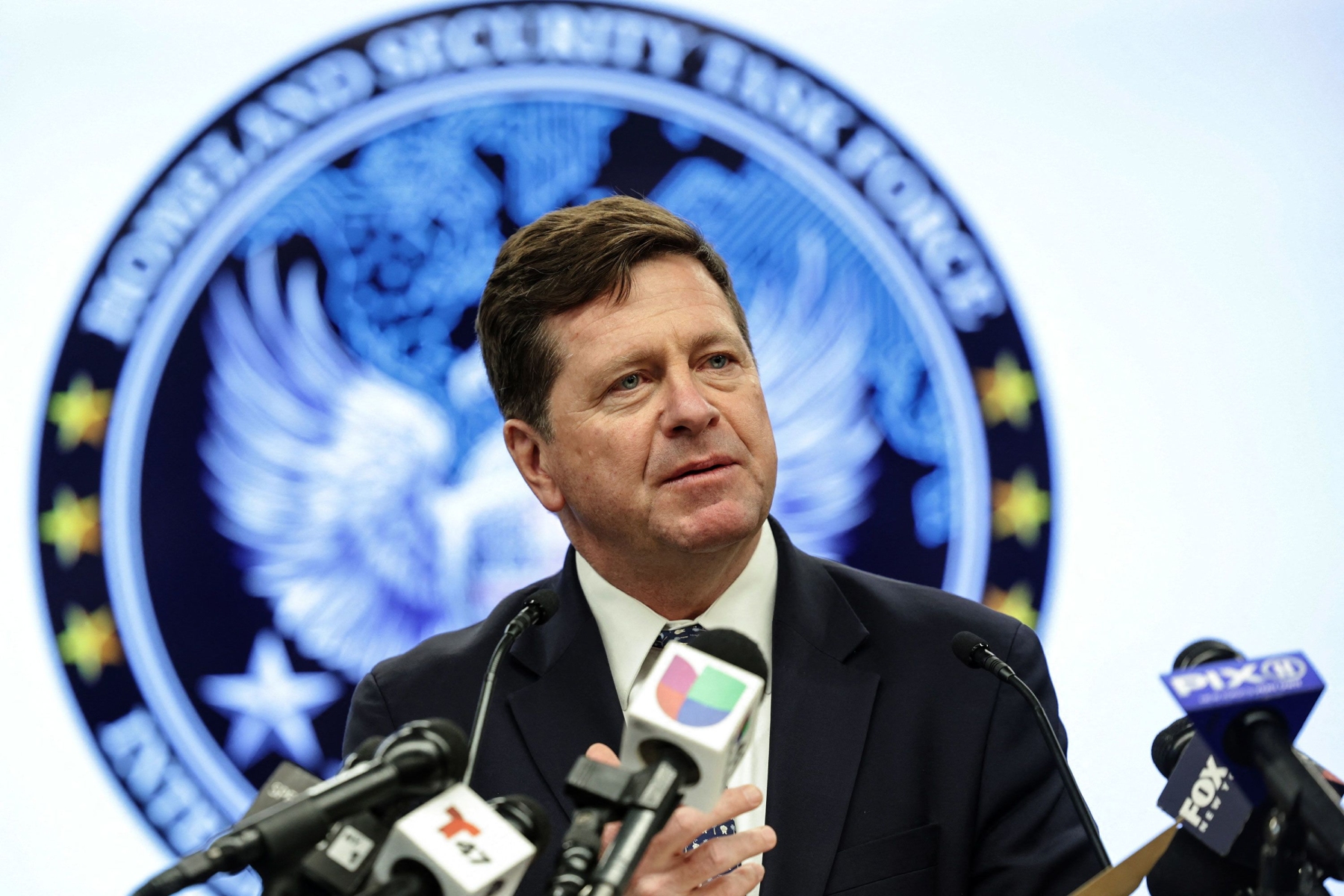
President Donald Trump announced Thursday that he’s nominating Jay Clayton, the US attorney for the Southern District of New York, to be his next director of national intelligence.
“Few people anywhere in the Legal Community are respected at the level of Jay,” Trump wrote in a post on Truth Social. “I encourage the United States Senate to confirm Jay as soon as possible.”
The selection of Clayton — who served as head of the Securities and Exchange Commission during Trump’s first term — comes amid a firestorm over Trump’s earlier decision to make top housing official Bill Pulte the acting national intelligence chief following the planned departure of Tulsi Gabbard.
The elevation of Pulte, who has no demonstrated national security background, prompted pushback from both Democratic and Republican lawmakers and has endangered the renewal of critical government surveillance powers.
Since Pulte’s selection, Republican lawmakers had urged Trump to quickly name a more qualified permanent nominee.
But Trump’s announcement is unlikely to save the key spy powers authority from its expiration Friday, as Democrats remained largely unmoved following the president’s Truth Social post. Pulte, they said, would still need to be replaced as the acting spy chief to earn their votes in support of a FISA extension.
Pulte — a wealthy businessman who was confirmed as head of the Federal Housing Finance Agency last year — has been a Trump loyalist with a record of going after many of the president’s biggest perceived political enemies through criminal referrals.
The president indicated to House Speaker Mike Johnson earlier this week that he wouldn’t back down away from Pulte, despite threats from Democrats to let the key surveillance power lapse over the appointment, two sources briefed on the meeting told CNN.
Trump stunned intelligence staffers and lawmakers on Tuesday by announcing Pulte would start his role as acting DNI on June 19 — before Gabbard’s anticipated departure on June 30.
His announcement about Clayton comes after Manhattan’s top federal prosecutor appeared on CNBC earlier this week, where he was grilled about the distinction between state laws that make California’s vote tabulation a slow process and actual evidence of fraud.
“There’s a great phrase, ‘opportunity for fraud,’” Clayton said.
A longtime corporate attorney, Clayton is well known within Republican circles. He has served as the top US attorney in the Southern District of New York since last year, where he was one of the signatories on the indictment against then-Venezuelan President Nicolás Maduro that was unsealed in coordination with his capture in a US raid.
Turnover at DNI
If confirmed, Clayton would become Trump’s second permanent chief of national intelligence after Gabbard, who announced her resignation last month, citing her husband’s diagnosis of a rare form of bone cancer.
Yet the office he’s now poised to inherit has faced a tumultuous several months rife with internal turf wars, high-profile resignations and the prospect of severe downsizing.
Trump originally selected Gabbard, a former Democratic congresswoman, as his top intelligence official thanks to her non-interventionist, “America First” ideology that had pushed her away from the Democratic Party and into the MAGA fold.
But her isolationist tendencies quickly put her at odds with Trump’s military actions against Iran and Venezuela. She came under additional scrutiny following the abrupt resignation of Joe Kent, who headed the National Counterterrorism Center under her command, over his objections to the war with Iran.
Months before announcing her resignation, Gabbard was routinely sidelined from some of the biggest foreign policy decisions of Trump’s second term.
Instead, much of her focus revolved around rooting out actors she thought were part of the so-called deep state — people in the intelligence community who the president suspected were working against his interests.
The DNI role, created after 9/11, oversees the 18 agencies that make up the intelligence community and was designed to avoid another catastrophic intelligence failure in which spy agencies don’t share information with each other.
This story has been updated with additional information.
CNN’s Kristen Holmes, Zachary Cohen, Hannah Rabinowitz and Aileen Graef contributed to this report.