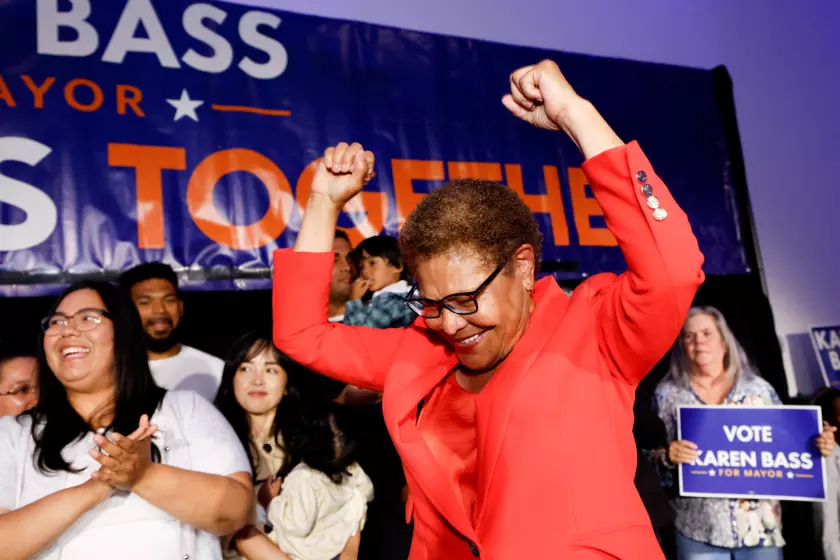
- Embattled Mayor Karen Bass made the Nov. 3 runoff after assembling a diverse coalition that included business leaders, organized labor and key elected officials.
- With primary election votes still being counted, it’s not clear yet whether she will face Spencer Pratt or Nithya Raman in the runoff.
Los Angeles Mayor Karen Bass took office four years ago with a reputation as a coalition builder — someone capable of bringing competing factions together to achieve a common goal.
On Wednesday, that goal became Bass’ reelection this fall. In a bruising primary campaign, a broad coalition of supporters assembled by the mayor helped her secure a spot in the Nov. 3 runoff, even as her top two rivals — reality TV personality Spencer Pratt and City Councilmember Nithya Raman — battled for the second spot on the ballot.
The mayor’s coalition featured organized labor, including the powerful police officers’ union; business leaders, working closely with Airbnb; the Los Angeles County Democratic Party, including key elected officials; and immigrant rights groups who applauded Bass for her condemnation of federal ICE raids.
“You don’t often get business and labor on the same side. You don’t often get police and progressives on the same side,” said political strategist Kerman Maddox, a longtime friend of Bass, not long after the Associated Press declared Tuesday that Bass would make the runoff. “She did it tonight, and we’re going to do it again in the runoff.”
It wasn’t yet clear Wednesday which opponent Bass will face. Mail-in ballots with an election day postmark will be accepted by county election officials through Tuesday. Although Pratt was leading Raman in partial returns, hundreds of thousands of ballots likely remain to be counted.

Bass faced withering criticism over the course of the campaign, with her rivals blasting her leadership on homelessness, housing production and the January 2025 Palisades fire, which destroyed thousands of homes and left 12 people dead. She was mocked in a series of AI videos made by Pratt supporters, many of them reposted by Pratt, including one that portrayed her as the Joker from Batman.
By assembling a diverse coalition of institutional allies, Bass managed to withstand those attacks, said Fernando Guerra, who heads the Center for the Study of Los Angeles at Loyola Marymount University.
“It was a frustrated, anti-incumbent electorate, and she weathered that storm,” Guerra said.
Bass thanked her allies at an election night party in Koreatown packed with civic leaders ranging from Stuart Waldman, president of the Valley Industry and Commerce Assn., to Councilmember Ysabel Jurado, a democratic socialist who represents downtown.
“We are going to work together to make sure that this city thrives,” Bass said.
Many of the decisions made by Bass during her first term have drawn praise from her allies. In 2023, she negotiated a generous package of raises and retention bonuses backed by the Los Angeles Police Protective League, the rank-and-file officers’ union, while pushing for a larger police department.
Last year, the mayor worked with the council to resurrect the city’s long postponed upgrade of the convention center, despite warnings about the long-term cost of the $2.6-billion project.
Expanding that facility’s exhibition space was a huge priority for the Central City Assn., a downtown business group, and the Los Angeles County Federation of Labor, which represents hundreds of thousands of unionized workers.
The Central City Assn., relying heavily on funding from Airbnb, spent about $1.6 million on efforts to reelect Bass. The Federation of Labor spent more than $1 million on mailers, videos and other pro-Bass expenses. The police union, which backed real estate developer Rick Caruso in 2022, put $1.2 million into ads criticizing Raman over her positions on police hiring and homelessness.
Raman voted against the police raises and the convention center project, calling both efforts financially reckless. Throughout her campaign, she pointed to those decisions as evidence that Bass engages in “pay-to-play deals” at City Hall.
On social media, Raman said Bass signed off on “a sweetheart LAPD Union contract that bankrupted the city and a convention center expansion that will cost us over $4 billion after debt payments.”
“Now these interests are spending $$$ to keep her in office,” she wrote.
Bass said the police raises were needed to keep the Los Angeles Police Department from shrinking. The convention center upgrade, which is slated to open in 2029, will boost tourism and the downtown economy, she said.
Councilmember Tim McOsker, who endorsed Bass, said the mayor made the right call on both the raises and the convention center, dismissing Raman’s criticism.
“Those were both good decisions,” he said. “Does it create friends for you? Are people appreciative? Sure. That’s fine.”
“Good decisions have good consequences,” he added.
Bass portrayed Raman as someone whose personal style had made it difficult for her to get things done. Raman, the mayor said, struggled throughout her tenure to build and maintain political relationships.

As if to emphasize that point, Bass secured support from some of Raman’s political allies.
Raman was the first L.A. council member to win office with support from the Democratic Socialists of America. Nevertheless, the other three DSA-backed council members — Hugo Soto-Martinez, Eunisses Hernandez and Jurado — all endorsed the mayor.
Waldman, who heads the Valley Industry and Commerce Assn., said Bass has a record of bringing together people who are frequently at odds. When business leaders were frustrated over the passage of a $30-per-hour minimum wage for hotel workers, Bass brokered a meeting with them and Council President Marqueece Harris-Dawson, he said in December.
Waldman’s group, which endorsed Caruso in 2022, is backing Bass this year, joining a coalition that includes many in organized labor.
“We disagree on a lot of things and we agree on a lot of things,” he said. “But we all care about what’s best for the city. Looking at candidates in the race, it was clear that was Karen Bass.”
Bass’ opponents took a sharply different view.
Raman said Bass had failed to act with urgency on the production of new apartments, repairs to deteriorating infrastructure and the exodus of entertainment industry jobs. Pratt held the mayor responsible for the Palisades fire and said she had made the city more dangerous, allowing drug-addicted homeless residents to menace Angelenos.
Pratt said he got into the race because he felt the city had failed his family and his neighbors in Pacific Palisades.
“Now I look around and the city is failing most of Los Angeles,” he told reporters Tuesday outside his election night party at Mexican restaurant Don Antonio’s.
Bass has pointed to her record, including a 17.5% drop in street homelessness — the number of people living outside or in their vehicles — and a homicide rate that is at levels not seen since the mid-20th century. Her allies say they look forward to a fight against Pratt, who is a Republican in a city where Democrats outnumber GOP voters by nearly 4 to 1.
This race was much tougher for Bass than the one she waged in 2022, in large part because she now has a record that has exposed her to criticism, said Assemblymember Mark Gonzalez (D-Los Angeles). Bass acknowledged her mistakes during the campaign, said Gonzalez, a former head of the county Democratic Party.
“[She’s] admitted she’s not perfect,” Gonzalez said. “She’s working with a coalition of groups to get us to a perfect place, but she’s not perfect.”