
After spending more than $440 million on the midterms, the Tesla CEO will face a very different reception when Democrats control Congress.
By Tim Higgins
Money can’t buy everything—even for the world’s richest man.
Voters made that clear Tuesday when Elon Musk’s political power was delivered a stunning blow. He had poured more than $440 million into races to support Republican candidates only to see Democrats gain control of both the House and Senate.
In the most bruising defeat of the night for Musk, Senate candidate James Talarico beat Republican Ken Paxton in Texas, becoming the first Democrat to win a statewide election in 32 years.
Musk, a Texas resident, spent more than $150 million on that race alone, fueling a barrage of television ads highly critical of Talarico in an attempt to rescue Paxton’s troubled campaign. The effect appears to have backfired, helping fuel enthusiastic Talarico supporters who, in the days leading up to the election, said they were put off by Musk’s involvement.
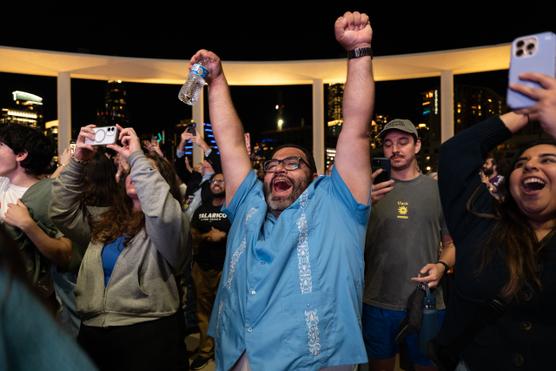
“We just proved that all the money in the world is no match for the people of Texas,” Talarico said in a victory speech in Austin, Texas, that alluded to Musk but didn’t outright name him.
As the results rolled late into the night, many turned to Musk’s own social-media network, X, to see how he might respond. Eventually, he joked: “Guess my election-interfering space lasers didn’t work this time.”
Even before the blue wave hit, Democrats had signaled that, if put into power, they planned to use their expansive authority in Congress to target the Tesla TSLA -2.12%decrease; red down pointing triangle and SpaceX SPCX -3.45%decrease; red down pointing triangle chief executive along with President Trump.

They want to look at Musk’s role in cutting government spending during the early days of the Trump administration as head of the Department of Government Efficiency and how he may have limited Ukraine’s use of SpaceX’s satellites in its war with Russia.
One prominent Democrat has even called on nationalizing SpaceX. A government takeover of Musk’s companies is an unlikely outcome but such rhetoric—cheered on in some corners—underscores the animosity Musk has stoked among Democrats after helping put Trump back in office two years ago.
Musk appears to realize that battles are ahead.
“Live by the sword, die by the sword,” Musk posted on X ahead of the election amid Democrats calling for investigations. “Those who pick fights with me should understand that I will find out who is really pulling the strings and come for them, not just their puppets.”
The risk for Musk and his companies is that he becomes distracted with political knife fights on Capitol Hill at a sensitive moment. After SpaceX’s historic record-setting IPO—and a string of high-profile milestones from building a cloud business to showing off a flying car—SpaceX and Tesla are considering a merger. In recent days, Trump has even suggested he would consider a pardon for allies such as Musk.
For most of his adult life, Musk wasn’t considered political. That changed with the pandemic and how he later felt Democrats mistreated him. He relocated SpaceX’s and Tesla’s headquarters to Texas from California after skirmishes with Democrats in the Golden State.
His very public embrace of Trump—shortly after the failed assassination attempt in Butler, Pa., during the 2024 campaign—helped attract excitement to the campaign. Musk acted as if he was on the ballot, holding campaign events of his own across Pennsylvania, a key battleground state. He drew large crowds, including many young men who said they were inspired by Musk and wanted to hear about his plans for Mars and how he could take his business know-how to Washington.
Eventually, other tech leaders followed Musk’s lead and tried to curry favor with Trump. Some of the biggest names in tech, including Amazon.com founder Jeff Bezos, Meta CEO Mark Zuckerberg and Google CEO Sundar Pichai, joined Musk on stage at Trump’s inauguration in 2025.
But Musk held a special spot. For an unprecedented few months, he was something of a fixture at the White House as “First Buddy” while overseeing DOGE. He and Trump were often photographed palling around and Musk seemed to almost take up residence in his government office as he cut programs, such as the U.S. Agency for International Development.

In the end, Musk’s efforts to cut government spending failed to live up to the hype. And the bromance was short lived as Musk’s antics in Washington, D.C., including waving a chain saw around at an event, became a distraction and the perception of his actual political influence began to fade. He failed to recapture the 2024 success in a 2025 Wisconsin state supreme court election where his heavy involvement was seen as a political liability.
By spring of that year, Musk had a very public falling out with Trump only to be later brought back into the fold. His money then began helping Republican midterm races.
In recent weeks, Musk said he got carried away the first time around, to the frustration of some of his investors and customers. “What I should have done, I think, was be more in the background,” he said last month in a podcast with Walter Isaacson, his biographer.
All of which helps explain why Musk stayed off the trail this fall and looked more like a traditional deep-pocketed donor. He spent more than $440 million on the midterms—significantly more than the close to $300 million he spent in 2024.
While he wasn’t out campaigning, he used his social-media bully pulpit, especially against Talarico. Musk made or retweeted around 60 posts naming Talarico, including one that called him “Pure evil.”
For his part, Talarico carefully embraced Musk as a foil. During Texas campaign stops in Fort Worth, Texarkana and Tyler, for example, Talarico almost appeared to be running against Musk instead of Paxton.
“Elon Musk wants our land, he wants our water, he wants our taxpayer dollars and he wants his very own personal United States Senator,” Talarico said in Tyler to a crowd of almost 2,000 supporters.
The audience’s visceral jeers at the mention of “Elon” were telling. In total that night, Talarico called out “Elon” almost as many times as he said his actual opponent’s name.
In those final days before Election Day, Musk, in many ways, had become the face of what troubled voters: They said they were unhappy with the income inequality, rise of artificial intelligence and Big Tech’s influence on the White House.
At the Fort Worth event, 29-year-old office manager Phil Pruitt, who once supported Trump and counted himself a fan of Musk, said he felt differently now. He was put off by the amounts of money Musk was putting into the race.
“These tech bros have this attitude where they know everything and that’s just, like, completely what I’m not for,” he said. “The thing I’m most passionate about is just really caring for people.” He added, “Politically-wise, just where we are at now, there’s no empathy.”
Now, Musk will see how much empathy Democrats have for him


