
Project had been halted during legal challenge over impact on Texas border region
WASHINGTON—The Supreme Court allowed the Trump administration to proceed with construction of a border wall along a 300-mile stretch in southwest Texas, rejecting arguments from preservationists that the wall will harm precious natural resources.
In an 8-1 ruling, the court temporarily lifted a district judge’s injunction that had blocked the wall in the Big Bend region of Texas.
The government’s need for security along the U.S.-Mexico border “outweighs any aesthetic, recreational, and environmental harm” that the challengers will incur, the court wrote in an unsigned, five-page opinion.
Justice Ketanji Brown Jackson recorded a dissent from the decision without explaining her reasoning.
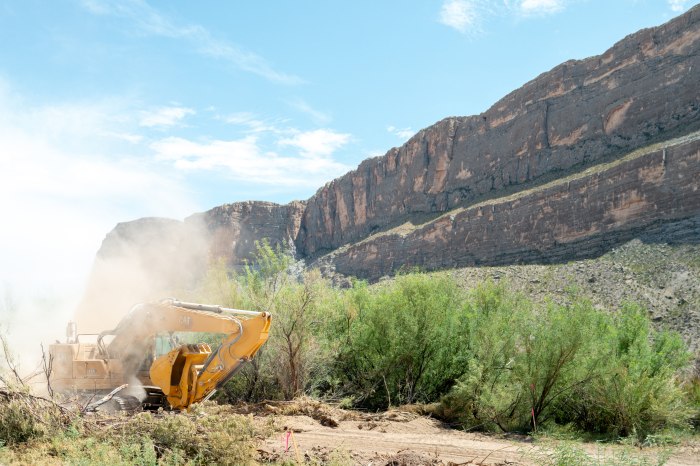
The administration wants to erect barriers and roads in a remote, largely undeveloped area that includes deserts, canyons, part of the Rio Grande River and Big Bend National Park. U.S. Solicitor General John Sauer told the court that gaps in the border wall there can be exploited by drug cartels illegally entering the U.S. from Mexico.
The plan has drawn opposition from environmentalists, preservation groups and local residents. In court papers, they described the area as a rugged and majestic wilderness with unique historical and cultural resources that would be destroyed by the border wall construction.
Last month, U.S. District Judge Kathleen Cardone, a George W. Bushappointee based in El Paso, blocked the construction.
Cardone’s injunction hinged on the Department of Homeland Security’s attempt to bypass certain environmental requirements in order to build the wall quickly. The judge ruled that Congress hadn’t clearly authorized the department to sidestep those requirements, and she invoked a legal principle known as the major questions doctrine that has been embraced by the Supreme Court’s conservative majority in other significant cases. The doctrine says that Congress must be unequivocal if it wants to authorize the executive branch to undertake consequential policy changes.
In lifting Cardone’s injunction, the high court noted that a 1996 immigration law gives DHS the power to “waive” legal requirements in order to efficiently build barriers at the border. The law also sharply limits the power of courts to review those waivers.
The Trump administration, the high court wrote, is “exceedingly likely” to succeed in its argument that Cardone didn’t have the power to block the construction. The decision allows litigation to proceed in the lower court while construction of the wall occurs.
One of the legal challengers, a group dedicated to preserving a historic church in the region, said it was disappointed by Monday’s decision but would keep fighting the construction in court.
“The history, culture, and ecosystems of Texas’s borderlands are too precious to be pushed aside for a physical border barrier when no emergency threat exists and more efficient and less expensive means of border security are available,” said Martha Stafford, a member of the board of director of Friends of the Ruidosa Church.
The Department of Homeland Security did not respond to a request for comment.
Appeared in the November 10, 2026, print edition as 'Supreme Court Lets U.S. Build Border Wall in Big Bend'.