
China plays a prominent role in the vision of a 'non-aligned' foreign policy championed by Jean-Luc Mélenchon, who has praised the 'highly beneficial relationship' between the two countries.
By Sandrine Cassini and Jean-Baptiste Chastand
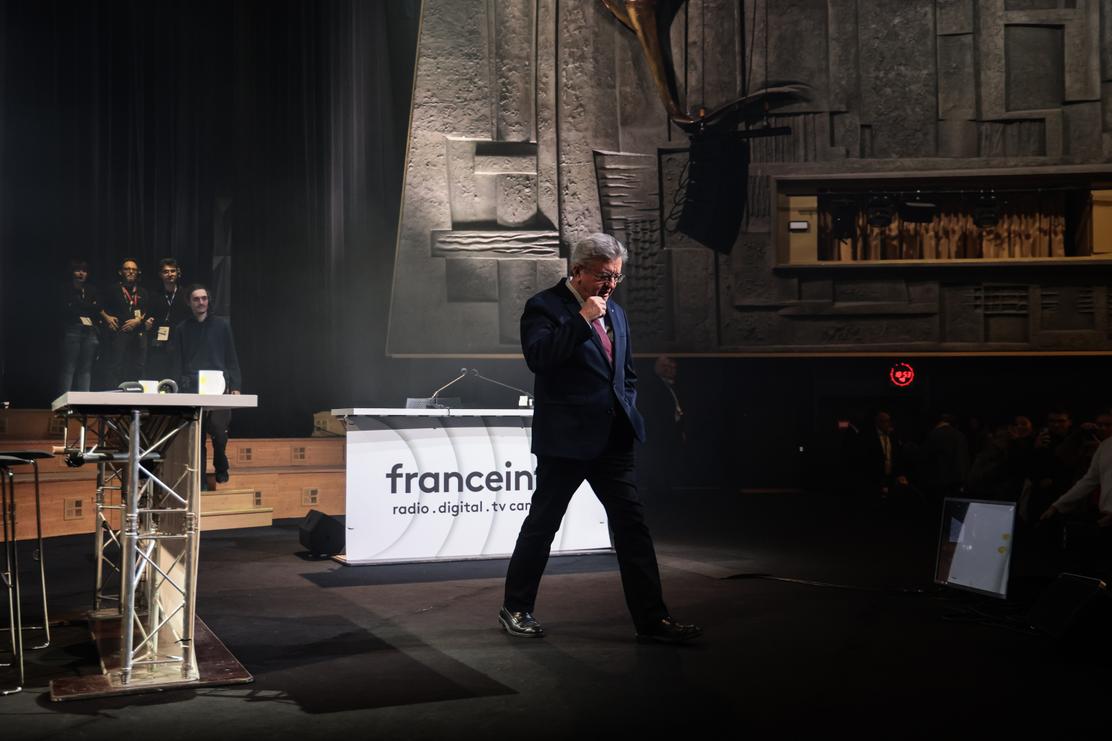
It was an unusual occasion, and Jean-Luc Mélenchon was careful not to publicize it on his own media channels. On September 23, the four-time French presidential candidate attended a reception marking China's National Day at the Chinese embassy in Paris. Surrounded by several other elected officials from his hard-left La France Insoumise (LFI) party, including Paris MP Sophia Chikirou, Mélenchon took a front-row seat to listen to the ambassador celebrate the Chinese Communist Party (CCP), "which for 77 years has led the Chinese people on the path of socialism with Chinese characteristics."
Speaking in front of the embassy's camera, Mélenchon, fascinated by China's military organization, its model of economic planning and its spectacular development, said he was "very admiring of China's technical and scientific achievements" and praised a "very profitable relationship" between the two countries. For Chinese diplomats, securing a presidential candidate's attendance was a masterstroke. However, among other French political leaders, the priority is to establish a balance of power with an economic juggernaut that is devastating European industry, as center-left presidential candidate Raphaël Glucksmann has lamented. "China has an imperialist vision and seeks the submission of the rest of the world," said MEP Pierre Jouvet, who is a spokesperson for Glucksmann's campaign.
You have 85.15% of this article left to read. The rest is for subscribers only.
Subscribe now to read the full story. Sign in