
Destroyed bases, tired troops and low ammunition stocks. The Iran War has thrust the US military into an increasingly dire situation.
he Iran War may have the US military on the brink of a systemic “breakdown”.
Damaged and destroyed bases.
Wrecked early-warning radars.
Stretched supply lines.
Maintenance issues.
Overtired troops.
Critically low advanced ammunition stocks.
Be the first to know when news breaks. Download our new app
Investigative news service The Intercept says it has spoken with two US administration officials (who sought to remain anonymous for fear of retribution) about the state of the conflict.
One warned of an imminent morale and logistics “breakdown”.
The other bemoaned a “complete lack of planning”.
It mirrors a growing groundswell of think-tank analysts and military insiders ringing alarm bells.
“We didn’t plan for this war; we just did it sort of on the fly,” Hudson Institute analyst and retired navy commander Bryan Clark told US media.
“And when you fight a war as a pick-up game, this is the kind of stuff that happens.”
But Trump administration Secretary of War Peter Hegseth insists such reports are “NOT TRUE”, adding “You should be ashamed. We don’t hate the fake news media enough”.
That banner is NOT TRUE, @CNN. Shame on you.
— Pete Hegseth (@PeteHegseth) August 4, 2026
We don’t hate the Fake News media enough. pic.twitter.com/QCwEoykQZR
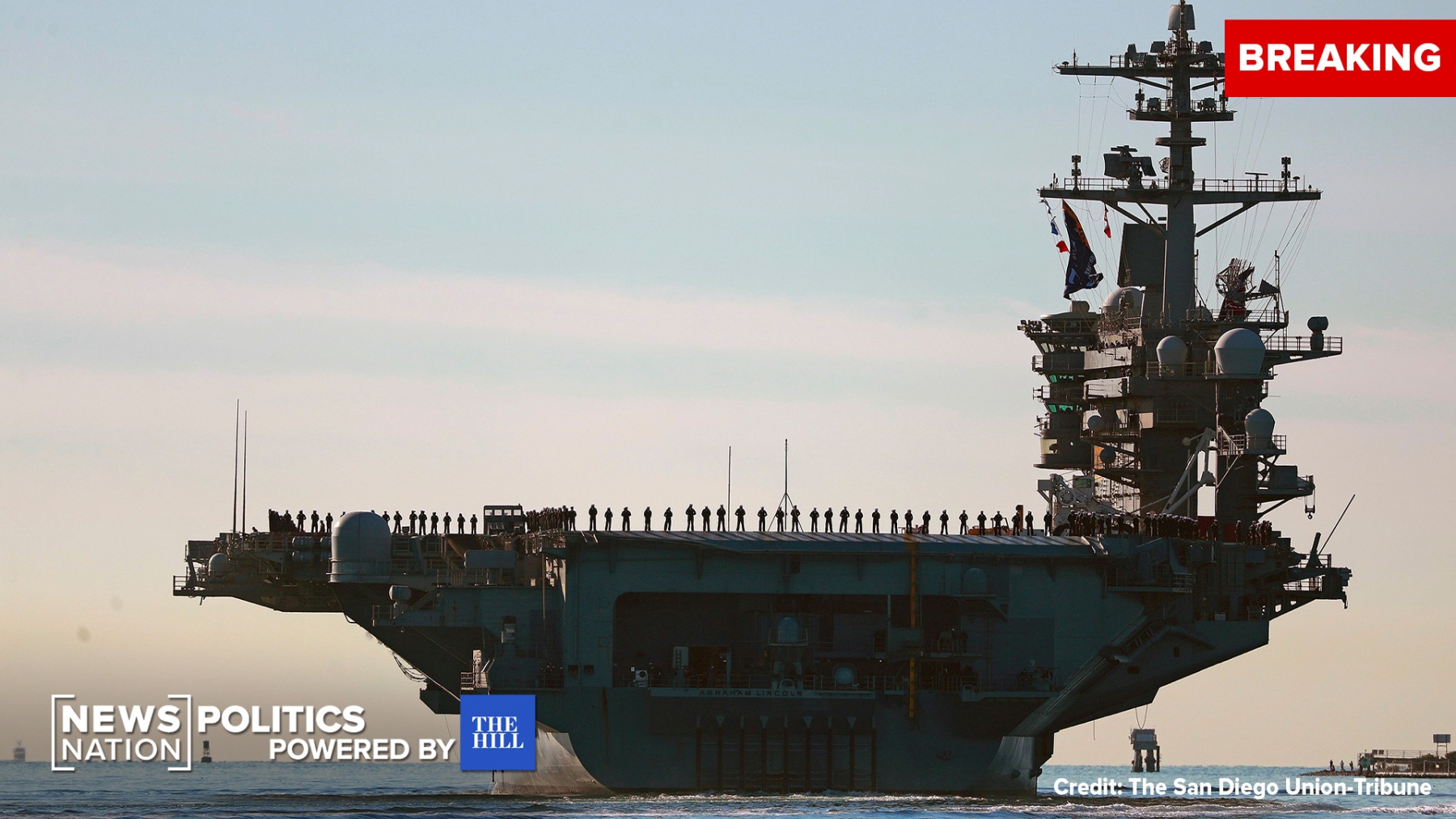
He went on to shoot the messenger (sacking the editorial staff of his military’s internal Stars and Stripes news service) that reported the dire living conditions aboard the aircraft carrier USS Abraham Lincoln after nine months without a break.
The former news presenter is, instead, concerned about appearances.
Specifically, do his men look attractive enough?
The Pentagon this week issued an email asking troops to step forward if they fit strict height and fitness criteria, along with “impeccable grooming and uniform standards (no exception)”. They are to stand alongside the Secretary of War at a speech later this month.
Those who impress Mr Hegseth most will win the privilege of joining him for a private workout afterwards.


‘Bound to end’
The Strait of Hormuz is 11,300km from the White House. The mental gap appears much greater.
The day after US and Israeli surprise attacks killed Iran’s Ayatollah Ali Khamenei and much of his family, US President Donald Trump declared the special military operation would last just “four to five weeks”.
Epic Fury was not intended to be a military campaign: “[It] won’t be difficult”.
That same day, Iran struck back.
Its missiles and drones overwhelmed US and Arab defences.
A naval base in Bahrain was destroyed. Radar sites smashed. Airfields attacked.


Some 28 weeks later, there’s no end in sight.
But the 47th President of the United States still insists it will all be over before Christmas.
President Trump is now saying the war will end “right after the election” in November.
Which is inconvenient.
Soaring fuel prices and inflation have the Republican Party’s midterm vote prospects plummeting. And that’s despite President Trump, 80, declaring the war won (or almost won) at least 30 times since it began.
It’s a military failure with global implications.

“In the past six months, America’s power … has proved insufficient to defeat Iran, a repressive, economically stagnant regime armed with cheap missiles and drones,” assesses University of St Andrews strategic analyst Professor Payson O’Brien.
“The American age that followed World War II was bound to end eventually.
“What’s shocking is how suddenly that moment has arrived.”
But Centre for Strategic and International Studies (CSIS) adviser and retired Colonel Mark Cancian offers another perspective.
“Our ability to destroy the Iranian air defence system and then launch 13,000 strikes on Iran with very, very few losses by historical standards is extraordinarily low. The Israelis had another 10,000,” he explains.
“That’s an immense amount of damage that we were able to do, almost with impunity.”
Put simply: The problem’s not with the weapons. Or the military.
It’s how and why it’s used.


The Pentagon is suffering a “beyond critical” shortage of advanced missile interceptors, a US defence official recently told the Associated Press.
President Trump insisted otherwise on Tuesday.
“I’ve just received a Report that the United States is producing more Exquisite and Elite Weapons than at any time in our History,” he boasted to social media.
“They are being delivered on a daily basis to our Forces in the Middle East, and beyond.”
But the Pentagon’s independent Inspector General had, just hours earlier, released its formal unclassified report on the first four months of the Epic Fury campaign.
It confirmed Iran’s ongoing resistance has led to depleted ammunition stocks, supply bottlenecks and strained morale.
The CSIS think tank believes about 65 per cent of pre-war Patriot missile stocks (2330 interceptors) were fired between February and July. That left 830 available.
The more capable THAAD edge-of-space ballistic missile interceptor burned through almost half of its 450 warheads, leaving less than 270 for future use.
And both have since had to fend off fresh Iranian barrages in recent weeks.


“When you run out, you’re out,” states Colonel Cancian.
“And as we’re seeing in Ukraine, then the adversary’s missiles just get through.”
The Inspector General report is the first official acknowledgment of the problem. And of the difficulty in replacing them.
“The most persistent bottlenecks remain in the production of solid rocket motors, the availability of high-grade explosives and propellants, and the recruitment of skilled manufacturing labour,” the report states.
Colonel Cancian says this means the US military must rely on stockpiles of older, more numerous – but less effective – weapons.
“The concern in the Pentagon and that Joint Staff General Kane keep raising is China and what the effect of reduced munitions inventories will have on deterrence of China,” he adds.
The White House doesn’t see the issue.
“The United States Military has more than enough munitions, ammo, and stockpiles to serve all of the Commander-in-Chief’s strategic goals and beyond,” President Trump’s spokeswoman, Anna Kelly, insists.
Trump administration-appointed Central Command (CENTCOM) commander Admiral Brad Cooper agrees: “I’m not concerned at all”.


Body blows
“They blew the hell out of Bahrain,” acting navy Secretary Hung Cao admitted last week.
“We’re not getting back in there anytime soon,” adds US navy Admiral Daryl Caudle.
“I just want to be completely honest with that.”
Anonymous Washington DC officials have told US media that the US military’s effectiveness was “crippled” in the opening hours of the war. An Iranian missile and drone counter-attack destroyed the US navy Fifth Fleet headquarters at Manama, Bahrain, in the Persian Gulf.
Some now suspect the facility is so badly damaged it will never be rebuilt.
Other key setbacks include missile damage to the Combined Air Operations Centre at Al Udeid Air Base in Qatar, which has put it out of action.


“The effect of these losses on US operations was nearly instantaneous,” Professor O’Brien assesses.
“A key reason the Trump administration did not militarily escalate with Iran over the summer, despite all of its threats to do so, was the loss of the base in Bahrain – which the navy relied on for decades to resupply ships in the Middle East.”
The independent watchdog report into Epic Fury sketches an outline of the full extent to which US forces and facilities have been hit. At least that which has not been deemed Top Secret.
Iran has “damaged and destroyed hundreds of buildings and structures at US bases in Kuwait, Bahrain, Qatar, UAE, Saudi Arabia, Iraq, Oman, and Jordan during the conflict,” it reports.
“For the moment – and likely for longer – the bases taken out of commission by Iranian attacks have been largely abandoned as operational facilities because of the continuing threat to US personnel and equipment,” Professor O’Brien states.
The watchdog concedes that “dozens of US aircraft were destroyed or damaged”. This includes one EC-3 Sentry Early Warning aircraft, four F-15 fighter aircraft, 12 KC-135 refuelling aircraft, and almost a quarter (around 30) of the US inventory of MQ-9 Reaper drones.
Another missile attack on Muwaffaq Salti Air Base in Jordan last week has added several more F-15s and A-10 attack aircraft to that tally.