
Tips for navigating a feed full of machine-made content
When I look at my phone, I’ve been starting to lose my grip on what’s real. A stool’s wood grain seemed suspiciously smooth. The steam emanating from a fried zucchini fritter was…unnatural. Last week, I was swooning over a Pinterest living room before I spotted the disclaimer: AI-modified.
Artificial intelligence is pumping a lot of stuff into our feeds. Some is harmless fun. Some is engineered to rile us up. Some is straight-up scammy. Most of it looks impressively lifelike on a smartphone screen. And now we suffer the mental tax of constantly having to ask, “Is this real or AI?”
It’s eroding our sense of reality.
I explore this in a special three-part audio series, “AI and the Blurring of Reality,” airing Saturdays on WSJ’s Tech News Briefing. The first episode is out now, featuring a potty-mouthed AI grandma with millions of Instagram and TikTok followers and the researchers trying to make sense of it all.
Whether you listen or not, here’s a quick primer on this brave new online ecosystem, and a practical guide for surviving it.
Enter the simulation
Remember the pope in a big puffy jacket back in March 2023? Not long ago, AI moments arrived in sporadic, viral spikes.
Now, they’re the norm. The arrival of powerful models such as Google’s Nano Banana and Veo 3 put high-quality visual generation in just about everyone’s hands. Former tells—six-fingered hands, jumbled text—went away. Creators like Eric Suerez and Adam Vaserstein pounced.
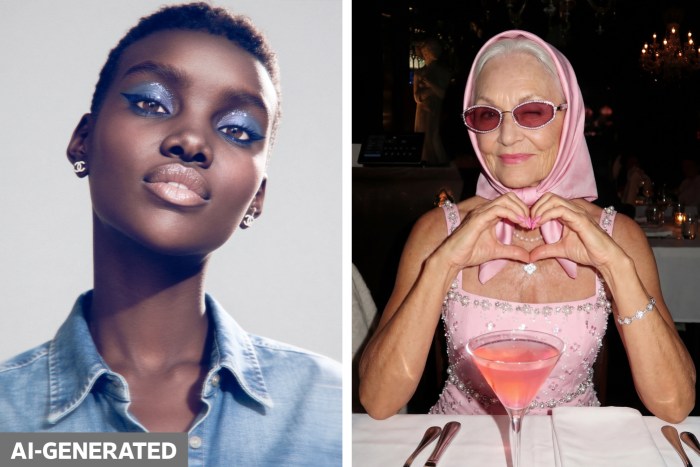
During Fourth of July weekend last year, the pair used Veo 3 to generate the first images of Granny Spills, a luxury-brand-wearing, pink-obsessed, party-hopping sassy septuagenarian. The character’s Instagram account gained a million followers within a month.
Beneath a video of Granny putting makeup on a World Cup star, one commenter wrote, “What the heck did I just watch?” I felt the same when I first came across Granny in my feed, splayed across Justin and Hailey Bieber’s arms at the Coachella Music Festival. (The actual Biebers had nothing to do with the post.)
Vaserstein, who took years to amass millions of followers with funny man-on-the-street interviews, was pleased with the success. “We found it way easier to grow these AI fictional characters,” he says.
Granny and other AI influencers don’t hide their digital roots. “If people know that something’s not real, it doesn’t stop them from enjoying it,” says Cameron-James Wilson, the creator of digital model Shudu, citing beloved characters like Barbie and Elsa from “Frozen.”
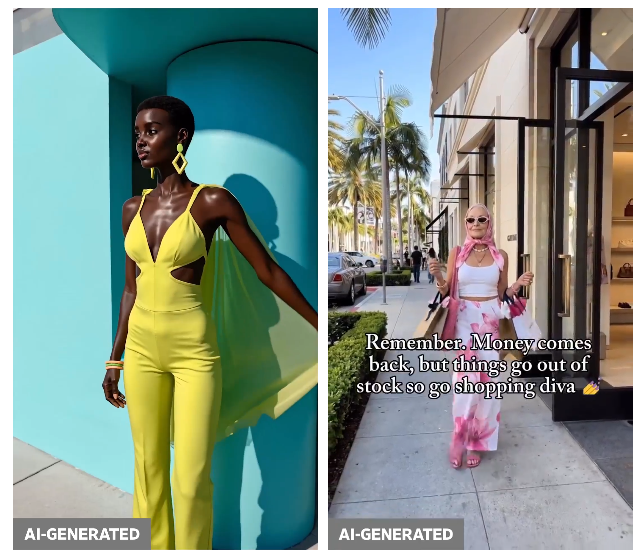
Shudu has a tall, lean figure and an immaculate, glowing complexion. When I asked whether a synthetic supermodel creates unrealistic beauty standards, Wilson agrees it’s possible—and isn’t new. “I used to be a fashion photographer for 10 years. I’ve done tons of retouching,” he says. “I know that for decades, what we’ve seen is not what’s real.”
I’m intrigued by the rise of AI influencers. I’m more disturbed by the prevalence of subtle synthetic images: AI cooking videos, AI ads with robotic voice-overs, AI celebrity-wedding photos, AI political deepfakes…and the list goes on.
We can no longer trust our eyes and ears. Last year, AI tracks hit the Billboard charts for the first time, prompting French streamer Deezer to build a synthetic-audio detector. My library came back at 1% AI. Just enough to make me doubt my own taste.
Think like a fact-checker
So, how can we tell if something is AI-generated?
“I do this for a living and I’m pretty good at it and it’s hard,” says Hany Farid, digital-forensics expert and Dartmouth College professor of computer science.
Our brains aren’t wired for this. “If you think about the millions of years of evolution, our neural architecture wasn’t designed to say, ‘Is the tiger in the brush real or fake?’ It’s ‘Tiger! Run!’” he says.
Now, people are starting to doubt even verifiable events, according to Farid. “Did this happen? I said yes. You said no. This is a dangerous world we’re entering if we don’t have a shared sense of reality.”
What can be done? Short of quitting the internet altogether, you can evaluate your feed by thinking like a researcher:
• Does this match the real world? AI often struggles with lighting, reflections and visual perspective. Shadows might be inconsistent with the sun’s position. Look for wavy lines on straight structures like iron beams. If you want to dig deeper, cross-reference location details using Google Street View.
• Who posted this? Audit the profile for red flags: a recent creation date, post frequency and blatant engagement bait.
• Is this too good—or too infuriating—to be true? Check your emotional pulse and question the poster’s intent. Then ask yourself: How likely is this scenario? Watch for rage-bait—social-media algorithms tend to amplify content that triggers strong emotions like surprise, delight and outrage.
As Renee DiResta, associate professor at Georgetown University, told me, generative AI is a tool: “You can take a hammer and build a house with it, or you can use it as a weapon, right?” In today’s feed, it pays to watch where the hammer is swinging.
We Want to Hear From You
You can also record a voice memo and send it to tnb@wsj.com or leave us a voicemail at (212) 416-2236.