
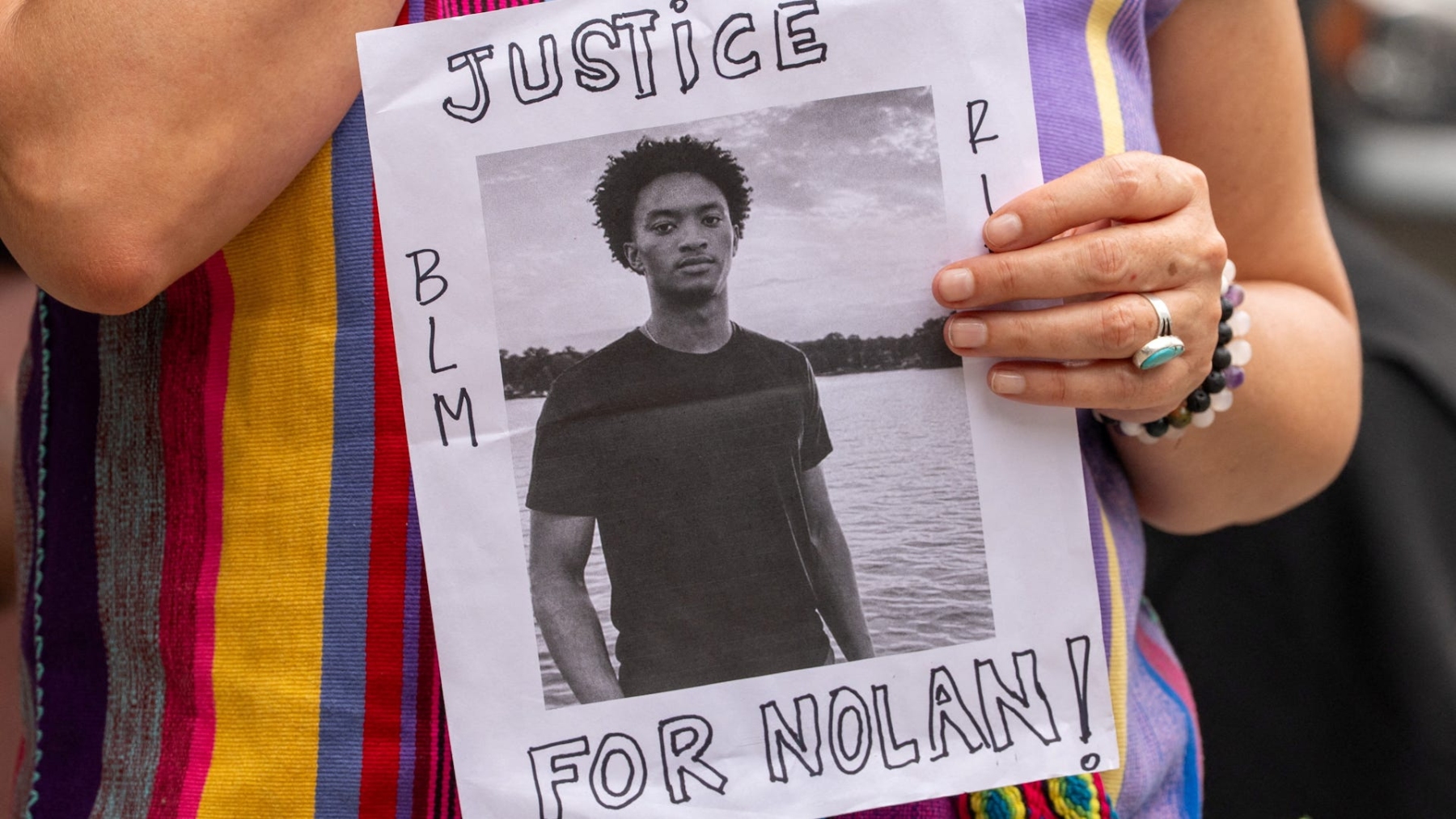
When Mississippi teenager Nolan Wells disappeared after a July Fourth boat trip, questions immediately began to swirl about what happened to him and why.
Nearly three weeks after his body was found, many of those questions remain unanswered.
Parallel investigations into his death have revealed little publicly so far. Wells' family fears his death will be written off as an accidental drowning, citing conflicting witness accounts and unusual cell phone activity. The mysterious death has attracted speculation from the public nationwide and attention from major true-crime figures like Nancy Grace.
But the death of a young Black man after an outing with a predominantly White group of friends has also dredged up fears among Black Americans that they aren't safe in such environments and that the justice system won't handle their cases properly if something goes wrong, according to Nadine Smith, president and CEO of online civil rights organization Color of Change.
Wells' family has launched their own independent investigation, citing that lack of trust in law enforcement in a state with a long history of racist violence. Officials in Jackson County have said they have not found signs of foul play, but are continuing to investigate.
"There are two stories unfolding here. One is the mystery of what happened to him and the other is that it has surfaced in the American consciousness, especially among Black Americans, some familiar anxieties," Smith said. "It is really a story of the unhealed history and lived pattern recognition in Black America."
What happened to Nolan Wells?
Officials said Wells traveled with friends to Horn Island, located about 10 miles off the coast of Mississippi, to celebrate the Fourth of July. According to the National Park Service, the island is only accessible via private boat and "there is no staff, drinking water, shelter, facilities, or communication on the island."
GPS data obtained by CBS News from the Mississippi Department of Marine Resources showed the boat reportedly traveled on arrived around 11:14 a.m. and left at 4:31 p.m. Family attorney Ben Crump has said Wells' friends reported they last saw him around 3 p.m.
Christine Wonsley, Wells' mother, said a friend of Wells contacted her around 11 p.m. that night, setting off a frantic search. Wonsley said the family met with law enforcement around midnight and were eventually able to track down Wells' phone and his car, which were at different locations.
Wells' father, Elmore Wonsley, said he left by boat around 5 a.m. to search for his son. The Jackson County Sheriff's Office led a land and water search on July 5 and July 6 assisted by the Mississippi Department of Marine Resources, National Park Service employees, the United Cajun Navy and other volunteers.
The search ended July 6 after the United Cajun Navy announced a body was discovered on the northwest end of the island. The body was later identified as Wells.
In a recent interview with Nancy Grace, Todd Terrell, founder and president of the Cajun Navy said Wells was found face down, "fully clothed." The United Cajun Navy later clarified that Wells was wearing only swim trunks.
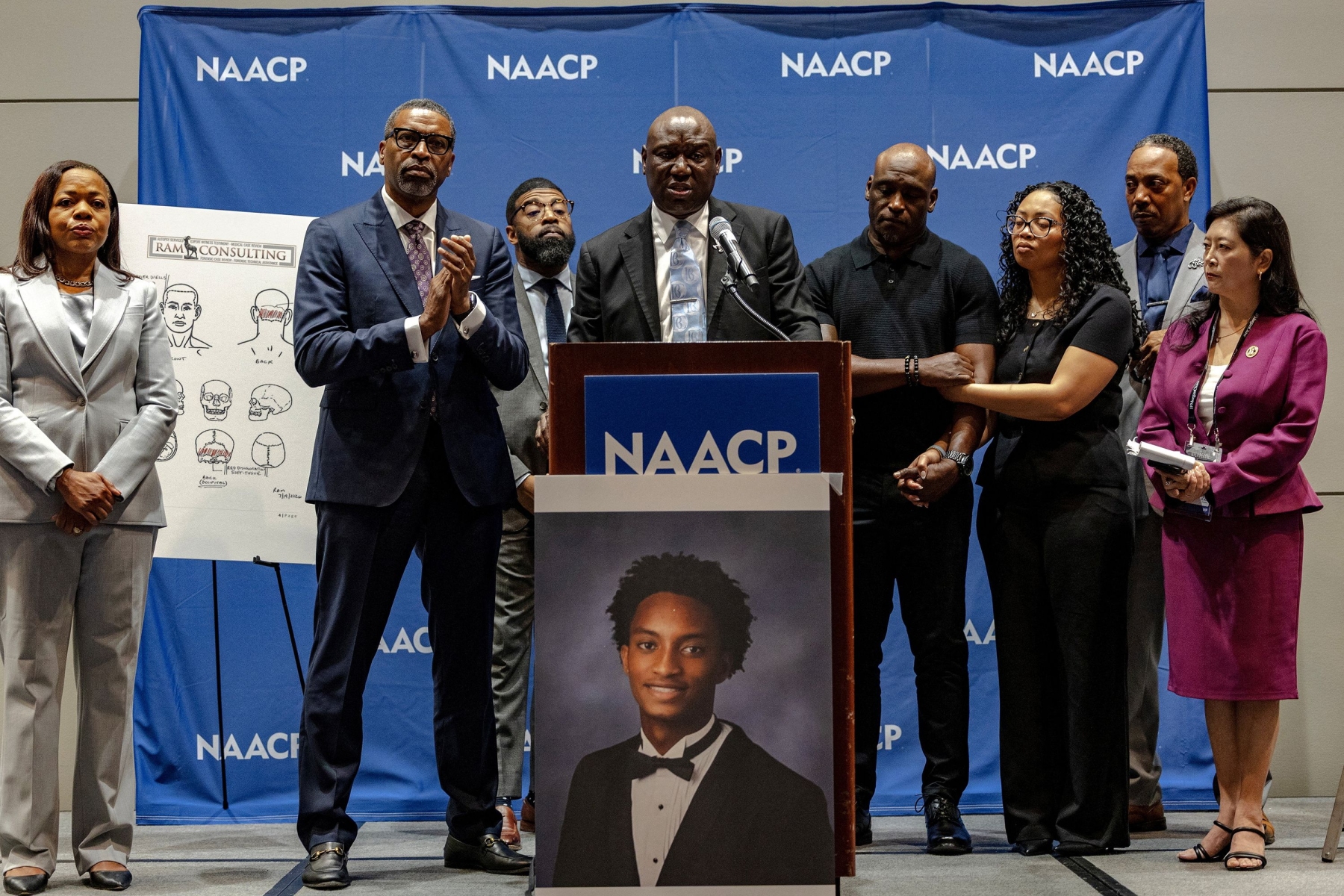
An independent autopsy, which was conducted by forensic pathologist Dr. Roger Mitchell and paid for by former NFL player Colin Kaepernick, could not determine the cause or manner of Wells' death, Crump announced July 22. Bailey C. Martin, a spokesperson for the Mississippi Department of Public Safety, confirmed in a July 22 statement to USA TODAY that the state medical examiner completed an initial autopsy on Wells on July 7 at 8:30 a.m., and the investigation is "active and ongoing."
Jackson County Sheriff John Ledbetter said shortly after Wells' body was recovered that his team had found no sign of foul play at that time. But at this point, there are more questions than answers about what happened to Wells and investigators should avoid making assumptions, said Tyron Pope, a retired sergeant supervisor with the New York City Police Department.
"I wouldn't narrow the investigation to just a single theory," said Pope, an assistant professor at John Jay College of Criminal Justice.
Family questions suspicious circumstances
Crump said there were "glaring contradictions" in the accounts given by the last people to see Wells alive. The people Wells arrived with said he was talking to a young woman, chose to stay behind and planned to ride back with someone else, according to officials.
"The young woman says that he went and got back on the boat with the boys," Crump said. "The boys say 'no, he said he was going to stay with her.' And that's a conflict."
The family and their supporters have said the notion that Wells chose to stay behind on the island without his cell phone or keys doesn't make sense. Crump also questioned how Wells, who knew how to swim, could have drowned without anyone seeing him struggling.
Jackson County Coroner Bruce Lynd told CNN the currents can be strong on the barrier islands and there have been drownings "many times over the years.” Experts have said drowning can be fast, silent and look different than one might expect.
"It is very, very easy to drown and have nobody recognize that," said Andrea Zaferes, a medicolegal death investigator who trains law enforcement on aquatic death and homicide investigations.
Zaferes said there are three major questions investigators need to answer when a body is found in or near water: Does it make sense the body was found in that water at that time? Does the location, position, posture, and state of the decedent and the people who reported the death make sense? And does it make sense the victim is dead?
Too often, she said uncovering what really happened when a person dies in these circumstances becomes incredibly challenging because "everybody has the opportunity to make assumptions that cause of death is drowning."
"Investigators don't specifically have training, and they certainly don't have training for events that involve foul play," she said.
Is race a factor?
Though it's not yet clear what happened to Wells, Smith said the circumstances surrounding his death shed a spotlight on the common experience of being the only Black person in a predominantly White group. Smith, who grew up in the Florida panhandle, recalled her own experience being one of just two Black girls on her high school softball team. She said the dynamic can be not only isolating but dangerous.
"You can't think about these stories without thinking about the things that our parents taught us, that we have taught our children," Smith said. "Even in the most integrated communities, you can't do what your white friends do. You can't go all of the places they can go without being very vigilant about your safety because it has been true in our lives."
Rev. Al Sharpton has said advocates are not definitively linking Wells' death to racism, but they're not discounting it as a factor yet either. "So, to tell us, ‘Don’t rush to judgment saying it was racist’ is fine. But then I’m telling you, don’t rush to judgment saying it was not racism, because we do not know," Sharpton said.
Crump has repeatedly invoked the death of Emmett Till, a Black teenager whose 1955 murder in Mississippi helped galvanize the civil rights movement, at press conferences about Wells and suggested that investigators would be handling the case differently if Wells was White and the friends who left the island without him were Black. NAACP President Derrick Johnson reiterated those concerns July 22.
"We're not accusing anyone of anything other than the state of Mississippi and local officials," Johnson said. "We're accusing them of being derelict in their duties."
Advocates have long sought to raise awareness of the historical lack of police and media attention to cases of missing people of color. Similar anger, suspicion and skepticism was raised after Demartravion "Trey" Reed, 21, was found hanging from a tree on a university campus in the Mississippi Delta in 2025. The state medical examiner's office determined that Reed's death was a suicide, but the family - also represented by Crump - initiated its own investigation into his death, beginning with an independent autopsy. Reed's family said in April they had not yet received the results of the second autopsy.
The state medical examiner's office has also come under fire over the 2021 death of Damien Cameron after an altercation with law enforcement, which was ruled "undetermined." Three pathologists who examined the autopsy report told Mississippi Today and The New York Times that his death should have been deemed a homicide.
"This moment is about heartbreak for this family experiencing this loss, deep suspicion that it is notgoing to be handled in the way that it ought to be because racism will cloud the judicial system as italways does," Smith said.
Contributing: Bonnie Bolden and Pam Dankins, Mississippi Clarion Ledger; James Powel and Melina Khan, USA TODAY