
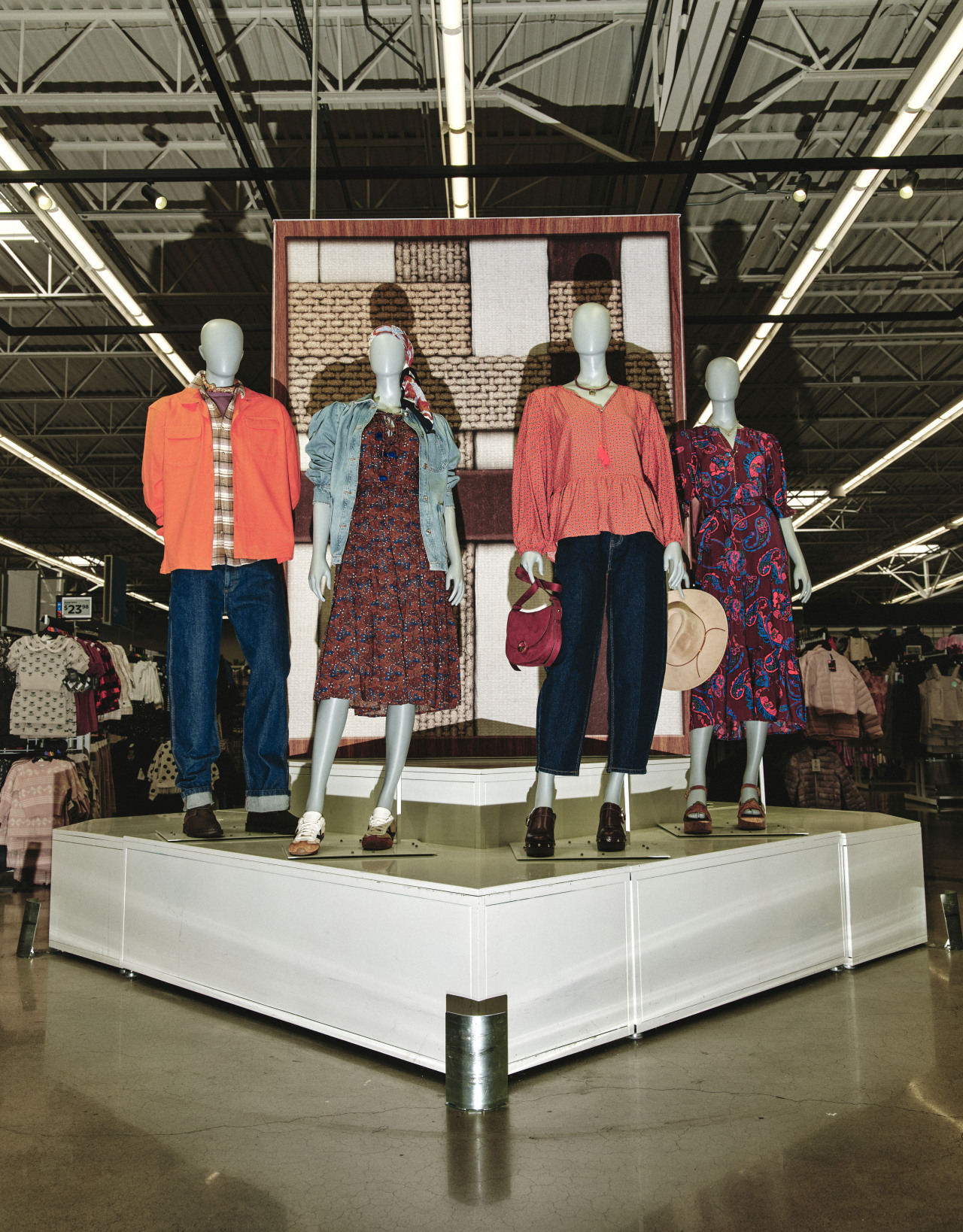
It is the retailer’s latest attempt to become a fashion destination for more shoppers—and reclaim ground lost to Amazon.
By Sarah Nassauer | Photography by Tristan deBrauwere for WSJ
Walmart WMT 0.10%increase; up pointing triangle wants even its inexpensive women’s clothing to feel trendier.
The retailer, which has been facing slowing growth lately, this week plans to introduce a new store brand of women’s clothing, bags and other accessories as part of its push to appeal to younger, trendier shoppers. Most of the new line, called Scenario, will cost less than $25, a price that aims to appeal to the discount shoppers who are the foundation of Walmart’s business.
It is part of Walmart’s latest attempt to become a fashion destination for more Americans. Right now many Walmart customers buy their groceries at the chain, but buy clothing elsewhere. Those who do buy clothes are often purchasing basics at low prices—simple T-shirts or leggings—and the women who shop its largest brands tend to skew older. Increasing fashion sales may help the company reclaim ground it has lost to Amazon over the past several years.
Last week, Walmart reported its weakest quarterly comparable sales growth in over six years. Categories such as fashion have become one way executives see potential to grow sales faster. Sales of nonfood items—throw pillows, kitchen gadgets and apparel—tend to garner higher margins and aren’t categories where Walmart already dominates.
Previous efforts by Walmart to increase clothing sales by offering more fashionable items have proved costly and unsuccessful. The launch of the new line comes as Walmart’s clothing and accessories sales have grown for seven consecutive quarters, and it is taking market share from department stores and specialty apparel retailers, executives said. Still, its biggest competitor, Amazon is growing its overall share of apparel sales faster, according to some third-party data.
Walmart’s new Scenario brand is launching with hundreds of items, including blouses with embroidered sleeves, pintuck denim shirts and faux leather bags. The items will take up space in its stores that had been filled with its existing low-price women’s store brand, Time and Tru, which sells slightly elevated basic items like cardigans and jeans and does over $2 billion in sales annually.
 |
 |
| Most of the Scenario line will cost less than $25, a price that aims to appeal to the discount shoppers who are the foundation of Walmart’s business. |
Time and Tru, which tends to appeal to shoppers 55-years or older, will continue with a smaller selection, paired down to the most popular items such as classic T-shirts and dresses.
Walmart has traditionally been known for selling low-price jeans and bins of bulk socks. But over the past decade it has gradually added slightly higher-priced, style-forward items in an effort to appeal to more customers who might also shop at Gap, J.Crew or Nordstrom.
“We knew we weren’t servicing all their closet needs,” said Denise Incandela, who became executive vice president of fashion for Walmart U.S. in 2021. Data showed that “while our customer gave us credit for extraordinary value, they weren’t giving us credit for style and quality,” she said.
Walmart’s fashion push under Incandela began nearly a decade ago, when Walmart’s top executives gathered in a conference room inside their Bentonville, Ark., headquarters to hear from her. At the time, Incandela was a newly hired executive in the e-commerce division who had been tasked with improving the company’s online fashion assortment and sales. She had previously spent years as an executive at Saks Fifth Avenue and Ralph Lauren and earlier in her career was a McKinsey consultant.
Walmart could become a larger fashion destination beyond basics, she told the room, which included then-Chief Executive Doug McMillon and U.S. store leadership, recalls Scott Hilton, a former Walmart e-commerce executive who was Incandela’s manager at the time.
She flashed a slide with a data point that would become an organizing thought in Walmart’s effort to sell more fashion: 80% of the money existing Walmart shoppers spent on apparel was at higher-priced retailers, not Walmart. She told those in the room that this meant shoppers were willing to spend more on fashion, but they didn’t do it at Walmart.
As its efforts have started to bear fruit, the company is attracting more high-income shoppers, executives have said. Compared with 2021, more of the money Walmart customers spend on apparel there is for items priced $25 or higher, according to internal documents viewed by The Wall Street Journal. Customers also see it as more stylish.

The recent push isn’t the first time Walmart has tried to sell more fashionable clothing. Earlier attempts to move upscale left memorable scars.
In the 2000s, the company vacillated between a fashion-forward and a basics-focused approach—neither of which helped sales much. Walmart executives concluded that customers wanted “high-quality basics and fashion basics at great prices,” said an internal memo near the end of that era.
It returned to those roots to try to steady the business. That meant ensuring the bulk of the assortment were basics, and some were slightly more fashionable items—but still “something you would see on seven out of 10 women,” said a person familiar with the strategy. The team focused on improving quality and pairing down some assortment to tidy stores, said this person. Business improved.
But as Walmart worked to grow online to fend off Amazon, leaders focused again on expanding the retailer’s appeal.
Walmart introduced the Time and Tru women’s apparel brand in 2018, along with new children’s and men’s brands. That was a cautious toe-dip into slightly more modern, trendy apparel.
Walmart also introduced more fashion-brand partnerships with celebrities like Ellen DeGeneres and Sofía Vergara. At first, those items sold mostly online. But Walmart started testing more trendy items at higher price points in stores. In 2019, it introduced Scoop as a trendy women’s fashion brand exclusive to Walmart. The following year it introduced another, Free Assembly. It aimed to appeal to young adult shoppers.
It started calling the category “fashion,” not “apparel” internally. It is adding the word “fashion” to the signage on the front of newly renovated stores. The word-change is important, said Incandela, because its meaning goes beyond clothing. And “it’s getting us internally to think of ourselves as credible in fashion,” she said.


It opened a fashion design office in New York City that now employs around 165 designers, brand managers and digital merchants. It plans to start selling its first store-brand cashmere sweaters this fall.
Its new inexpensive store brand, Scenario, helps round out its more affordable options, executives said. Scenario is designed to attract women around 35 years old who want more trendy details in their outfits than Time and Tru traditionally offers, said Marcus Brown, a lead designer for the Scenario line. It will have a modern bohemian—or “boho”—aesthetic, and items are mostly made of natural fabrics like cotton and include more embroidery and pleating details, he said. Most items will be sold under $25, what Walmart considers an “opening price point” for its customers, he said.
Still, Walmart isn’t moving away from the sale of inexpensive basics, the bulk of its apparel revenue, said Incandela. “This is an ‘and’ strategy,” she said. “We’re still going to cover those big-volume driving socks and underwear and denim and Ts,” to serve budget shoppers, she said.