
Son of imprisoned former president finishes first, leaving leftist incumbent with fight ahead of Oct. 25 runoff
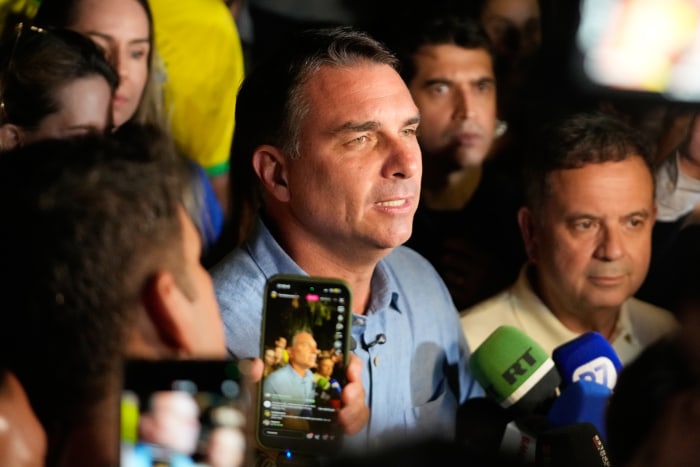
SÃO PAULO—Flávio Bolsonaro dealt President Luiz Inácio Lula da Silva a bruising first-round defeat Sunday, finishing ahead of the leftist leader and putting Brazil’s right within reach of taking back power in Latin America’s largest nation.
Flávio Bolsonaro, a 45-year-old senator and the eldest son of imprisoned former President Jair Bolsonaro, received 47.3% of votes, short of the 50% needed for an outright victory, while da Silva got just 44.8% with 98% counted late Sunday. Other right-wing candidates won a combined 5%, leaving the 80-year-old incumbent fighting for his political survival ahead of the Oct. 25 runoff.
The result—and major victories by conservatives in concurrent congressional and state elections Sunday—underscored the strength of right-wing sentiment in Brazil that none of the major polls had managed to capture. On the eve of the vote, Datafolha had put Bolsonaro at 42% of votes against 45% for da Silva.
Brazil’s right has gained ground in recent years, fueled by anger over violent street crime, the growing political clout of evangelical Christians and frustration among businesses and middle-class voters over taxes, spending and the left’s stewardship of the economy.
“Brazil has had enough…this is the end of the era of the Workers’ Party,” Flávio Bolsonaro said of da Silva’s leftist movement in an elated speech after Sunday’s vote.
The Bolsonaro family scored a series of victories Sunday. Jair Bolsonaro’s wife, Michelle Bolsonaro, was elected to the Senate, as was another son, Carlos, while his youngest son, Jair Renan, and his brother, Renato, won seats in the lower house of Congress.
Da Silva called the disappointing result a “lesson in democracy,” vowing to do what it takes to win the runoff.
This campaign has been one of the most vicious in Brazil’s democratic history. Neither da Silva nor Bolsonaro showed up for the televised debates, leaving little room for policy discussion as the campaign ricocheted between personal attacks and accusations of treason, pedophilia and blasphemy. A sprawling banking scandal that has engulfed Brazil’s political class has also dominated the campaign, implicating figures from both the left and right.
The bitter two-way feud has also drawn in a third protagonist: President Trump. The U.S. president has made reasserting U.S. influence in Latin America a centerpiece of his foreign policy as right-wing governments have swept to power across much of South America, from Argentina to Colombia. Brazil is now one of the last major countries in the region governed by the left, alongside Uruguay.

Da Silva and his allies have accused the Trump administration of trying to interfere in the election and help return Brazil’s right to power, pointing to U.S. tariffs and Washington’s efforts to send officials to Brazil to discuss “electoral integrity.” Tensions escalated again Friday when the U.S. suspended consular services at its embassy and consulates across Brazil, citing security concerns just two days before the vote.
Trump has stopped short of formally endorsing a candidate in this election but has longstanding ties to the Bolsonaro family, having backed Jair Bolsonaro in 2022 and more recently hosting Flávio at the White House.
The election isn’t just a settling of political scores but a personal grudge match that has spilled over into Brazil’s courts.
In 2018, da Silva was in prison on corruption charges and barred from running, paving the way for Jair Bolsonaro’s presidential victory that year. Da Silva was freed in 2019 and his convictions annulled after the Supreme Court ruled that the court that had heard his cases lacked jurisdiction. Later it found that the main judge, Sergio Moro, was biased. Da Silva returned to the presidency in 2023 after defeating Jair Bolsonaro.
Now their positions are reversed. Jair Bolsonaro is barred from running and is serving a 27-year sentence at home for plotting to overturn the 2022 election. Prosecutors said he also knew of a plan, code-named “Green and Yellow Dagger,” to assassinate da Silva and other officials. Bolsonaro has denied plotting a coup. Justice Alexandre de Moraes, who presided over Bolsonaro’s case, now also faces possible investigation. Meanwhile, Moro, the former judge, was elected as a state governor Sunday.

But while the two camps remain deeply divided, many Brazilian voters are simply fed up with politics altogether. Some 23% of voters said they had no interest in the election, while 10% planned to cast a blank or null ballot or stay home, according to a recent survey by polling firm Quaest. Voting is compulsory for most Brazilian adults, though the fine for failing to do so is lower than the price of a city bus ride.
The disengagement is particularly high among poorer women, a key constituency for da Silva. In the 2022 election, 29% of women in the lower-income group either stayed home or cast blank or null ballots.
This month’s race is set to be the last showdown of the Lula-Bolsonaro era. Now an octogenarian, da Silva has indicated this will be his final run, while Jair Bolsonaro has been stripped of his political rights and remains barred from running even if he is released from house arrest. But the divisions they have come to embody run deeper than any one election, said Rafael Cortez, a political scientist at São Paulo-based consulting firm Tendências.
“Brazil is a society marked by profound inequalities—economic, racial and gender inequalities, among others,” said Cortez. “This radicalization is not simply the result of the behavior of political elites; it also has structural roots.”
Da Silva has promised to expand the social safety net for Brazil’s poor, raising benefits under the country’s flagship welfare program and offering fresh debt relief to struggling households.
But Bolsonaro is campaigning on a sharply different vision: slashing government spending and taking a far harder line on crime. He has proposed cutting at least 10 ministries and imposing a new cap on government spending to fix Brazil’s deteriorating public finances.
He also plans to designate Brazil’s powerful drug gangs as narcoterrorist organizations, as Trump already did earlier this year, lower the age of criminal responsibility to 16 from 18 and build five maximum-security prisons inspired by the model of El Salvador’s President Nayib Bukele.
Appeared in the October 5, 2026, print edition as 'Bolsonaro Son Surges to a Lead In First Round of Brazil Election'.