
Ex-prosecutor suggests Democrats are wasting time on matters that should be left to others
Pro and college football fans in the U.S. were just treated to another fall weekend of thrilling finishes, controversial calls and, during commercial breaks, nearly wall-to-wall midterm campaign ads.
The games are some of the highest-rated programs left on linear television, and much of the messaging from Democratic candidates highlighted what are said to be failings of the Donald Trump administration's handling of the release and investigation of the Jeffrey Epstein files.
Democrats have spent $53 million US on ads mentioning the late sex offender in competitive races, compared to $3 million from Republicans, the Washington Post recently reported, citing figures from political spending trackers AdImpact. During the 2024 presidential campaign, according to CNN, Epstein featured in just three campaign ads, all involving candidates in Florida, where he kept his main residence.
If Democrats regain control of one or both houses of Congress after the Nov. 3 vote, learning more about Epstein will be "one of our top priorities," according to a recent interview Rep. Robert Garcia of California, who sits on the House's oversight committee, had with Bloomberg News.
Two pieces of legislation already introduced in Congress could be among the avenues they pursue.
But former federal prosecutor Ankush Khardori has suggested Democrats, if they prevail, should instead focus on the abundant examples of potential corruption by Donald Trump's administration and family members over the past two years.
Khardori has called the release of contextless Epstein documents beginning last year "a historic mistake" which has led to censorious, but uneven, consequences for those who merely knew the man but have never been accused of a crime.

"The presumption of innocence has been turned on its head. We have countenanced an ethos of guilt by association," he wrote in a Boston Globe op-ed, reproduced on his website. Khardori draws attention to the April suicide of Norway's Edward Juul Rod-Larsen, whose family, and mostly his parents, faced questions about their contacts with Epstein.
Nearly one year after the enactment of the Epstein Files Transparency Act and over 19 interviews done by the House's oversight committee, "a key claim made by lawmakers and other advocates for disclosure — that the Justice Department’s files would expose a hidden child sex trafficking ring — has not been substantiated," he wrote.
Khardori says Democrats could assign a respected prosecutor to oversee an Epstein-related commission if they truly feel there's more to learn.
2 criminal referrals made
Providing more evidence than what previously existed was always going to prove a formidable task, given Epstein's death and accomplice Ghislaine Maxwell's questionable credibility given she's serving a lengthy prison sentence. Add to that the fact that three of the many women who said they were abused by Epstein are no longer alive, nor are a handful of the many notable people, mostly men, who spent time with Epstein.
The Justice Department does not comment on ongoing probes, and is not required to act upon a congressional referral, so it's not clear if they're pursuing those leads. But the difficulties of establishing guilt in sexual assault allegations that are many years old have been demonstrated in cases involving powerful and well-defended men like Peter Nygard, Frank Stronach and Harvey Weinstein, cases where some charges have been dropped and retrials have occurred.
And were a case ever to reach trial, Kellen would likely be asked about problematic allegations levelled by some women that Kellen, an adult at the time she knew Epstein and Maxwell, helped facilitate abuse.
Lawmakers want access
Democrat Ro Khanna and Republican Thomas Massie, who led the charge in the House in getting the Transparency Act passed, are among five co-sponsors of a follow-up bill to address what they say are failings of the Justice Department. The proposed legislation could open the door for state attorneys general and survivors to sue the department for access to unredacted files that have currently been held back by the administration, which claims they are too sensitive or privileged, as in the case of lawyer-client communications, to release.
Garcia and Democratic Sen. Elizabeth Warren have also hinted at what else could come by recently introducing the Epstein Wall Street Records Act, which would require regulators "to disclose supervisory records related to Epstein and his associates" and to "investigate Epstein-connected banks and executives for possible banking, securities, or illicit financing violations."

Democrats have accused at least three major financial institutions of not properly following anti-money laundering laws to report large, suspicious transactions with Epstein's accounts.
Garcia, per the Bloomberg report, also seemed to suggest that bringing back some witnesses for another appearance, but under oath, could prove more fruitful. Those who've appeared for interviews, including Bill Clinton and Bill Gates, were advised before questioning that they had an obligation to tell the truth.
But if witnesses are brought back, lawmakers might want to hold more focused sessions. CBC News has read all publicly available transcripts from the oversight committee and the sessions were often repetitive — legislators dipped in and out due to their other duties, often asking questions already posed by colleagues.
Several lines of inquiry seemed to offer debatable value — multiple witnesses who visited Epstein's New York townhouse were asked about the strange painting of Clinton in a blue dress that the financier possessed, while many others, regardless of their occupation or connection to Epstein, were asked point blank if they could offer any information supporting the idea that he was working for Mossad or some other foreign intelligence service.
Nearly every witness was read a list of mostly famous names known to have spent time with Epstein — from Woody Allen to Noam Chomsky to Ehud Barak — to see if they, too, had interactions with those individuals, calling to mind Hillary Clinton's comment after her interview that the panel was on a "fishing expedition."
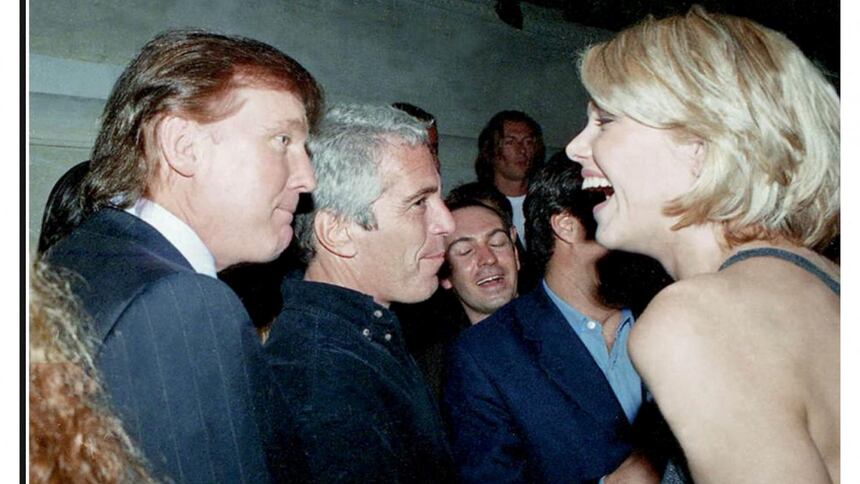
Trump has described Epstein as an acquaintance, though others have said their relationship, at least in the 1990s, was more friendly. While the explanations for why Trump broke off communications have differed, it appears he was no longer in contact with Epstein for some time when the financier was indicted in Florida in 2006.
As if to remind voters of sexual misconduct allegations Trump himself has faced in the past, whether they watch football or not, Democrats on Monday followed up the campaign ads with a report from their judiciary committee members that collects seemingly every damning mention of Trump in the Epstein file dump so far, including allegations of sexual abuse and rape.
At least one allegation was publicly reported as far back as the 2016 presidential election, while another one other emerged during the 2024 campaign in a more limited form. Now, that same accuser alleges she wasn't just groped by Trump in an alleged 1993 incident, but raped.
The most shocking information concerns alleged incidents with a young teen, even though a civil suit related to that case was twice dropped by the anonymous plaintiff's lawyers over a decade ago.
Trump has never been formally accused of a crime with respect to activities related to his Epstein friendship.
The House Democrats recommended a special counsel be appointed to investigate the allegations, something only the attorney general can do. In a week's time, however, the Democrats could have more levers to get to damaging information they appear to sincerely believe they can find.