
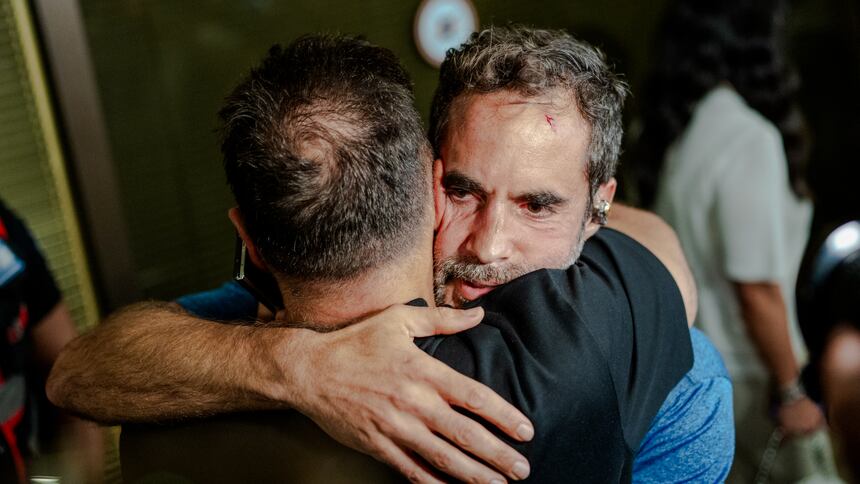
Will look for possible motive, any evidence of others being involved in planning
The United Arab Emirates prosecutor general has ordered an investigation into the stabbing aboard FlyDubai Flight FZ1073 from Dubai to Tel Aviv, which was diverted and landed in Saudi Arabia after a struggle in the cockpit, the state news agency reported Thursday.
The U.A.E. has started investigations that are seeking to establish the circumstances and motives, and to determine "whether the incident was linked to any terrorist activity or purpose, or involved prior planning or direction," the state news agency reported.
Emirati judicial authorities have jurisdiction over the case because the aircraft is registered in the U.A.E. and flies under its flag, the statement said, adding that U.A.E. law applies to crimes committed on board, even if they occur outside the country's territory.
Questions loomed over the motives and background of a co-pilot who stabbed the captain of the passenger jet. Israel officials have said it was an apparent attempt to crash the plane, which had more than 170 people on board.
One question is what weapon was used in the attack and, if it was a knife, how a pilot could transport it onto the aircraft without being detected.
Passengers and crew aboard a FlyDubai flight regained control after a co-pilot attacked the pilot and sent the plane plunging nearly 4,200 metres in less than 30 seconds, Israeli officials say. Aviation analyst Mark Miller discusses what the reported damage to the aircraft suggests about the violence onboard.
Disaster was averted on Wednesday after the wounded captain managed to unlock the cockpit door, allowing passengers to subdue the attacker and a reserve crew that had been on board to land the plane in Saudi Arabia.
Israeli Prime Minister Benjamin Netanyahu said the attacker was being investigated in Saudi Arabia, where the plane landed at Tabuk airport, and that he believed he would be taken to the U.A.E.
Saudi Arabia has issued no statements on its investigations.
Israeli officials have identified the attacker as an Omani national. Omani authorities have not commented.
"We have constraints that say you can't have pilots from countries that don't have diplomatic relations with Israel. So obviously he was able to go through that," Netanyahu told Fox News on Thursday.
Passengers intervened
Saudi Arabia's Tabuk airport said Wednesday that both pilots had been hospitalized after sustaining injuries.
FlyDubai said Wednesday that the underlying reasons for the event remained unknown and warned against "premature speculation."

Israeli Defence Minister Israel Katz said Wednesday that Israel's preliminary information indicated that the co-pilot aimed to crash the plane, describing him as a terrorist, though Netanyahu only described it as "a serious security incident."
The flight plunged nearly 4,300 metres in less than 30 seconds as it flew over Saudi Arabia before the passengers and crew managed to subdue the attacker and land the plane.
Netanyahu and Indian Prime Minister Narendra Modi have hailed the Flight FZ1073 captain and Indian national Smit Machchhar as a hero.
Machchhar was in a good health and recovering well, the Indian Embassy in the U.A.E. said on Thursday on X.
The embassy said the Indian ambassador there visited the pilot in hospital and it remained in close co-ordination with local authorities to ensure his continued medical care and well-being.
Israel has also lauded passengers who subdued the attacker.

Yaniv Hayun, one of the men who incapacitated the attacker, described running to the cockpit as the plane nosedived.
"We pulled the assailant out, I pulled him out. After I pulled him out, we took control of the plane, I pulled up the yoke [steering control of the plane], I straightened the plane out a bit," he said talking to reporters upon his return to Israel on Wednesday.
The incident heightened security fears in Israel weeks before Israelis vote in the first election since the Hamas-led Oct. 7, 2023, attacks, with Israel's security figuring prominently in the campaigning.
The U.S. and Israel launched strikes against Iran in February, in a conflict that quickly spread to the Gulf and Lebanon, where Israel has been fighting Iran-backed militant group Hezbollah.